GHRP-2 vs GHRP-6: Two Ghrelin Receptor Peptides
GHRP-2 and GHRP-6 are both synthetic ghrelin receptor ligands from the pre-ghrelin era. What separates them, and why GHRP-6 has the odder literature.

Cover illustration: AI-generated editorial artwork. Conceptual only; not an exact molecular structure, actual laboratory result or evidence of clinical effects.
GHRP-2 and GHRP-6 are synthetic hexapeptides acting at the ghrelin receptor. They belong to a class whose name is a historical artefact: they were named for an observed activity decades before anyone knew what receptor they bound or that a natural ligand for it existed.
For laboratory research use only. The research materials supplied by HealthyWelness are not approved medicines, foods or cosmetics and are not for human or veterinary use. This article summarises published research and is not medical advice.
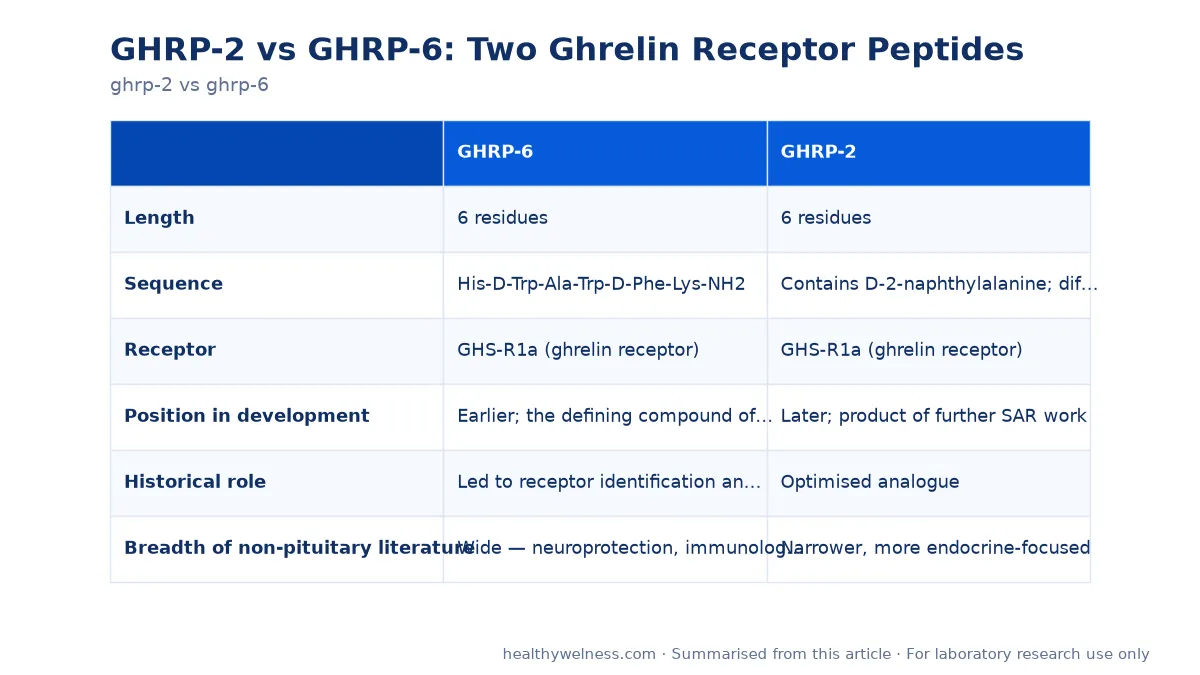
Side by side
| GHRP-6 | GHRP-2 | |
|---|---|---|
| Length | 6 residues | 6 residues |
| Sequence | His-D-Trp-Ala-Trp-D-Phe-Lys-NH2 | Contains D-2-naphthylalanine; different composition |
| Receptor | GHS-R1a (ghrelin receptor) | GHS-R1a (ghrelin receptor) |
| Position in development | Earlier; the defining compound of the class | Later; product of further SAR work |
| Historical role | Led to receptor identification and to ghrelin | Optimised analogue |
| Breadth of non-pituitary literature | Wide — neuroprotection, immunology, fish studies | Narrower, more endocrine-focused |
A class named backwards
Most drug classes are named for a target. This one was named for an assay result. Researchers screening for compounds that released growth hormone from pituitary tissue found short peptides that worked, and called them growth hormone-releasing peptides — while the receptor remained unidentified.
The sequence of discovery ran in reverse from the usual: active compound first, then the receptor it bound (named the growth hormone secretagogue receptor, after the compounds), and only in 1999 the endogenous ligand, ghrelin. Cyril Bowers, who was central to this work, wrote the history up in Methods in Enzymology in 2012; it is the single best source for how the class came about.
Two things follow for anyone reading this literature. First, pre-1999 papers describe pharmacology without being able to name the receptor, so terminology shifts across the decades. Second, the receptor was named after the synthetic compounds, not the natural hormone — which is why “growth hormone secretagogue receptor” and “ghrelin receptor” refer to the same protein.
The D-amino acid signature
Both peptides contain D-amino acids, which is unusual and deliberate. Proteases that cleave natural peptides are stereospecific for L-amino acids; inserting a D-residue blocks cleavage at that site. In a six-residue peptide this is essential, since an all-L hexapeptide would be degraded almost immediately.
The 2017 structure-activity review by Ferro and colleagues in Drug Testing and Analysis traces how these substitutions map onto activity across the class. It is written from an analytical and anti-doping standpoint, which makes it unusually concrete about structures and metabolites — useful if you are developing a detection method or checking a certificate of analysis.
Why GHRP-6 has the stranger bibliography
Search PubMed for GHRP-6 and the results are not confined to endocrinology:
| Study | Context | Reported observation |
|---|---|---|
| Delgado-Rubin de Celix et al., 2006 | Glutamate excitotoxicity | Acted as a survival factor in that model |
| Garcia-Fernandez et al., 2011 | Pituitary, hypothalamus, cerebellum | Effects on cell turnover differing from those of insulin, and differing by region |
Published work has also examined GHRP-6 in fish — antimicrobial peptide transcription in tilapia and as a vaccine adjuvant in several species. The usual explanation is receptor distribution: GHS-R1a is expressed well beyond the pituitary, so a ligand for it has more than one place to act.
The methodological caution is the same one that applies to any widely expressed receptor. An effect in a non-pituitary tissue may be receptor-mediated locally, or secondary to changes in the endocrine axis, and distinguishing the two requires a receptor-blockade or knockout control rather than inference.
Practical differences in the lab
| Consideration | Note |
|---|---|
| Solubility | Both are short and generally water-soluble; GHRP-2 is more hydrophobic owing to the naphthylalanine residue |
| Tryptophan content | GHRP-6 carries two Trp residues — light-sensitive; store and handle protected from light |
| Low-concentration losses | Hexapeptides adsorb to plasticware; a carrier protein is common in dilute working solutions |
| Identity confirmation | MS distinguishes them clearly; the D-residues do not change mass, so chirality needs chiral methods |
| Purity concern | Diastereomeric impurities from racemisation during synthesis are not resolved by mass alone — check the HPLC trace |
That last point deserves emphasis. Because the D-amino acids are what give these peptides their stability, partial racemisation during synthesis produces an impurity with identical mass and different biology. Mass spectrometry will not flag it; chromatographic resolution will. See how to read a certificate of analysis for what to look for. Concentration maths: reconstitution calculator.
Our GHRP-2 research material is supplied for laboratory research use. Certificates are available for listed products — contact us for the latest report.
Open questions
- How do the two peptides compare on receptor residence time, as distinct from potency?
- Which of the reported non-pituitary effects are receptor-mediated in that tissue?
- What is the metabolite profile of each, given the D-residue positions?
Related research
Frequently asked questions
What does GHRP stand for?
Growth hormone-releasing peptide. The name is historical: these peptides were identified by their ability to release growth hormone from pituitary tissue before the receptor they act on, or its natural ligand ghrelin, had been identified.
Do GHRP-2 and GHRP-6 act on the GHRH receptor?
No. They act at the growth hormone secretagogue receptor, GHS-R1a, which is the ghrelin receptor. GHRH analogues such as sermorelin act at a separate receptor. The two systems converge on the same pituitary cells but are pharmacologically distinct.
What is the structural difference between them?
Both are short synthetic peptides containing D-amino acids. GHRP-6 is a hexapeptide with the sequence His-D-Trp-Ala-Trp-D-Phe-Lys-NH2. GHRP-2 is a different hexapeptide incorporating a D-2-naphthylalanine residue, developed later in the same structure-activity programme.
Which came first?
GHRP-6 came first and is the more historically significant of the two: it was the compound used to define the growth hormone secretagogue pharmacology that eventually led to the identification of the receptor and then of ghrelin in 1999.
Why does GHRP-6 appear in immunology and fish papers?
Published work has examined GHRP-6 in contexts beyond the pituitary, including as a survival factor in glutamate excitotoxicity, in pituitary and hypothalamic cell turnover, and in antimicrobial and vaccine-adjuvant studies in fish. The ghrelin receptor is expressed in many tissues, which is the usual explanation offered.
References
- Bowers CY. History to the discovery of ghrelin. Methods Enzymol. 2012. PMID: 22975043 https://pubmed.ncbi.nlm.nih.gov/22975043/
- Ferro P, et al. Structure-activity relationship for peptidic growth hormone secretagogues. Drug Test Anal. 2017. PMID: 26811125 https://pubmed.ncbi.nlm.nih.gov/26811125/
- Delgado-Rubin de Celix A, et al. Growth hormone releasing peptide-6 acts as a survival factor in glutamate-induced excitotoxicity. J Neurochem. 2006. PMID: 17076656 https://pubmed.ncbi.nlm.nih.gov/17076656/
- Garcia-Fernandez M, et al. Insulin and growth hormone-releasing peptide-6 (GHRP-6) have differential beneficial effects on cell turnover in the pituitary, hypothalamus and cerebellum. Mol Cell Endocrinol. 2011. PMID: 21352888 https://pubmed.ncbi.nlm.nih.gov/21352888/
For laboratory research use only. The research materials supplied by HealthyWelness are not approved medicines, foods or cosmetics and are not for human or veterinary use. This article summarises published research and is not medical advice.
Sources
- Bowers CY. History to the discovery of ghrelin. Methods Enzymol. 2012. PMID: 22975043
- Ferro P, et al. Structure-activity relationship for peptidic growth hormone secretagogues. Drug Test Anal. 2017. PMID: 26811125
- Delgado-Rubin de Celix A, et al. Growth hormone releasing peptide-6 acts as a survival factor in glutamate-induced excitotoxicity. J Neurochem. 2006. PMID: 17076656
- Garcia-Fernandez M, et al. Insulin and growth hormone-releasing peptide-6 (GHRP-6) have differential beneficial effects on cell turnover in the pituitary, hypothalamus and cerebellum. Mol Cell Endocrinol. 2011. PMID: 21352888