Half-Life Calculator
Work out how much of a compound remains after any length of time, and download the decay curve for your lab notes or slides.
Idealised first-order decay for laboratory planning. Real clearance and stability depend on the system. Not for dosing or scheduling in humans or animals.
How the half-life calculation works
First-order decay removes a fixed fraction, not a fixed amount, in each interval. The fraction remaining after time t is 0.5^(t ÷ t½). One half-life leaves 50%, two leave 25%, and five leave about 3%.
Worked example
A compound with a half-life of 24 hours, starting from 100 units, has passed two half-lives after 48 hours. The calculator shows 25 units remaining.
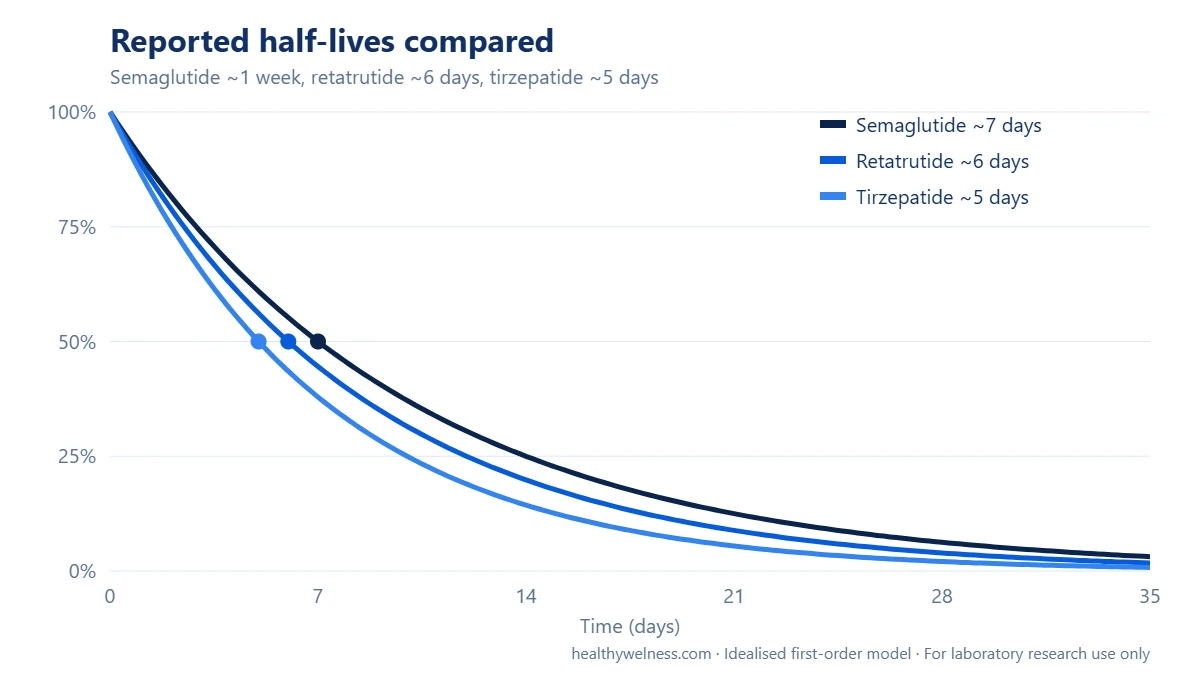
Reported values used here
| Compound | Reported | System | Source |
|---|---|---|---|
| Retatrutide | ~6 days | Human pharmacokinetics, phase 1b | Urva et al., 2022 |
| Tirzepatide | ~5 days | Human pharmacokinetics, pooled clinical studies | Schneck et al., 2024 |
| Semaglutide | ~1 week | Human clinical pharmacology data | Clinical pharmacology data |
| BPC-157 | under 30 min | Rats and dogs; 30 min is the upper bound | He et al., 2022 |
Frequently asked questions
What does this half-life calculator do?
It applies first-order decay: the amount left equals the starting amount multiplied by 0.5 raised to elapsed time divided by half-life. After five half-lives about 3% remains.
Where do the reported values come from?
Each value comes from the published source named beside it. Compounds without a reported figure are left out rather than estimated. Enter your own value for anything else.
Does a plasma half-life tell me how stable a solution is?
No. A plasma half-life describes clearance in a living system. Stability in a vial depends on temperature, pH, diluent and storage, and has to be measured separately.
Can I use this to plan doses?
No. It is a laboratory arithmetic tool. Our products are for in-vitro research only and are not for human or veterinary use.
Related guides
Last updated October 30, 2026