Hexarelin vs Ipamorelin: Selectivity and Structure
Hexarelin and ipamorelin are both secretagogues, but one was designed for selectivity. A structural and pharmacological comparison of the two.

Cover illustration: AI-generated editorial artwork. Conceptual only; not an exact molecular structure, actual laboratory result or evidence of clinical effects.
These two peptides are routinely listed side by side as interchangeable secretagogues. They are not interchangeable, and the reason is historical: one of them was designed specifically to be narrower than the other. The 1998 report by Raun and colleagues in the European Journal of Endocrinology is titled “Ipamorelin, the first selective growth hormone secretagogue” — and the implicit comparator in that claim is the earlier series to which hexarelin belongs.
For laboratory research use only. The research materials supplied by HealthyWelness are not approved medicines, foods or cosmetics and are not for human or veterinary use. This article summarises published research and is not medical advice.
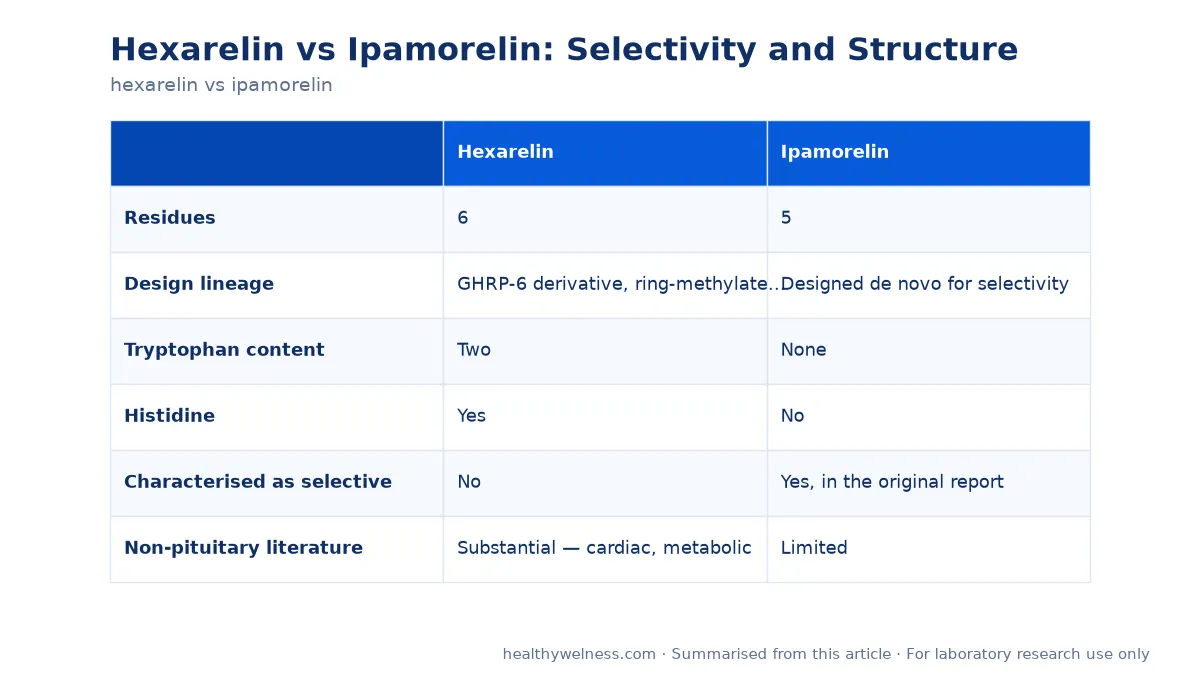
Side by side
| Hexarelin | Ipamorelin | |
|---|---|---|
| Residues | 6 | 5 |
| Design lineage | GHRP-6 derivative, ring-methylated Trp | Designed de novo for selectivity |
| Tryptophan content | Two | None |
| Histidine | Yes | No |
| Characterised as selective | No | Yes, in the original report |
| Non-pituitary literature | Substantial — cardiac, metabolic | Limited |
| Proposed secondary target | CD36 discussed in cardiac work | None established |
| Oxidation sensitivity | High | Lower |
What “selective” meant in 1998
The claim is specific and worth reading carefully rather than as a marketing adjective. In the original characterisation, selectivity meant that the peptide produced growth hormone release without the parallel activity at other endocrine axes seen with earlier compounds of the class. It is a statement about the models and readouts used in that study, not an absolute property established across every system.
For experimental purposes, that distinction matters in one direction only: a selectivity claim narrows what you can assume, it does not guarantee a clean result. If a readout in a particular tissue has not been examined, selectivity in the pituitary axis says nothing about it.
Why hexarelin has the larger literature
Hexarelin’s research base is broader because interest in it moved outside the growth hormone axis. The 2014 review by Mao and colleagues collects the cardiovascular work, which includes the proposal that cardiac effects involve CD36 — a scavenger receptor, unrelated to GHS-R1a. The 2017 study by Huang and colleagues is representative of the primary work: cardiomyocyte protection in a rat ischaemia–reperfusion model, with interleukin-1 signalling implicated.
The 2000 study by Papotti and colleagues provides the structural context for all of this by documenting secretagogue binding sites across peripheral human tissues. Once it is established that the receptor family is present outside the pituitary, non-pituitary effects stop being surprising and become something to control for.
Ipamorelin, by contrast, has a literature shaped by its original purpose. It is used as the narrow comparator in studies that need one, and the body of independent work on it is correspondingly smaller. Less published work is not the same as less reliable, but it does mean fewer independent replications to lean on.
Choosing between them for an experiment
| If the question is | Use | Reason |
|---|---|---|
| Does this tissue respond to secretagogue signalling at all? | Hexarelin | Broader activity makes a positive result more likely to appear |
| Is an observed effect specific to the growth hormone axis? | Ipamorelin | Narrower characterised profile; fewer confounds |
| Comparison with published cardiac work | Hexarelin | That literature exists for hexarelin and not for ipamorelin |
| Both, as a selectivity contrast | Both | The difference between them is itself the readout |
| A long exposure window is needed | Neither alone | Both are short peptides with rapid clearance in rodents |
That last row is the one most often missed. The 2000 kinetic study by Roumi and colleagues characterised hexarelin’s disposition in rats and found the rapid clearance expected of a six-residue peptide. Neither of these compounds provides sustained exposure, so a study design that depends on it needs a modified analogue rather than a dosing schedule — and that is a different experiment with different controls.
The handling difference is real
This is the practical point that catalogue comparisons omit. Hexarelin contains two tryptophan residues and a histidine. Ipamorelin contains neither. Tryptophan and histidine are the residues most readily oxidised, and metal-catalysed oxidation at histidine is a well-documented degradation route in model peptides.
The consequence is that the two compounds do not tolerate the same treatment:
- Hexarelin needs light protection and a low-metal diluent; ipamorelin is more forgiving on both counts.
- In a side-by-side experiment, differential degradation can masquerade as differential potency. If hexarelin underperforms, confirm the material before concluding anything pharmacological.
- Both should be aliquoted after reconstitution rather than repeatedly frozen and thawed. See storing reconstituted peptides.
- Molar concentrations should be derived from net peptide content on the certificate, since both are supplied as acetate salts. Our reconstitution calculator takes those inputs.
Our hexarelin acetate research material is supplied for laboratory research use. Certificates are available for listed products — contact us for the latest report.
Open questions
- Is CD36 involvement in hexarelin’s cardiac activity established or still a hypothesis?
- Has ipamorelin’s selectivity been retested in systems beyond those in the 1998 characterisation?
- How much do the two differ in measured stability under identical storage conditions?
Related research
Frequently asked questions
What is the main difference between hexarelin and ipamorelin?
Selectivity. Ipamorelin was reported in 1998 as the first selective growth hormone secretagogue, meaning it produced little activity at other axes in the models tested. Hexarelin belongs to the earlier, broader-acting series and has a separate cardiac literature.
Are they structurally related?
Only loosely. Both are short synthetic peptides containing D-amino acids and an amidated C-terminus, but the sequences differ. Hexarelin is a six-residue GHRP-6 derivative; ipamorelin is a five-residue peptide with no tryptophan.
Which has more published research?
Hexarelin has the larger body of work, spread across pituitary, cardiac and metabolic models. Ipamorelin’s literature is narrower and concentrated on its original characterisation as a selective agonist.
Does either act outside the ghrelin receptor?
Published work on hexarelin discusses cardiac actions proposed to involve CD36, outside the secretagogue receptor system. For ipamorelin the evidence points to a narrower profile, which was the point of its design.
Which is easier to handle in the laboratory?
Ipamorelin, on composition alone. It lacks tryptophan and histidine, the two residues most prone to oxidation, whereas hexarelin contains two tryptophans and a histidine. That makes hexarelin the more light- and oxidation-sensitive reagent.
References
- Raun K, et al. Ipamorelin, the first selective growth hormone secretagogue. Eur J Endocrinol. 1998. PMID: 9849822 https://pubmed.ncbi.nlm.nih.gov/9849822/
- Mao Y, et al. The cardiovascular action of hexarelin. J Geriatr Cardiol. 2014. PMID: 25278975 https://pubmed.ncbi.nlm.nih.gov/25278975/
- Papotti M, et al. Growth hormone secretagogue binding sites in peripheral human tissues. J Clin Endocrinol Metab. 2000. PMID: 11061542 https://pubmed.ncbi.nlm.nih.gov/11061542/
- Huang J, et al. The Growth Hormone Secretagogue Hexarelin Protects Rat Cardiomyocytes From in vivo Ischemia/Reperfusion Injury Through Interleukin-1 Signaling Pathway. Int Heart J. 2017. PMID: 28321024 https://pubmed.ncbi.nlm.nih.gov/28321024/
- Roumi M, et al. Kinetics and disposition of hexarelin, a peptidic growth hormone secretagogue, in rats. Drug Metab Dispos. 2000. PMID: 10611139 https://pubmed.ncbi.nlm.nih.gov/10611139/
For laboratory research use only. The research materials supplied by HealthyWelness are not approved medicines, foods or cosmetics and are not for human or veterinary use. This article summarises published research and is not medical advice.
Sources
- Raun K, et al. Ipamorelin, the first selective growth hormone secretagogue. Eur J Endocrinol. 1998. PMID: 9849822
- Mao Y, et al. The cardiovascular action of hexarelin. J Geriatr Cardiol. 2014. PMID: 25278975
- Papotti M, et al. Growth hormone secretagogue binding sites in peripheral human tissues. J Clin Endocrinol Metab. 2000. PMID: 11061542
- Huang J, et al. The Growth Hormone Secretagogue Hexarelin Protects Rat Cardiomyocytes From in vivo Ischemia/Reperfusion Injury Through Interleukin-1 Signaling Pathway. Int Heart J. 2017. PMID: 28321024
- Roumi M, et al. Kinetics and disposition of hexarelin, a peptidic growth hormone secretagogue, in rats. Drug Metab Dispos. 2000. PMID: 10611139