ARA-290 Reconstitution: An 11-Residue Helix Mimic
ARA-290 reproduces a helical face of erythropoietin in eleven residues. Why that makes handling unforgiving, and how to reconstitute it properly.


Cover illustration: AI-generated editorial artwork. Conceptual only; not an exact molecular structure, actual laboratory result or evidence of clinical effects.
ARA-290 is a harder reagent than its size suggests. Eleven residues sounds trivial to handle, and for an ordinary short peptide it would be. The complication is that ARA-290 works by reproducing a shape — a helical surface that erythropoietin presents as part of a folded protein — and a short peptide holds a shape only loosely. Handling that preserves mass does not necessarily preserve function.
For laboratory research use only. The research materials supplied by HealthyWelness are not approved medicines, foods or cosmetics and are not for human or veterinary use. This article summarises published research and is not medical advice.
Why the design makes handling unforgiving
In the parent protein, the relevant surface is held in position by the rest of the fold. Strip it down to eleven residues and the molecule is largely flexible in solution, sampling many conformations of which the active one is a fraction. Anything that depletes that fraction reduces activity.
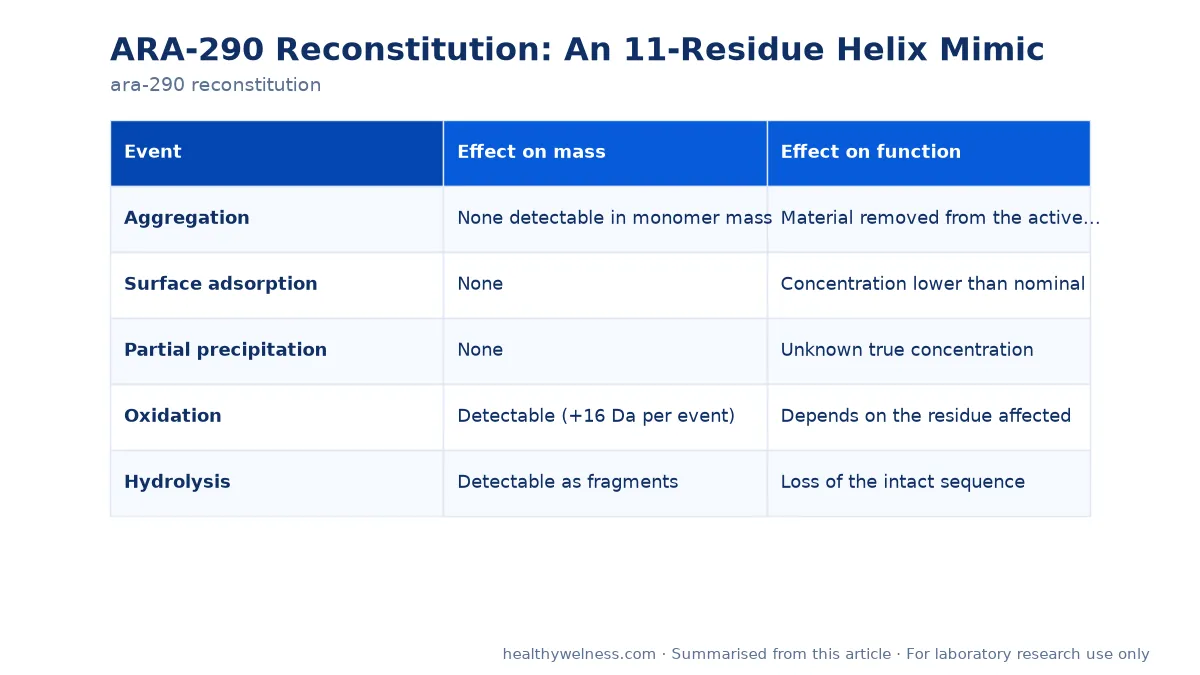
| Event | Effect on mass | Effect on function |
|---|---|---|
| Aggregation | None detectable in monomer mass | Material removed from the active population |
| Surface adsorption | None | Concentration lower than nominal |
| Partial precipitation | None | Unknown true concentration |
| Oxidation | Detectable (+16 Da per event) | Depends on the residue affected |
| Hydrolysis | Detectable as fragments | Loss of the intact sequence |
The first three rows are the problem. They are invisible to a mass measurement, which means the standard confirmation most laboratories perform cannot detect them. For a conformationally dependent peptide, this is the category of failure to design against.
Reconstitution, step by step
- Let the sealed vial reach room temperature. Opening cold glass in a humid room condenses water into a hygroscopic powder. Every subsequent problem starts here.
- Centrifuge briefly if material may have moved in transit. Powder in the cap is powder not in the solution, and for a small quantity the fraction lost is not negligible.
- Use the diluent named on the certificate. Composition determines solubility, and the lot’s certificate is the authority rather than a general rule.
- Add the diluent slowly down the inside wall. Let it run over the cake. Do not direct a stream onto the powder.
- Swirl gently until fully dissolved. Do not vortex and do not pipette up and down vigorously. Shear and foaming promote aggregation at the air–liquid interface, which is precisely the loss route described above.
- Inspect against a dark background. Haze or particulates mean aggregation has already begun. A clear solution is the minimum acceptable state, not a good sign.
- Aliquot immediately into single-use volumes, then freeze. Date and label with concentration and diluent.
Volume arithmetic comes from the net peptide content and the target concentration; our reconstitution calculator takes those inputs. The net content figure, not the nominal vial weight, is the correct input — counterion and residual water are real mass, and for an eleven-residue peptide the counterion is a proportionally large share.
The solid state deserves attention too
A lyophilized peptide is not inert because it is in a freezer. The 1992 study by Pikal and colleagues examined freeze-dried formulations and found stability governed by moisture and oxygen content, not temperature alone. Translated into practice: desiccant in the storage container, a properly reseated cap, and the warm-before-opening rule above.
For solution stability, the 2014 study by Li and colleagues on a short peptide’s chemical degradation gives the kinetic framework — pH, temperature and time as the governing variables — and the 1998 work by Khossravi and colleagues documents metal-catalysed oxidation as a specific route worth excluding by using a clean, low-metal diluent.
Dilute solutions are where material disappears
This is the practical failure most often mistaken for a negative result. At low working concentrations, a peptide adsorbs to tube walls, pipette tips and plate surfaces. For an eleven-residue peptide in the nanomolar range, the fraction lost can be substantial.
Mitigations, in order of usefulness:
- Prepare dilute solutions immediately before use. Adsorption is time-dependent.
- Include carrier protein where the assay tolerates it; it saturates the surfaces.
- Use low-binding plasticware and keep the same consumables across an experiment, so that if loss occurs it is at least consistent.
- Minimise transfer steps. Each container is another surface.
The 2016 study by Stalmans and colleagues on quality control of cationic peptides is a useful reference on how much peptide handling and analysis can diverge from assumption, and the general certificate framework is in how to read a certificate of analysis.
Why the receptor target raises the stakes
ARA-290 is designed to engage the innate repair receptor rather than the classical erythropoietin receptor — that selectivity is the whole point of building a peptide instead of using the parent protein. The 2018 study by Bitto and colleagues is a representative example, examining activation of the EPOR–beta common receptor complex by cibinetide in a mouse model, and the 2017 study by Nairz and colleagues reports innate immune cell effects in experimental colitis.
The handling consequence is that an experiment with this peptide is testing a selectivity claim, and a selectivity experiment is especially vulnerable to material that is not what it is assumed to be. If the peptide has partly aggregated, the comparison between receptor pathways is being made at an unknown concentration, and a difference in engagement can be manufactured by handling alone.
Our ARA-290 research material is supplied for laboratory research use. Certificates are available for listed products — contact us for the latest report. See what ARA-290 is.
Open questions
- How much material is lost to adsorption at typical working concentrations?
- Does aggregation occur at concentrations used for stock solutions, and is it detectable by routine methods?
- How many freeze–thaw rounds produce a measurable change in activity?
Related research
Frequently asked questions
What is ARA-290?
An 11-residue peptide, also called cibinetide, designed to reproduce a structural region of erythropoietin that engages the innate repair receptor rather than the classical erythropoietin receptor. It is a structural mimic, not a fragment taken unchanged from the parent protein.
Why is an 11-residue peptide difficult to handle?
Because its activity depends on reproducing a shape that a folded protein normally holds in place. A short peptide has little intrinsic structure, so the conformation it needs is a transient population rather than a fixed state. Aggregation or adsorption removes it without changing the mass.
What diluent should be used?
The one named on the certificate for the lot. For a short peptide an aqueous diluent is usually appropriate, but solubility depends on the residue composition and the certificate is the authority for the specific material.
How should reconstituted ARA-290 be stored?
Aliquoted and frozen, with the working aliquot refrigerated over a short period. Repeated freezing and thawing of a single tube is the main avoidable loss for a peptide whose function depends on a conformational population.
Does mass spectrometry confirm that the material is correct?
It confirms composition. For a short peptide, mass is close to definitive for identity, but it says nothing about whether the material has aggregated or adsorbed in solution. Those failures leave the mass unchanged and are detected by inspection and by chromatography.
References
- Bitto A, et al. Activation of the EPOR-beta common receptor complex by cibinetide ameliorates impaired wound healing in mice with genetic diabetes. Biochim Biophys Acta Mol Basis Dis. 2018. PMID: 29223734 https://pubmed.ncbi.nlm.nih.gov/29223734/
- Nairz M, et al. Cibinetide dampens innate immune cell functions thus ameliorating the course of experimental colitis. Sci Rep. 2017. PMID: 29026145 https://pubmed.ncbi.nlm.nih.gov/29026145/
- Khossravi M, et al. Chemical pathways of peptide degradation: IX. Metal-catalyzed oxidation of histidine in model peptides. Pharm Res. 1998. PMID: 9688066 https://pubmed.ncbi.nlm.nih.gov/9688066/
- Li R, et al. Stability of an anti-stroke peptide: driving forces and kinetics in chemical degradation. Int J Pharm. 2014. PMID: 24929015 https://pubmed.ncbi.nlm.nih.gov/24929015/
- Pikal MJ, et al. Formulation and stability of freeze-dried proteins: effects of moisture and oxygen on the stability of freeze-dried formulations of human growth hormone. Dev Biol Stand. 1992. PMID: 1592171 https://pubmed.ncbi.nlm.nih.gov/1592171/
- Stalmans S, et al. Quality control of cationic cell-penetrating peptides. J Pharm Biomed Anal. 2016. PMID: 26397208 https://pubmed.ncbi.nlm.nih.gov/26397208/
For laboratory research use only. The research materials supplied by HealthyWelness are not approved medicines, foods or cosmetics and are not for human or veterinary use. This article summarises published research and is not medical advice.
Sources
- Bitto A, et al. Activation of the EPOR-beta common receptor complex by cibinetide ameliorates impaired wound healing in mice with genetic diabetes. Biochim Biophys Acta Mol Basis Dis. 2018. PMID: 29223734
- Nairz M, et al. Cibinetide dampens innate immune cell functions thus ameliorating the course of experimental colitis. Sci Rep. 2017. PMID: 29026145
- Khossravi M, et al. Chemical pathways of peptide degradation: IX. Metal-catalyzed oxidation of histidine in model peptides. Pharm Res. 1998. PMID: 9688066
- Li R, et al. Stability of an anti-stroke peptide: driving forces and kinetics in chemical degradation. Int J Pharm. 2014. PMID: 24929015
- Pikal MJ, et al. Formulation and stability of freeze-dried proteins: effects of moisture and oxygen on the stability of freeze-dried formulations of human growth hormone. Dev Biol Stand. 1992. PMID: 1592171
- Stalmans S, et al. Quality control of cationic cell-penetrating peptides. J Pharm Biomed Anal. 2016. PMID: 26397208