GHRP vs GHRH Analogues: Two Receptors, Not One
Hexarelin and GHRP-2 act at the ghrelin receptor; sermorelin and tesamorelin at the GHRH receptor. Why the two families are not interchangeable.


Cover illustration: AI-generated editorial artwork. Conceptual only; not an exact molecular structure, actual laboratory result or evidence of clinical effects.
Catalogue listings put hexarelin, GHRP-2, sermorelin and tesamorelin under one heading, and the heading hides the most important fact about them: these are two families acting at two different receptors with two different natural ligands. They converge on the same downstream axis, which is why they are grouped, and they arrive there by separate routes, which is why they are not substitutes.
For laboratory research use only. The research materials supplied by HealthyWelness are not approved medicines, foods or cosmetics and are not for human or veterinary use. This article summarises published research and is not medical advice.
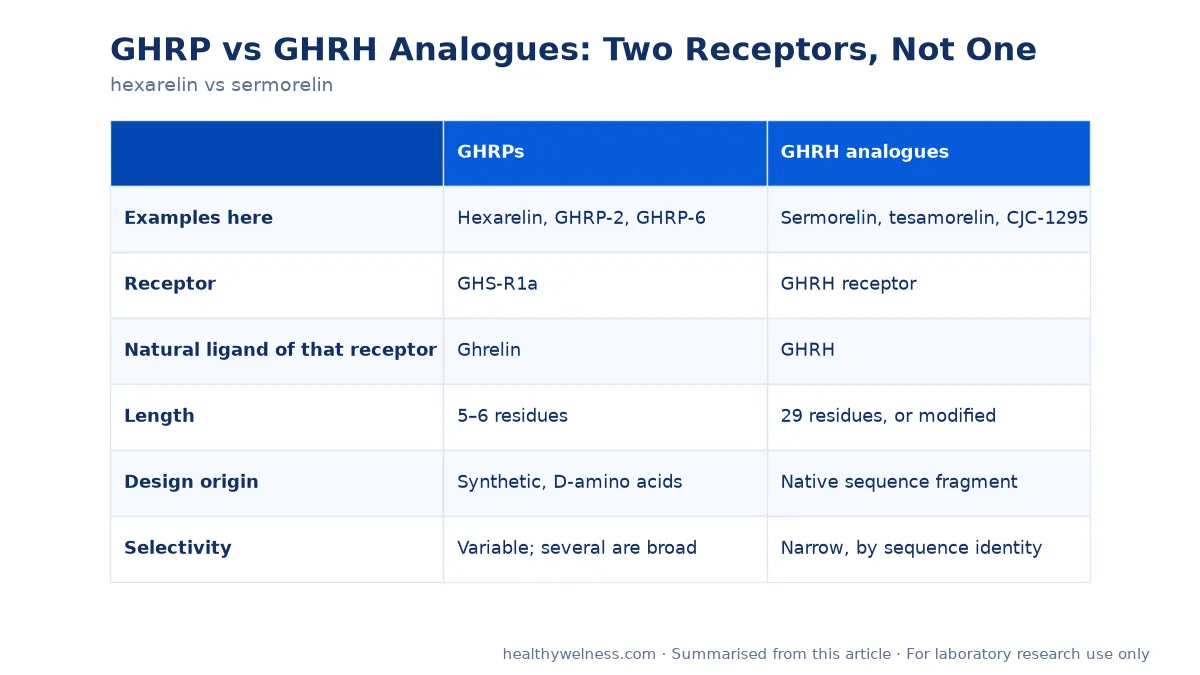
The two families
| GHRPs | GHRH analogues | |
|---|---|---|
| Examples here | Hexarelin, GHRP-2, GHRP-6 | Sermorelin, tesamorelin, CJC-1295 |
| Receptor | GHS-R1a | GHRH receptor |
| Natural ligand of that receptor | Ghrelin | GHRH |
| Length | 5–6 residues | 29 residues, or modified |
| Design origin | Synthetic, D-amino acids | Native sequence fragment |
| Selectivity | Variable; several are broad | Narrow, by sequence identity |
| Non-pituitary literature | Substantial | Limited |
The receptor row is the whole article in one line. Everything else follows from it.
Why the GHRPs behave less predictably
The 1998 review by Bowers in Cellular and Molecular Life Sciences is written from inside the period when this family was developed, before the receptor was cloned, and it conveys how the compounds were characterised: by activity first, mechanism later. That history left the series without the selectivity that a structure-led programme would have built in.
The 2000 study by Papotti and colleagues in the Journal of Clinical Endocrinology and Metabolism is the paper that makes the consequence concrete. It documented growth hormone secretagogue binding sites across peripheral human tissues — so the receptor population is not confined to the pituitary, and a peripheral effect is not evidence of a pituitary mechanism.
Hexarelin illustrates where this leads. The 2014 review by Mao and colleagues collects a cardiovascular literature for it that includes the proposal that some cardiac effects involve CD36, a receptor outside the secretagogue system entirely. A compound with a second candidate target is a poor instrument for isolating the first one.
Why the GHRH analogues are narrower
Sermorelin is the native GHRH sequence, residues 1–29, amidated. Its selectivity is not engineered; it is inherited. A peptide identical to the native ligand’s active region engages the native receptor, and the axis downstream of that receptor is mapped.
The 1985 study by Barron and colleagues compared GHRH(1–29)-NH2 against a D-Ala2 analogue, and the comparison also reveals the family’s weakness: position 2 is the dipeptidyl peptidase-4 cleavage site, and every long-acting analogue in this family exists to protect it. The native peptide is selective and fragile; the modified analogues trade sequence fidelity for persistence.
Which to choose
| If the question is | Family | Reason |
|---|---|---|
| Does this tissue respond to secretagogue signalling? | GHRP | Broader activity; receptor present peripherally |
| Is an effect specific to the GHRH receptor? | GHRH analogue | Sequence-level selectivity |
| Comparison with cardiac literature | Hexarelin | That literature exists for this compound |
| A long exposure window | Modified GHRH analogue | GHRPs are cleared rapidly in rodents |
| Testing whether the two routes converge | One from each | The contrast is the experiment |
The fourth row rests on measurement rather than inference: the 2000 kinetic study by Roumi and colleagues characterised hexarelin’s disposition in rats and found the rapid clearance expected of a six-residue peptide. A design requiring sustained exposure needs a modified analogue, which means a different compound and different controls.
The comparison that is worth running
Because the two families converge on one axis from different receptors, a direct comparison asks a real question: does engaging the axis at one point produce the same downstream outcome as engaging it at another? That is interpretable, provided two conditions hold.
- Molar equivalence. A six-residue and a 29-residue peptide have very different masses, so equal weights are not equal amounts.
- Exposure matched, or modelled. Otherwise a duration difference is read as a potency difference. This is the most common error in published comparisons within this group.
What such an experiment cannot establish is relative potency, since potency is defined against a receptor and the receptors differ. Multi-way comparisons within one family are a separate matter and are covered in sermorelin, ipamorelin and tesamorelin compared.
Handling differences
- GHRPs: short, robust in structure, but hexarelin and GHRP-6 are tryptophan-rich and therefore oxidation- and light-sensitive. Use a low-metal diluent and amber vials. See what hexarelin is.
- GHRH analogues: longer, with methionine, tryptophan and asparagine present. More degradation routes and faster loss in protease-containing media.
- Both: store sealed, dry and dark at −20 °C; warm before opening; aliquot on first reconstitution.
- Both: compute molarity from net peptide content rather than vial weight. Our reconstitution calculator takes those inputs.
Our hexarelin acetate research material is supplied for laboratory research use. Certificates are available for listed products — contact us for the latest report.
Open questions
- Do the two receptor routes produce identical downstream signatures when exposure is matched?
- What are the peripheral secretagogue binding sites at the molecular level?
- How much of the apparent potency difference between families is duration rather than efficacy?
Related research
- What is hexarelin?
- GHRP-2 compared with GHRP-6
- What is sermorelin?
- Hexarelin compared with ipamorelin
Frequently asked questions
What is the difference between a GHRP and a GHRH analogue?
The receptor. Growth hormone releasing peptides such as hexarelin and GHRP-2 act at the growth hormone secretagogue receptor GHS-R1a, whose natural ligand is ghrelin. GHRH analogues such as sermorelin and tesamorelin act at the GHRH receptor. These are different receptors with different natural ligands.
Are the two families structurally similar?
No. The GHRPs are short synthetic peptides of five or six residues containing D-amino acids. The GHRH analogues are 29-residue fragments of a native hormone or modified versions of it. They share neither length nor design origin.
Does one family have more published research?
They have different literatures. The GHRPs have broad non-pituitary work, including cardiac and metabolic models for hexarelin. The GHRH analogues have older clinical studies and, for tesamorelin, a regulatory development history.
Can a compound from each family be compared directly?
Yes, and it is a legitimate experiment, because both converge on the same downstream axis from different receptors. What such a comparison cannot do is treat a difference as a potency difference, since the receptors differ.
Which family is more fragile in the laboratory?
The GHRH analogues, generally. A 29-residue peptide containing methionine, tryptophan and asparagine has more vulnerable positions than a five- or six-residue synthetic peptide, although the tryptophan-rich GHRPs have their own oxidation sensitivity.
References
- Bowers CY. Growth hormone-releasing peptide (GHRP). Cell Mol Life Sci. 1998. PMID: 9893708 https://pubmed.ncbi.nlm.nih.gov/9893708/
- Papotti M, et al. Growth hormone secretagogue binding sites in peripheral human tissues. J Clin Endocrinol Metab. 2000. PMID: 11061542 https://pubmed.ncbi.nlm.nih.gov/11061542/
- Barron JL, et al. Growth hormone responses to growth hormone-releasing hormone (1-29)-NH2 and a D-Ala2 analog in normal men. Peptides. 1985. PMID: 2866496 https://pubmed.ncbi.nlm.nih.gov/2866496/
- Mao Y, et al. The cardiovascular action of hexarelin. J Geriatr Cardiol. 2014. PMID: 25278975 https://pubmed.ncbi.nlm.nih.gov/25278975/
- Roumi M, et al. Kinetics and disposition of hexarelin, a peptidic growth hormone secretagogue, in rats. Drug Metab Dispos. 2000. PMID: 10611139 https://pubmed.ncbi.nlm.nih.gov/10611139/
For laboratory research use only. The research materials supplied by HealthyWelness are not approved medicines, foods or cosmetics and are not for human or veterinary use. This article summarises published research and is not medical advice.
Sources
- Bowers CY. Growth hormone-releasing peptide (GHRP). Cell Mol Life Sci. 1998. PMID: 9893708
- Papotti M, et al. Growth hormone secretagogue binding sites in peripheral human tissues. J Clin Endocrinol Metab. 2000. PMID: 11061542
- Barron JL, et al. Growth hormone responses to growth hormone-releasing hormone (1-29)-NH2 and a D-Ala2 analog in normal men. Peptides. 1985. PMID: 2866496
- Mao Y, et al. The cardiovascular action of hexarelin. J Geriatr Cardiol. 2014. PMID: 25278975
- Roumi M, et al. Kinetics and disposition of hexarelin, a peptidic growth hormone secretagogue, in rats. Drug Metab Dispos. 2000. PMID: 10611139