Semax vs Bromantane: Peptide and Small Molecule
Semax is a peptide with a modern literature; bromantane is an adamantane small molecule documented largely in 1990s Russian-language journals.

Cover illustration: AI-generated editorial artwork. Conceptual only; not an exact molecular structure, actual laboratory result or evidence of clinical effects.
This comparison is worth making mainly to show how different two bodies of evidence can be while both being real. Semax is a peptide with a modern multi-group literature. Bromantane is a small molecule documented almost entirely in Russian-language journals from the 1990s, with little independent extension since. Both have citable papers; they are not equally well characterised.
For laboratory research use only. The research materials supplied by HealthyWelness are not approved medicines, foods or cosmetics and are not for human or veterinary use. This article summarises published research and is not medical advice.
A note on scope: bromantane is not offered here and is not a peptide. It appears in this comparison because researchers working with Semax encounter it, not as a product.
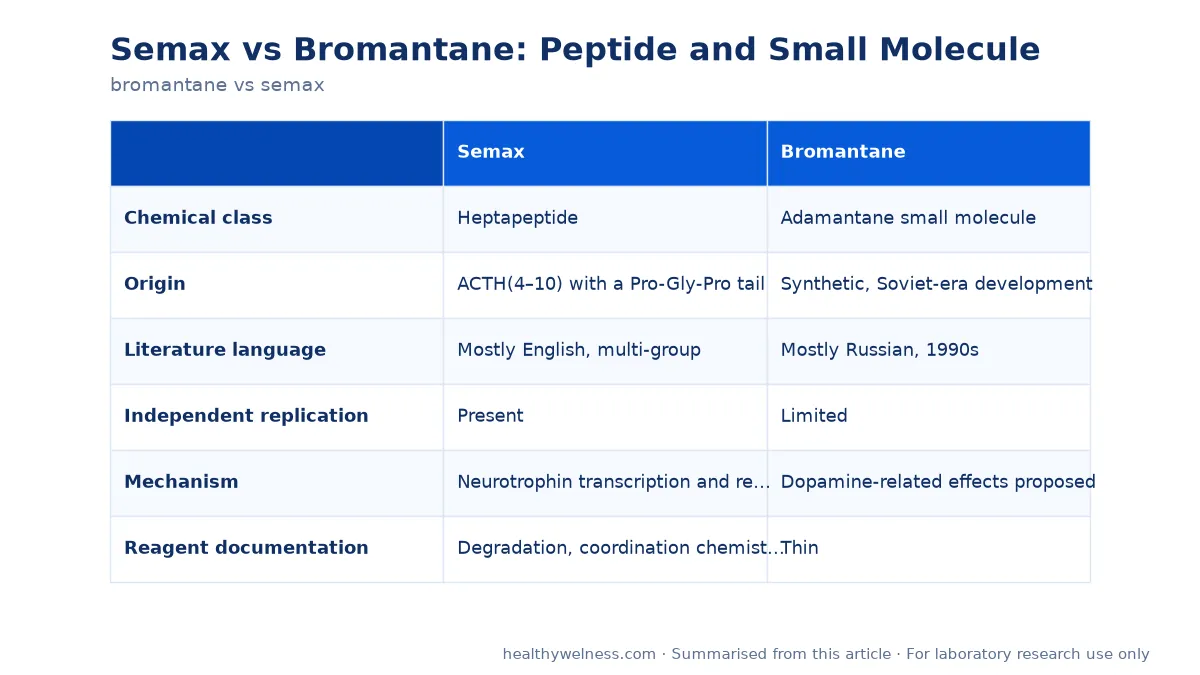
Side by side
| Semax | Bromantane | |
|---|---|---|
| Chemical class | Heptapeptide | Adamantane small molecule |
| Origin | ACTH(4–10) with a Pro-Gly-Pro tail | Synthetic, Soviet-era development |
| Literature language | Mostly English, multi-group | Mostly Russian, 1990s |
| Independent replication | Present | Limited |
| Mechanism | Neurotrophin transcription and related pathways | Dopamine-related effects proposed |
| Reagent documentation | Degradation, coordination chemistry, variants | Thin |
| Offered here | Yes | No |
What the bromantane literature contains
Three papers represent it fairly, and reading them together is instructive about the limits of the evidence.
The 1995 microdialysis study by Grekhova and colleagues examined dopamine release and metabolism in the dorsal striatum of freely moving rats. Microdialysis is a sound method and the readout is direct, so this is a real finding rather than an inference.
The 1999 review by Morozov and colleagues discussed proposed mechanisms of neurotropic action. A review of proposed mechanisms, published several years after the primary work, is a signal in itself: when the mechanism is still being proposed rather than tested, the field has not converged.
The 2002 study by Iezhitsa and colleagues in Bulletin of Experimental Biology and Medicine reported toxic effects on neurological status after a single treatment in experimental animals. We include it because omitting it would misrepresent the literature; a comparison that reports only activity findings and not adverse ones is not a comparison of the evidence.
Why language and indexing matter for assessment
This is not a judgement about the quality of the research. Soviet and Russian pharmacology produced substantial work, and several peptides in this catalogue — Semax and Selank among them — come from the same tradition. The issue is assessability.
- Abstracts are indexed; full texts often are not accessible. Methods and controls cannot be examined in the usual way.
- Replication by independent groups is limited. A finding confirmed once in one laboratory is a different thing from one confirmed in several.
- The work has not been extended. Thirty years on, the mechanistic questions raised in the 1990s remain roughly where they were.
Semax illustrates the contrast within the same research tradition. Its literature did continue: the 2010 study by Dmitrieva and colleagues on neurotrophin and receptor gene transcription after cerebral ischaemia is modern work in an indexed English-language journal, and the field has produced reagent-level studies as well, such as the 2006 work by Zolotarev and colleagues on tritium-labelled peptides and their biodegradation. That is the kind of paper that tells you how a compound behaves as a material rather than what it does biologically.
What this means for a laboratory choosing between them
| Requirement | Semax | Bromantane |
|---|---|---|
| Published handling and stability information | Available | Scarce |
| Mechanistic controls | Pathway-level work exists | Limited |
| Comparable published conditions to anchor against | Yes | Few, and old |
| Known structural variants | Yes — acetylated and amidated forms | Not documented in the same way |
| Independent confirmation of key claims | Present | Largely absent |
The practical conclusion is not that bromantane’s findings are wrong. It is that an experiment built on them has less to stand on, and a result that disagrees with the 1990s work would be difficult to interpret, because there is no modern baseline to compare against.
Handling Semax
Semax is among the more forgiving peptides in this category. It is seven residues, water-soluble, and its Pro-Gly-Pro tail resists many peptidases.
- Store sealed lyophilized powder at −20 °C, dry and dark; warm the vial before opening.
- Reconstitute in aqueous diluent, swirling gently; aliquot on first reconstitution. See storing reconstituted peptides.
- Check whether the variant is the acetylated and amidated form, which is a different compound with different coordination chemistry. See N-acetyl Semax amidate.
- Compute molarity from net peptide content; for a seven-residue peptide the counterion is a proportionally large share of vial weight. Our reconstitution calculator takes those inputs.
Our Semax research material is supplied for laboratory research use. Certificates are available for listed products — contact us for the latest report.
Scope note
This material is supplied for laboratory research use only. It is not a medicine, not a supplement, and not for human or veterinary use. Bromantane is discussed here as literature context and is not offered.
Open questions
- Have any bromantane findings been replicated outside the original research tradition?
- What accounts for the field not extending that work after the 1990s?
- How do the two compare on a modern readout under matched conditions?
Related research
Frequently asked questions
What is bromantane?
A small molecule built on an adamantane scaffold, developed in the Soviet Union and described in Russian-language pharmacology journals from the 1990s. It is not a peptide and shares no structural relationship with Semax.
Why is the bromantane literature hard to assess?
Because most of it is Russian-language work from the 1990s published in journals with limited indexing and little subsequent independent replication. The papers are real and citable, but the body of evidence has not been extended in the way a modern pharmacology programme would.
Is bromantane's mechanism established?
Not firmly. Microdialysis work from 1995 reported effects on dopamine release and metabolism in rat striatum, and a 1999 review discussed proposed neurotropic mechanisms. These are findings rather than a settled account.
Does the published work include safety observations?
A 2002 paper in Bulletin of Experimental Biology and Medicine reported toxic effects on neurological status after single treatment in experimental animals. That is a factual part of the literature and should be read alongside the activity reports.
Which is better characterised as a reagent?
Semax. It has a modern, multi-group literature, a documented degradation profile, published coordination chemistry, and variants whose differences are characterised. Bromantane’s reagent-level documentation is much thinner.
References
- Dmitrieva VG, et al. Semax and Pro-Gly-Pro activate the transcription of neurotrophins and their receptor genes after cerebral ischemia. Cell Mol Neurobiol. 2010. PMID: 19633950 https://pubmed.ncbi.nlm.nih.gov/19633950/
- Grekhova TV, et al. The effect of bromantane, a new immunostimulant with psychostimulating action, on release and metabolism of dopamine in the dorsal striatum of freely moving rats: a microdialysis study. Biull Eksp Biol Med. 1995. PMID: 7795203 https://pubmed.ncbi.nlm.nih.gov/7795203/
- Morozov IS, et al. The mechanisms of the neurotropic action of bromantan. Eksp Klin Farmakol. 1999. PMID: 10198757 https://pubmed.ncbi.nlm.nih.gov/10198757/
- Iezhitsa IN, et al. Toxic effect of single treatment with bromantane on neurological status of experimental animals. Bull Exp Biol Med. 2002. PMID: 12124651 https://pubmed.ncbi.nlm.nih.gov/12124651/
- Zolotarev IuA, et al. Evenly tritium-labeled peptides and their in vivo and in vitro biodegradation. Bioorg Khim. 2006. PMID: 16637290 https://pubmed.ncbi.nlm.nih.gov/16637290/
For laboratory research use only. The research materials supplied by HealthyWelness are not approved medicines, foods or cosmetics and are not for human or veterinary use. This article summarises published research and is not medical advice.
Sources
- Dmitrieva VG, et al. Semax and Pro-Gly-Pro activate the transcription of neurotrophins and their receptor genes after cerebral ischemia. Cell Mol Neurobiol. 2010. PMID: 19633950
- Grekhova TV, et al. The effect of bromantane, a new immunostimulant with psychostimulating action, on release and metabolism of dopamine in the dorsal striatum of freely moving rats: a microdialysis study. Biull Eksp Biol Med. 1995. PMID: 7795203
- Morozov IS, et al. The mechanisms of the neurotropic action of bromantan. Eksp Klin Farmakol. 1999. PMID: 10198757
- Iezhitsa IN, et al. Toxic effect of single treatment with bromantane on neurological status of experimental animals. Bull Exp Biol Med. 2002. PMID: 12124651
- Zolotarev IuA, et al. Evenly tritium-labeled peptides and their in vivo and in vitro biodegradation. Bioorg Khim. 2006. PMID: 16637290