Orforglipron vs Retatrutide: Small Molecule or Peptide
Orforglipron is a non-peptide GLP-1 receptor agonist; retatrutide is a triple-agonist peptide. The structural contrast and what it changes.


Cover illustration: AI-generated editorial artwork. Conceptual only; not an exact molecular structure, actual laboratory result or evidence of clinical effects.
This is one of the more instructive comparisons in incretin research, because the two compounds differ on the axis that usually matters least in a catalogue and most in the laboratory: one is a peptide and the other is not. They converge on overlapping biology from opposite ends of chemical space.
For laboratory research use only. The research materials supplied by HealthyWelness are not approved medicines, foods or cosmetics and are not for human or veterinary use. This article summarises published research and is not medical advice.
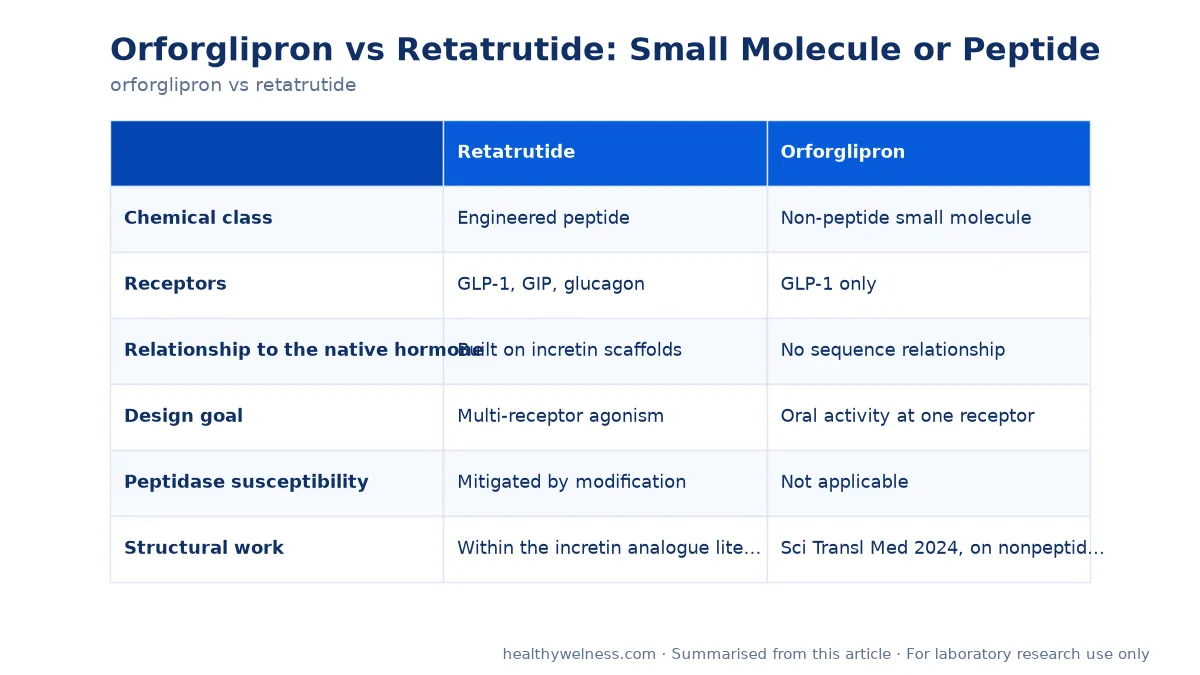
Side by side
| Retatrutide | Orforglipron | |
|---|---|---|
| Chemical class | Engineered peptide | Non-peptide small molecule |
| Receptors | GLP-1, GIP, glucagon | GLP-1 only |
| Relationship to the native hormone | Built on incretin scaffolds | No sequence relationship |
| Design goal | Multi-receptor agonism | Oral activity at one receptor |
| Peptidase susceptibility | Mitigated by modification | Not applicable |
| Structural work | Within the incretin analogue literature | Sci Transl Med 2024, on nonpeptide agonism |
| Laboratory class | Peptide handling | Small-molecule handling |
What “nonpeptide agonism” means structurally
The 2024 study by Sloop and colleagues in Science Translational Medicine is titled “The pharmacological basis for nonpeptide agonism of the GLP-1 receptor by orforglipron”, and it is the paper to read if the question is how rather than whether.
The problem it addresses is not trivial. Class B G protein-coupled receptors like the GLP-1 receptor normally bind a long peptide in two parts: the extracellular domain grips the ligand’s C-terminal region while the N-terminal region reaches into the receptor core. A small molecule cannot do both. Finding a chemical series that activates such a receptor anyway was a long-standing problem, and that is what makes this compound interesting beyond its clinical programme.
The experimental consequence for anyone comparing the two: a small molecule and a peptide may engage the same receptor differently enough to produce different signalling profiles. Matching receptor occupancy does not guarantee matching downstream output, and a difference between them is a finding rather than an inconsistency.
Why oral activity was the goal
Peptides are poor oral agents for reasons that are structural rather than incidental: peptidases in the gut cleave them, and intact absorption of a large, charged, flexible molecule is inefficient. A non-peptide can be designed around both problems.
The 2023 phase 1b study by Pratt and colleagues in Diabetes, Obesity and Metabolism is where the compound’s human pharmacology begins; the 2023 and 2025 reports in the New England Journal of Medicine follow it into larger trials. For a research-catalogue reader the useful summary is that this is an unusually well-documented molecule for its age.
Retatrutide’s trial evidence is aggregated in the 2025 systematic review and meta-analysis by Abdrabou Abouelmagd and colleagues. Both compounds therefore have real clinical literatures — which is uncommon in this product category and worth keeping distinct from what research material is for.
One receptor versus three
This is the other axis of difference, and it cuts the opposite way from the chemistry.
- Orforglipron engages one receptor, so an effect observed with it can be attributed to GLP-1 receptor signalling with reasonable confidence.
- Retatrutide engages three, so an effect cannot be attributed to any single receptor without selective comparators. Triple agonism is the design, and it is also an interpretive constraint.
In an experiment, that makes orforglipron the cleaner probe and retatrutide the broader intervention. The same logic applies within the peptide class, as set out in retatrutide compared with tirzepatide.
Handling: not comparable
| Step | Retatrutide (peptide) | Orforglipron (small molecule) |
|---|---|---|
| Diluent | Aqueous, per certificate | Organic co-solvent for the stock |
| Vehicle control | Aqueous | Co-solvent-matched |
| Mixing | Swirl; do not vortex hard | Confirm full dissolution |
| Main silent failure | Aggregation, surface loss | Precipitation on dilution |
| Concentration from | Net peptide content | Formula weight and solubility limit |
| Identity data | HPLC plus peptide MS | NMR, LC-MS, residual solvent |
Retatrutide carries a lipid modification intended for albumin binding, which raises its hydrophobic character and makes gentle reconstitution more important than for a plain peptide — the detail is in reconstituting retatrutide. Net-content arithmetic is handled by our reconstitution calculator; for a small molecule the inputs are different and the calculator does not apply.
Our retatrutide research material is supplied for laboratory research use. Certificates are available for listed products — contact us for the latest report.
Scope note
This material is supplied for laboratory research use only. It is not a medicine, not a supplement, and not for human or veterinary use. The clinical studies cited are referenced as published literature about these molecules, not as statements about any use of research material.
Open questions
- Do peptide and non-peptide agonists at the GLP-1 receptor produce the same downstream signalling profile?
- Can the three receptor contributions to retatrutide’s profile be separated with selective comparators?
- What does the non-peptide scaffold cost in receptor affinity relative to the native ligand?
Related research
Frequently asked questions
What is orforglipron?
A non-peptide small molecule that activates the GLP-1 receptor. It is not an analogue of GLP-1 and shares no sequence with it; it engages the same receptor by a different chemical route, which a 2024 Science Translational Medicine paper sets out in structural terms.
How does that differ from retatrutide?
Retatrutide is a peptide engineered from incretin hormone scaffolds and acts at three receptors: GLP-1, GIP and glucagon. Orforglipron is one molecule at one receptor and is not a peptide at all.
Why does non-peptide agonism matter?
Because peptides are degraded by peptidases and are generally not absorbed intact from the gut, whereas a suitably designed small molecule can be. The entire point of the orforglipron programme is a molecule that works when taken by mouth.
Which has more clinical evidence?
Both have substantial trial literature. Orforglipron has several New England Journal of Medicine reports plus phase 1b work; retatrutide has randomised trials summarised in a 2025 systematic review and meta-analysis.
Do they need different handling as research material?
Yes, entirely. A peptide needs aqueous reconstitution, aliquoting and net-content arithmetic. A non-peptide small molecule needs an organic co-solvent, a matched vehicle control, and small-molecule analytical data.
References
- Sloop KW, et al. The pharmacological basis for nonpeptide agonism of the GLP-1 receptor by orforglipron. Sci Transl Med. 2024. PMID: 39693407 https://pubmed.ncbi.nlm.nih.gov/39693407/
- Pratt E, et al. Orforglipron (LY3502970), a novel, oral non-peptide glucagon-like peptide-1 receptor agonist: A Phase 1b, multicentre, blinded, placebo-controlled, randomized, multiple-ascending-dose study in people with type 2 diabetes. Diabetes Obes Metab. 2023. PMID: 37264711 https://pubmed.ncbi.nlm.nih.gov/37264711/
- Wharton S, et al. Daily Oral GLP-1 Receptor Agonist Orforglipron for Adults with Obesity. N Engl J Med. 2023. PMID: 37351564 https://pubmed.ncbi.nlm.nih.gov/37351564/
- Rosenstock J, et al. Orforglipron, an Oral Small-Molecule GLP-1 Receptor Agonist, in Early Type 2 Diabetes. N Engl J Med. 2025. PMID: 40544435 https://pubmed.ncbi.nlm.nih.gov/40544435/
- Abdrabou Abouelmagd A, et al. Efficacy and safety of retatrutide, a novel GLP-1, GIP, and glucagon receptor agonist for obesity treatment: a systematic review and meta-analysis of randomized controlled trials. Proc (Bayl Univ Med Cent). 2025. PMID: 40291085 https://pubmed.ncbi.nlm.nih.gov/40291085/
For laboratory research use only. The research materials supplied by HealthyWelness are not approved medicines, foods or cosmetics and are not for human or veterinary use. This article summarises published research and is not medical advice.
Sources
- Sloop KW, et al. The pharmacological basis for nonpeptide agonism of the GLP-1 receptor by orforglipron. Sci Transl Med. 2024. PMID: 39693407
- Pratt E, et al. Orforglipron (LY3502970), a novel, oral non-peptide glucagon-like peptide-1 receptor agonist: A Phase 1b, multicentre, blinded, placebo-controlled, randomized, multiple-ascending-dose study in people with type 2 diabetes. Diabetes Obes Metab. 2023. PMID: 37264711
- Wharton S, et al. Daily Oral GLP-1 Receptor Agonist Orforglipron for Adults with Obesity. N Engl J Med. 2023. PMID: 37351564
- Rosenstock J, et al. Orforglipron, an Oral Small-Molecule GLP-1 Receptor Agonist, in Early Type 2 Diabetes. N Engl J Med. 2025. PMID: 40544435
- Abdrabou Abouelmagd A, et al. Efficacy and safety of retatrutide, a novel GLP-1, GIP, and glucagon receptor agonist for obesity treatment: a systematic review and meta-analysis of randomized controlled trials. Proc (Bayl Univ Med Cent). 2025. PMID: 40291085