HGH Fragment 176-191 vs AOD-9604: Are They the Same?
HGH Fragment 176-191 and AOD-9604 are related but not identical: one carries an added N-terminal tyrosine. What the published work actually covers.


Cover illustration: AI-generated editorial artwork. Conceptual only; not an exact molecular structure, actual laboratory result or evidence of clinical effects.
These two names are used interchangeably in product listings, and they should not be. The compounds are related — both derive from the same C-terminal region of human growth hormone — but the published literature distinguishes them, and the distinction has direct consequences for molecular weight, analytical identification and which papers apply.
For laboratory research use only. The research materials supplied by HealthyWelness are not approved medicines, foods or cosmetics and are not for human or veterinary use. This article summarises published research and is not medical advice.
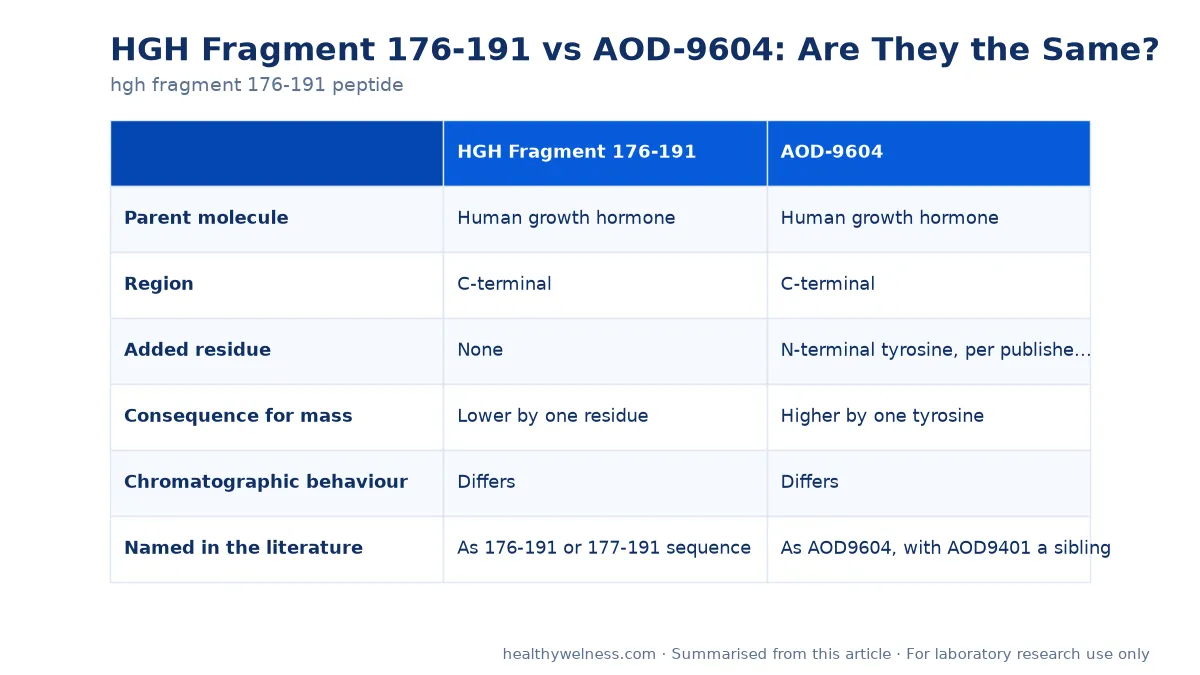
The relationship, stated precisely
| HGH Fragment 176-191 | AOD-9604 | |
|---|---|---|
| Parent molecule | Human growth hormone | Human growth hormone |
| Region | C-terminal | C-terminal |
| Added residue | None | N-terminal tyrosine, per published descriptions |
| Consequence for mass | Lower by one residue | Higher by one tyrosine |
| Chromatographic behaviour | Differs | Differs |
| Named in the literature | As 176-191 or 177-191 sequence | As AOD9604, with AOD9401 a sibling |
The short version: AOD-9604 is a defined, named compound with its own papers; “HGH Fragment 176-191” is a description of a residue range. A vial labelled with the residue range could contain the plain fragment or something with a modification, and only the sequence and mass on the certificate settle which.
Why the numbering is inconsistent
Both 176–191 and 177–191 appear in the literature. The 1993 paper by Wu and colleagues in Biochemistry and Molecular Biology International studied the synthetic C-terminal sequence 177–191 and described an antilipogenic action in that model. Later work refers to the domain by code names rather than residue numbers.
This is not sloppiness so much as a reflection of how the compounds were developed: the sequence was defined by activity, and different groups retained slightly different boundaries. The practical rule is therefore specific. When relying on a published finding, check that the sequence in the paper matches the sequence on the certificate, residue for residue. A one-residue difference at the boundary of a sixteen-residue peptide is a six per cent change in length.
What the primary literature actually examined
Three papers from the Ng and Wu groups form the core, and they are all rodent and cell-level work on lipid metabolism:
| Paper | Compound | System |
|---|---|---|
| Wu 1993 | Synthetic 177–191 sequence | Antilipogenic action, experimental |
| Ng 2000, J Mol Endocrinol | AOD9401 | Zucker fatty rats, molecular and cellular actions |
| Ng 2000, Horm Res | AOD9604 | Metabolic studies of the synthetic domain |
AOD9401 and AOD9604 are two members of the same series, which is itself informative: the group made more than one variant and characterised them separately. Treating all C-terminal growth hormone fragments as one compound erases distinctions the original investigators thought worth drawing.
The 2015 paper by Cox and colleagues in Drug Testing and Analysis is the most useful of the four for laboratory purposes, and the least often cited in product descriptions. It covers detection and in vitro metabolism of AOD9604 — which means it contains the kind of mass spectrometric and metabolic-stability information that identification work actually requires. Anti-doping analytical literature is generally the most structurally rigorous source available for compounds of this type, because unambiguous identification is its entire purpose.
What this means for identification
Names in this family are not reliable identifiers. The checks that are:
- The stated sequence. Count the residues and note the boundaries. A certificate that gives only a name has not identified the compound.
- The observed mass against the expected mass for that exact sequence. Compute the expected value yourself rather than accepting a pass statement; a one-residue difference is well within the resolving power of routine instruments.
- The chromatogram. An added tyrosine shifts retention appreciably. A single clean peak at the expected retention is evidence that one compound is present.
- Whether the molecular weight used in concentration maths matches. Using the wrong family member’s molecular weight introduces a systematic error into every subsequent calculation. See how to read a certificate of analysis.
Our reconstitution calculator takes the molecular weight as an explicit input precisely so that this value is a conscious choice rather than a default.
Handling
A sixteen-residue peptide from this region is a straightforward reagent. Store sealed lyophilized powder at −20 °C, dry and dark. Reconstitute gently and aliquot on first use rather than refreezing one tube. Tyrosine, where present, is a UV-absorbing and photo-oxidisable residue, so light protection is not merely conventional.
Our HGH Fragment 176-191 research material is listed with its stated sequence, so the sequence check described above can be carried out against whichever report you receive. Certificates are available for listed products — contact us for the latest report.
Scope note
This material is supplied for laboratory research use only. It is not a medicine, not a supplement, and not for human or veterinary use. The published work discussed above is rodent and in vitro research on lipid metabolism, and it does not establish any outcome in humans.
Open questions
- Does the added N-terminal tyrosine change activity, or only stability and analytical behaviour?
- How do the AOD9401 and AOD9604 variants compare directly in the same system?
- What fraction of material sold under the residue-range name matches that sequence exactly?
Related research
- What is AOD-9604?
- Reconstituting AOD-9604
- How to read a certificate of analysis
Frequently asked questions
Are HGH Fragment 176-191 and AOD-9604 the same compound?
They are closely related but not identical. AOD-9604 is described in the literature as the C-terminal fragment of human growth hormone carrying an additional tyrosine residue at the N-terminus. A plain 176-191 fragment lacks that residue, so the two differ in sequence length and mass.
Why does one extra residue matter?
Analytically it matters a great deal, because the two compounds have different molecular masses and different chromatographic retention. For concentration maths the molecular weight used must match the actual compound, not the one with a similar name.
What is the published literature on these fragments?
Several papers from the late 1990s and 2000s characterise synthetic C-terminal sequences of human growth hormone in rodent models, including the 177-191 sequence and the AOD9401 and AOD9604 domains. There is also an anti-doping detection and metabolism study from 2015.
Which numbering is correct, 176-191 or 177-191?
Both appear in the literature, referring to slightly different residue ranges of the same C-terminal region. Published papers specify the range they used, which is why the sequence on a certificate of analysis should be checked against the paper being relied on.
How should the material be identified?
By observed mass against the expected mass for the exact sequence stated, plus a chromatogram. Compounds in this family differ by single residues, and a name alone does not establish which one is in a vial.
References
- Wu Z, et al. Antilipogenic action of synthetic C-terminal sequence 177-191 of human growth hormone. Biochem Mol Biol Int. 1993. PMID: 8358331 https://pubmed.ncbi.nlm.nih.gov/8358331/
- Ng FM, et al. Molecular and cellular actions of a structural domain of human growth hormone (AOD9401) on lipid metabolism in Zucker fatty rats. J Mol Endocrinol. 2000. PMID: 11116208 https://pubmed.ncbi.nlm.nih.gov/11116208/
- Ng FM, et al. Metabolic studies of a synthetic lipolytic domain (AOD9604) of human growth hormone. Horm Res. 2000. PMID: 11146367 https://pubmed.ncbi.nlm.nih.gov/11146367/
- Cox HD, et al. Detection and in vitro metabolism of AOD9604. Drug Test Anal. 2015. PMID: 25208511 https://pubmed.ncbi.nlm.nih.gov/25208511/
For laboratory research use only. The research materials supplied by HealthyWelness are not approved medicines, foods or cosmetics and are not for human or veterinary use. This article summarises published research and is not medical advice.
Sources
- Wu Z, et al. Antilipogenic action of synthetic C-terminal sequence 177-191 of human growth hormone. Biochem Mol Biol Int. 1993. PMID: 8358331
- Ng FM, et al. Molecular and cellular actions of a structural domain of human growth hormone (AOD9401) on lipid metabolism in Zucker fatty rats. J Mol Endocrinol. 2000. PMID: 11116208
- Ng FM, et al. Metabolic studies of a synthetic lipolytic domain (AOD9604) of human growth hormone. Horm Res. 2000. PMID: 11146367
- Cox HD, et al. Detection and in vitro metabolism of AOD9604. Drug Test Anal. 2015. PMID: 25208511