KPV vs BPC-157: Two Different Research Lineages
KPV is a melanocortin-derived tripeptide; BPC-157 is a 15-residue gastric peptide fragment. Their literatures barely overlap, and the reason matters.

Cover illustration: AI-generated editorial artwork. Conceptual only; not an exact molecular structure, actual laboratory result or evidence of clinical effects.
These two peptides are often listed together because both appear in inflammation and tissue-repair contexts. Beyond that, they have almost nothing in common: different parent molecules, different signalling frameworks, different sizes, and two literatures that scarcely cite each other. The comparison is worth making mainly to establish that there is no shared mechanism to reason from.
For laboratory research use only. The research materials supplied by HealthyWelness are not approved medicines, foods or cosmetics and are not for human or veterinary use. This article summarises published research and is not medical advice.
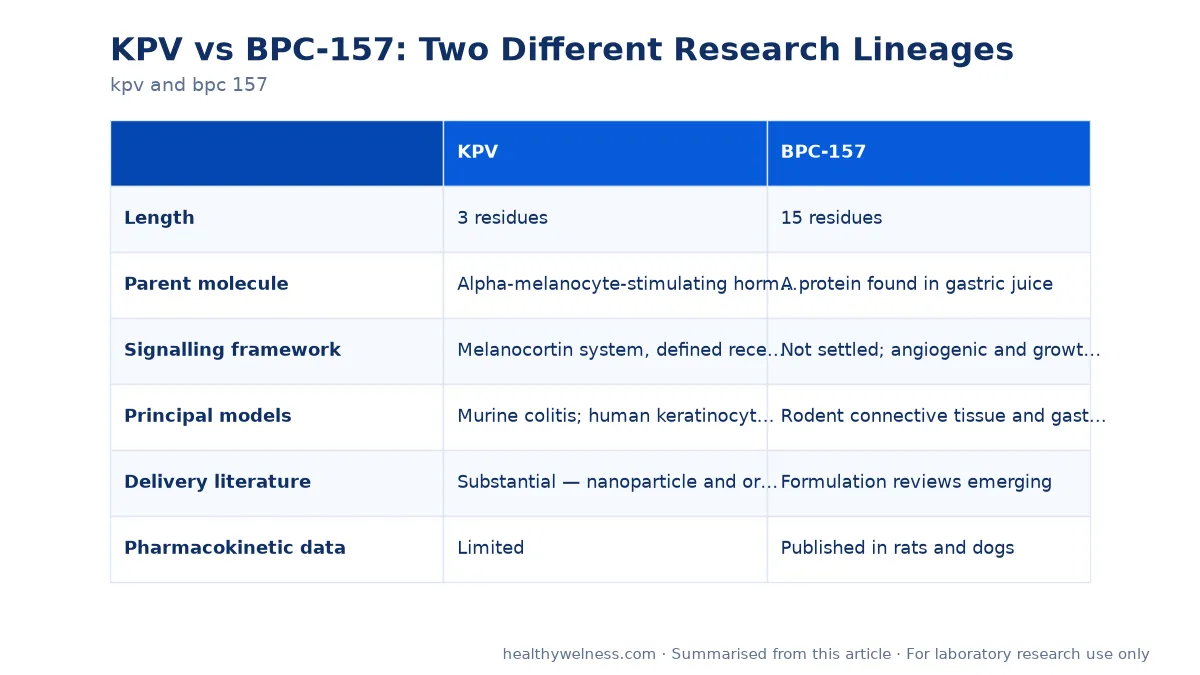
Side by side
| KPV | BPC-157 | |
|---|---|---|
| Length | 3 residues | 15 residues |
| Parent molecule | Alpha-melanocyte-stimulating hormone (residues 11–13) | A protein found in gastric juice |
| Signalling framework | Melanocortin system, defined receptor family | Not settled; angiogenic and growth factor pathways implicated |
| Principal models | Murine colitis; human keratinocytes | Rodent connective tissue and gastrointestinal models |
| Delivery literature | Substantial — nanoparticle and oral targeting | Formulation reviews emerging |
| Pharmacokinetic data | Limited | Published in rats and dogs |
| Handling difficulty | Minimal | Moderate |
KPV: a fragment with a defined parent
KPV is the C-terminal tripeptide of alpha-MSH, residues 11–13. That provenance is the most useful thing about it, because it places the peptide inside a characterised system: the melanocortin receptors are a known family with a known endogenous ligand and defined subtypes.
The 2003 review by Luger and colleagues in the Annals of the New York Academy of Sciences covers alpha-MSH and related peptides in the immune system and is the right framing reference. The 2004 study by Elliott and colleagues in the Journal of Investigative Dermatology examined signalling by alpha-MSH, the KPV fragment and ACTH in human keratinocytes — a direct comparison of the fragment against its parent in human cells, which is more than most fragment peptides have.
The 2008 study by Kannengiesser and colleagues in Inflammatory Bowel Disease reported anti-inflammatory potential in murine models of inflammatory bowel disease, and the 2017 study by Xiao and colleagues in Molecular Therapy took a delivery approach, using hyaluronic acid-functionalised nanoparticles for oral targeting in a colitis model.
That delivery paper is worth singling out, because it addresses the obvious problem with a tripeptide: three residues offer little resistance to proteolysis and provide no basis for tissue selectivity. Engineering the delivery rather than the molecule is a reasonable response, and it is the direction this literature has taken.
BPC-157: a larger peptide with a less settled mechanism
BPC-157 is a 15-residue sequence derived from a protein in gastric juice. Its literature is considerably larger than KPV’s but differently shaped: mostly rodent models across connective tissue and gastrointestinal systems, with mechanism inferred from downstream signalling rather than from a defined receptor.
The 2022 study by He and colleagues in Frontiers in Pharmacology is the most useful single paper for experimental planning, because it characterised pharmacokinetics, distribution, metabolism and excretion in rats and dogs. Studies of that type are rare in the research-peptide literature and they are what allow expectations about exposure to be anchored in measurement rather than assumption. The compound is covered in detail in what BPC-157 is.
The contrast with KPV is instructive. For KPV, the receptor system is defined but the fragment’s own pharmacokinetics are thin. For BPC-157, the pharmacokinetics are published but the receptor is not established. Each has the gap the other fills, which is why neither can be used to reason about the other.
What a comparison experiment could and could not show
Since there is no shared target, the only legitimate basis for comparison is a shared functional readout. Even then, several design points apply:
- Molar equivalence is the only fair basis. A tripeptide and a 15-mer differ greatly in mass, so equal masses are very unequal molar amounts.
- Proteolytic stability differs. In a serum-containing medium, both are degraded, but not at the same rate, and a difference in observed effect may be a difference in survival.
- Melanocortin receptor expression should be checked in any system where KPV is expected to act through that family. Absence of the receptor makes a null result uninformative.
- Combination work has essentially no published basis. There are no co-administration studies to anchor against, so any such experiment is exploratory and should be described as such.
Handling differences
| Consideration | KPV | BPC-157 |
|---|---|---|
| Aqueous solubility | High — a small, charged tripeptide | Good |
| Conformational requirement | None meaningful | Limited, but more than a tripeptide |
| Oxidation-prone residues | None | Present |
| Freeze–thaw tolerance | Good | Moderate — aliquot |
| Identity confirmation | Mass is nearly sufficient for three residues | Mass plus chromatogram |
| Surface loss when dilute | Low | Noticeable |
A three-residue peptide is about as forgiving a reagent as exists. There is no fold to lose, no disulfide to scramble, and with only three residues the number of possible deletion impurities is small enough that a mass measurement is close to definitive. Both should still be stored sealed, dry and frozen, and both should be aliquoted after reconstitution — see storing reconstituted peptides.
Concentration maths for both should start from net peptide content rather than vial weight; the correction is proportionally larger for the tripeptide, where counterion mass is a bigger share of the total. Our reconstitution calculator takes those figures from the certificate.
Our KPV research material is supplied for laboratory research use. Certificates are available for listed products — contact us for the latest report.
Open questions
- Which melanocortin receptor subtype, if any, mediates KPV’s reported activity?
- What are KPV’s pharmacokinetics, which remain much less characterised than BPC-157’s?
- Is there any mechanistic rationale for studying the two together, beyond overlapping model systems?
Related research
Frequently asked questions
What is KPV?
A tripeptide, lysine-proline-valine, corresponding to residues 11 to 13 of alpha-melanocyte-stimulating hormone. It is the C-terminal fragment of that hormone and is studied within the melanocortin literature, chiefly in models of intestinal and dermal inflammation.
What is BPC-157?
A 15-residue peptide corresponding to a partial sequence of a protein found in gastric juice. Its literature is mostly rodent work on connective tissue and gastrointestinal models, with a developing body of human systematic reviews.
Do their mechanisms overlap?
Not in any established way. KPV sits in melanocortin signalling, a defined receptor system with known family members. BPC-157’s mechanism is less settled, with published work implicating angiogenic signalling and growth factor receptor pathways.
Which has better-defined pharmacology?
KPV, in the sense that the melanocortin system is a well-characterised receptor family with an endogenous ligand and known subtypes. That does not mean KPV’s own activity is fully explained, but the framework it sits in is clearer.
Are they handled differently in the laboratory?
Yes, mainly by size. A tripeptide is small, highly soluble and not conformationally dependent, whereas a 15-residue peptide has more vulnerable positions and more structure to lose. The tripeptide is the more robust reagent by a wide margin.
References
- Kannengiesser K, et al. Melanocortin-derived tripeptide KPV has anti-inflammatory potential in murine models of inflammatory bowel disease. Inflamm Bowel Dis. 2008. PMID: 18092346 https://pubmed.ncbi.nlm.nih.gov/18092346/
- Elliott RJ, et al. alpha-Melanocyte-stimulating hormone, MSH 11-13 KPV and adrenocorticotropic hormone signalling in human keratinocyte cells. J Invest Dermatol. 2004. PMID: 15102092 https://pubmed.ncbi.nlm.nih.gov/15102092/
- Xiao B, et al. Orally Targeted Delivery of Tripeptide KPV via Hyaluronic Acid-Functionalized Nanoparticles Efficiently Alleviates Ulcerative Colitis. Mol Ther. 2017. PMID: 28143741 https://pubmed.ncbi.nlm.nih.gov/28143741/
- Luger TA, et al. New insights into the functions of alpha-MSH and related peptides in the immune system. Ann N Y Acad Sci. 2003. PMID: 12851308 https://pubmed.ncbi.nlm.nih.gov/12851308/
- He L, et al. Pharmacokinetics, distribution, metabolism, and excretion of body-protective compound 157, a potential drug for treating various wounds, in rats and dogs. Front Pharmacol. 2022. PMID: 36588717 https://pubmed.ncbi.nlm.nih.gov/36588717/
For laboratory research use only. The research materials supplied by HealthyWelness are not approved medicines, foods or cosmetics and are not for human or veterinary use. This article summarises published research and is not medical advice.
Sources
- Kannengiesser K, et al. Melanocortin-derived tripeptide KPV has anti-inflammatory potential in murine models of inflammatory bowel disease. Inflamm Bowel Dis. 2008. PMID: 18092346
- Elliott RJ, et al. alpha-Melanocyte-stimulating hormone, MSH 11-13 KPV and adrenocorticotropic hormone signalling in human keratinocyte cells. J Invest Dermatol. 2004. PMID: 15102092
- Xiao B, et al. Orally Targeted Delivery of Tripeptide KPV via Hyaluronic Acid-Functionalized Nanoparticles Efficiently Alleviates Ulcerative Colitis. Mol Ther. 2017. PMID: 28143741
- Luger TA, et al. New insights into the functions of alpha-MSH and related peptides in the immune system. Ann N Y Acad Sci. 2003. PMID: 12851308
- He L, et al. Pharmacokinetics, distribution, metabolism, and excretion of body-protective compound 157, a potential drug for treating various wounds, in rats and dogs. Front Pharmacol. 2022. PMID: 36588717