MGF vs PEG-MGF: What PEGylation Changes
MGF is the E domain of the IGF-1Ec splice variant. PEG-MGF adds a polyethylene glycol chain. A comparison of the two research forms and their literature.


Cover illustration: AI-generated editorial artwork. Conceptual only; not an exact molecular structure, actual laboratory result or evidence of clinical effects.
MGF and PEG-MGF differ by a polymer, not by a sequence. PEG-MGF is MGF with a polyethylene glycol chain attached. Understanding the pair therefore means understanding two separate things: what the E domain of IGF-1Ec is, and what PEGylation does to any molecule it is applied to.
For laboratory research use only. The research materials supplied by HealthyWelness are not approved medicines, foods or cosmetics and are not for human or veterinary use. This article summarises published research and is not medical advice.
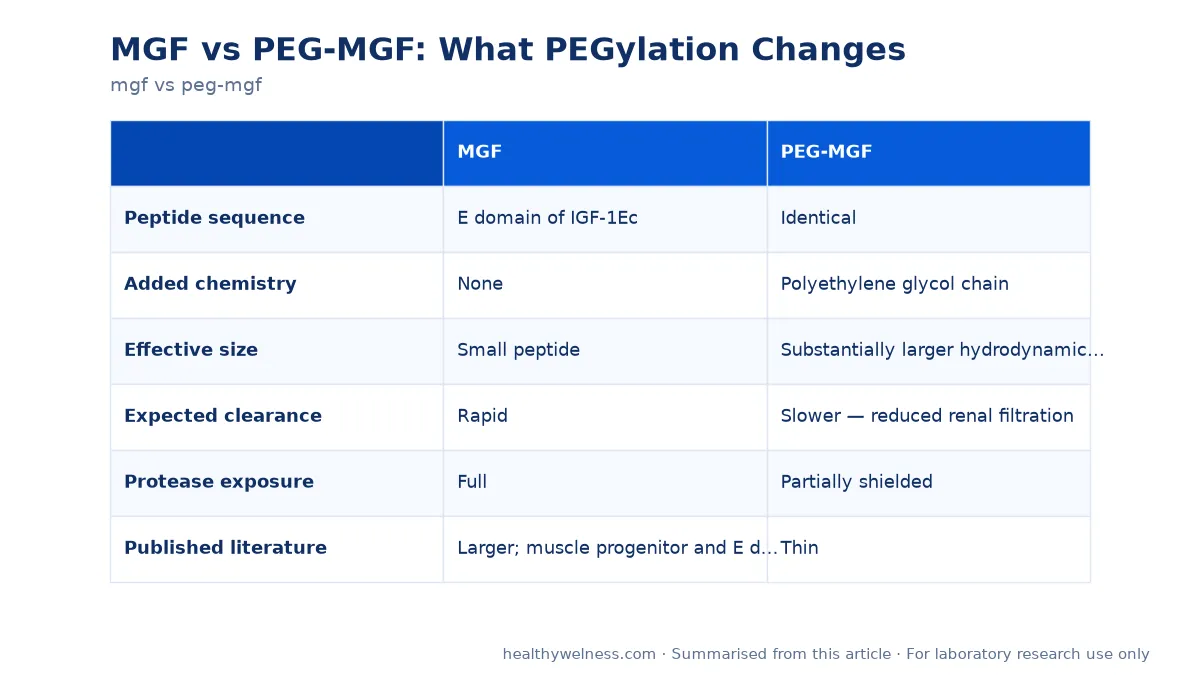
Side by side
| MGF | PEG-MGF | |
|---|---|---|
| Peptide sequence | E domain of IGF-1Ec | Identical |
| Added chemistry | None | Polyethylene glycol chain |
| Effective size | Small peptide | Substantially larger hydrodynamic radius |
| Expected clearance | Rapid | Slower — reduced renal filtration |
| Protease exposure | Full | Partially shielded |
| Published literature | Larger; muscle progenitor and E domain studies | Thin |
| Analytical complexity | Standard peptide MS | Higher — PEG gives heterogeneous mass |
What MGF actually is
The IGF-1 gene produces more than one transcript through alternative splicing. One variant, IGF-1Ec, differs from the principal form in its C-terminal E domain. “Mechano growth factor” is the name given to this variant — and in practice, to its distinctive E domain — because its expression was reported to increase in muscle following mechanical loading.
An important terminological point: research material sold as MGF is generally a synthetic peptide corresponding to the E domain, not the full-length IGF-1Ec protein. These are different molecules. The 2014 study by Vassilakos and colleagues addressed E domain activity specifically using synthetic peptides, and that paper is the right reference for what such a peptide does, as distinct from what the full variant does.
The 2011 study by Kandalla and colleagues is the other primary reference: it reported that an MGF E peptide activated human muscle progenitor cells and increased their fusion potential across age groups. That is a cell-level finding in human cells, which makes it one of the more directly relevant pieces of work in this area.
The receptor question, which is genuinely open
Here the literature is less tidy than product descriptions suggest. The E domain’s reported activity does not appear to run through the IGF-1 receptor, and the receptor that mediates it is not established. That is an honest gap, not a detail awaiting a citation.
Two consequences follow. Mechanistic claims about MGF should be read as provisional, since a pathway cannot be mapped confidently without knowing the entry point. And experiments using MGF alongside IGF-1 cannot assume a shared mechanism — the comparison is between two agents whose relationship is unresolved.
What PEGylation does, in general
PEGylation is a well-characterised technique applied across many therapeutic molecules, so its effects can be stated from the general literature:
- Slower renal clearance. Glomerular filtration is size-dependent. A PEG chain raises hydrodynamic radius above the efficient filtration threshold.
- Steric protection from proteases. The polymer shields cleavage sites.
- Possible loss of potency. The same shielding can impede receptor binding. PEGylated molecules frequently show reduced specific activity, offset by longer exposure.
- Heterogeneity. PEG reagents are polydisperse and attachment sites can vary, so a PEGylated product is a distribution of species rather than a single compound.
That last point is the practical one. A PEGylated peptide cannot be characterised like a plain one. Mass spectrometry returns a distribution, not a single mass; HPLC purity figures mean something different. When reading a certificate of analysis for PEG-MGF, check how PEG heterogeneity was handled before comparing a purity number with that of an unmodified peptide. See how to read a certificate of analysis.
Why the analytical literature is worth knowing
The 2014 paper by Thevis and colleagues characterised a biotechnologically produced full-length MGF by mass spectrometry, in an anti-doping detection context. Detection work tends to be the most structurally rigorous literature available on compounds like this, because the whole point is unambiguous identification. If you need to confirm what is actually in a vial, that body of work is more useful than the biology papers.
Choosing between them
| If the question is | Use | Reason |
|---|---|---|
| E domain activity on a cell system | MGF | Matches the published cell literature; no PEG confounder |
| Effect of extending exposure duration | Both, in parallel | The contrast is the experiment |
| Comparison with published results | MGF | The literature is overwhelmingly on the unmodified form |
| Analytical method development | Both | PEG heterogeneity is itself the methodological challenge |
Handling in the lab
- Both arrive lyophilized; store sealed at −20 °C, protected from light and moisture.
- Reconstitute gently down the vial wall and swirl. PEGylated material can be noticeably more viscous in concentrated solution.
- Aliquot after reconstitution rather than freeze–thawing one tube. See storing reconstituted peptides.
- Calculate concentration from the molecular weight on the certificate — the PEG form’s mass differs substantially, so do not reuse a figure between the two. Our reconstitution calculator takes MW as an input for this reason.
Our MGF research material is supplied for laboratory research use. Certificates are available for listed products — contact us for the latest report.
Open questions
- Which receptor mediates E domain activity?
- What does PEGylation cost in specific activity for this peptide?
- How closely does a synthetic E domain peptide reproduce the behaviour of full-length IGF-1Ec?
Related research
- What is IGF-1 LR3?
- Myostatin pathway research compounds
- How research peptides are made
Frequently asked questions
What is MGF?
Mechano growth factor refers to the E domain of IGF-1Ec, a splice variant of the IGF-1 gene. Research peptides sold as MGF are typically synthetic peptides corresponding to that E domain rather than the full-length splice variant protein.
What does PEGylation do?
Attaching a polyethylene glycol chain increases the molecule’s hydrodynamic size, which slows renal clearance and shields it from proteases. The result is a longer circulating duration. PEGylation does not change the peptide sequence.
Is MGF the same as IGF-1?
No. IGF-1Ec is a splice variant of the IGF-1 gene whose C-terminal E domain differs from that of the main IGF-1 transcript. MGF refers to that distinct E domain region, which is studied as having its own activity separate from the IGF-1 receptor.
Does MGF act on the IGF-1 receptor?
The published work on E domain peptides describes activity that does not appear to run through the IGF-1 receptor, and the receptor involved is not firmly established. This is an open question in the literature rather than a settled point.
Which form has more published research?
Unmodified MGF and E domain peptides have the larger literature, including muscle progenitor cell studies and work on the IGF-1Ec variant in several tissues. Published work specifically on the PEGylated form is comparatively thin.
References
- Kandalla PK, et al. Mechano Growth Factor E peptide (MGF-E), derived from an isoform of IGF-1, activates human muscle progenitor cells and induces an increase in their fusion potential at different ages. Mech Ageing Dev. 2011. PMID: 21354439 https://pubmed.ncbi.nlm.nih.gov/21354439/
- Vassilakos G, et al. Biological activity of the e domain of the IGF-1Ec as addressed by synthetic peptides. Hormones (Athens). 2014. PMID: 24776619 https://pubmed.ncbi.nlm.nih.gov/24776619/
- Thevis M, et al. Mass spectrometric characterization of a biotechnologically produced full-length mechano growth factor (MGF) relevant for doping controls. Growth Horm IGF Res. 2014. PMID: 25466910 https://pubmed.ncbi.nlm.nih.gov/25466910/
For laboratory research use only. The research materials supplied by HealthyWelness are not approved medicines, foods or cosmetics and are not for human or veterinary use. This article summarises published research and is not medical advice.
Sources
- Kandalla PK, et al. Mechano Growth Factor E peptide (MGF-E), derived from an isoform of IGF-1, activates human muscle progenitor cells and induces an increase in their fusion potential at different ages. Mech Ageing Dev. 2011. PMID: 21354439
- Vassilakos G, et al. Biological activity of the e domain of the IGF-1Ec as addressed by synthetic peptides. Hormones (Athens). 2014. PMID: 24776619
- Thevis M, et al. Mass spectrometric characterization of a biotechnologically produced full-length mechano growth factor (MGF) relevant for doping controls. Growth Horm IGF Res. 2014. PMID: 25466910