NAD+ vs MOTS-c: Coenzyme and Mitochondrial Peptide
NAD+ is a nucleotide coenzyme; MOTS-c a 16-residue peptide encoded in mitochondrial DNA. Both connect to mitochondria, but through quite different routes.

Cover illustration: AI-generated editorial artwork. Conceptual only; not an exact molecular structure, actual laboratory result or evidence of clinical effects.
NAD+ and MOTS-c appear together in longevity research catalogues, and both connect to mitochondria. Beyond that the resemblance ends. NAD+ is a coenzyme that enzymes consume or recycle; MOTS-c is a peptide encoded by mitochondrial DNA that appears to act as a signal. Understanding which is which prevents a lot of confusion.
For laboratory research use only. The research materials supplied by HealthyWelness are not approved medicines, foods or cosmetics and are not for human or veterinary use. This article summarises published research and is not medical advice.
Key points
- NAD+: nucleotide coenzyme, 663.4 g/mol, no amino acids.
- MOTS-c: 16-residue peptide, ~2174.6 g/mol, encoded in the mitochondrial 12S rRNA region.
- NAD+ is a substrate for enzymes; MOTS-c influences enzymes and gene expression.
- Both are reported to decline with age, by different measures.
- Their handling in the lab is almost entirely different.
Side by side
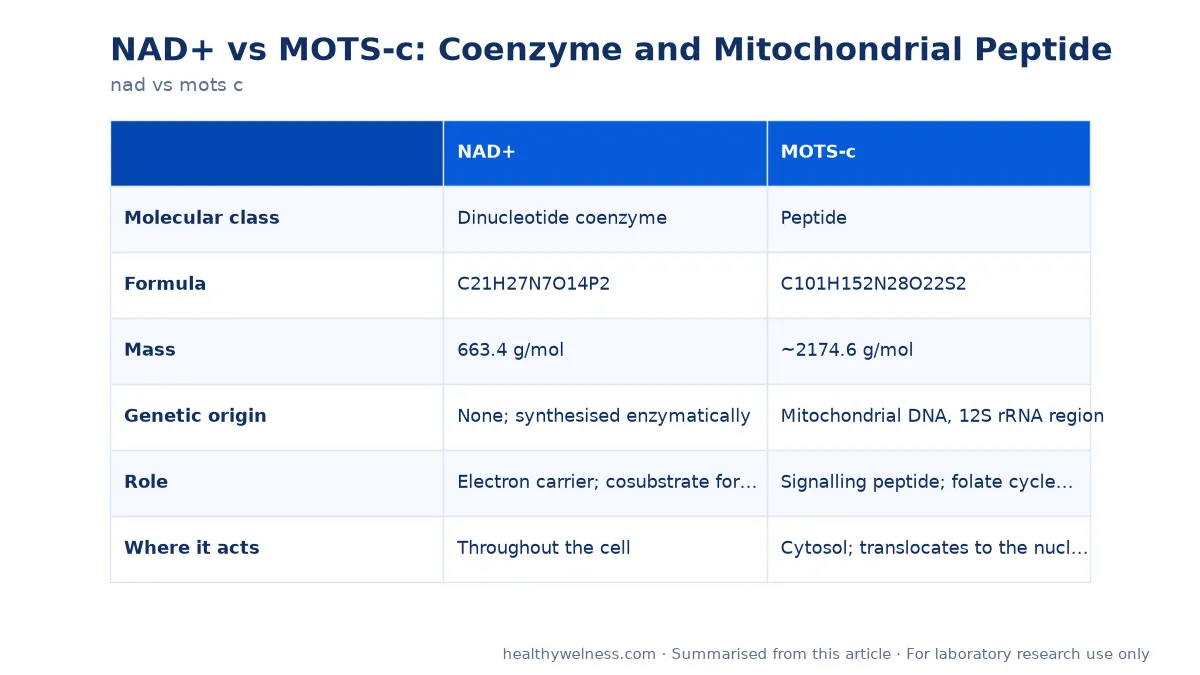
| NAD+ | MOTS-c | |
|---|---|---|
| Molecular class | Dinucleotide coenzyme | Peptide |
| Formula | C21H27N7O14P2 | C101H152N28O22S2 |
| Mass | 663.4 g/mol | ~2174.6 g/mol |
| Genetic origin | None; synthesised enzymatically | Mitochondrial DNA, 12S rRNA region |
| Role | Electron carrier; cosubstrate for sirtuins, PARPs, CD38 | Signalling peptide; folate cycle inhibition, AMPK activation |
| Where it acts | Throughout the cell | Cytosol; translocates to the nucleus under stress |
Products: NAD+ and MOTS-c. Profiles: NAD+ and MOTS-c.
Two kinds of mitochondrial connection
NAD+ is central to mitochondrial energy metabolism as the carrier that shuttles electrons into the respiratory chain. It is not made by mitochondria or encoded anywhere; it is synthesised through salvage and de novo pathways and consumed by sirtuins, PARPs and CD38 (Covarrubias et al., 2021).
MOTS-c’s connection is genetic. Mitochondria carry their own small genome, and MOTS-c is translated from a short open reading frame within the 12S rRNA gene. The discovery followed from humanin, an earlier mitochondria-encoded peptide, and suggested that mitochondria actively signal to the rest of the cell using peptides of their own (Lee et al., 2015).
Where the two could meet
Both intersect with cellular energy sensing, which is the closest thing to common ground. MOTS-c’s described cellular actions inhibit the folate cycle and the de novo purine biosynthesis tethered to it, leading to AMPK activation. AMPK and the NAD+-dependent sirtuins are both energy-state sensors, and the literature on each discusses the other. But the link is conceptual rather than demonstrated for these two specific agents, and we found no study administering both.
| Shared theme | NAD+ | MOTS-c |
|---|---|---|
| Energy sensing | Via sirtuins, which require NAD+ | Via AMPK activation |
| Age-related decline | Tissue NAD+ declines across model organisms | Plasma levels described as declining with age |
| Exercise | Levels respond to food intake, exercise and time of day | Exercise induces expression in human muscle and circulation |
The exercise observation is one of the more concrete MOTS-c findings: a 2021 study reported that exercise induces endogenous MOTS-c in human skeletal muscle and in circulation, alongside improved physical performance in mice of several ages (Reynolds et al., 2021).
Complications in the human data
Neither “declines with age” claim is quite as simple as it sounds. For NAD+, reviews describe a gradual decline linked causally to several age-associated conditions, with the caveat from the authors themselves that much remains to be learnt about how NAD+ influences human health (Covarrubias et al., 2021; Rajman et al., 2018). For MOTS-c, a review describes plasma levels declining with age (Mohtashami et al., 2022), yet in people without diabetes or cardiovascular disease, plasma MOTS-c and SHLP2 were positively associated with android and liver fat (Sequeira et al., 2021). Circulating concentrations therefore track more than age, which complicates their use as a simple biomarker.
Handling: entirely different rules
| Aspect | NAD+ | MOTS-c |
|---|---|---|
| Main stability driver | Buffer and pH; Tris more stable than phosphate or HEPES | Temperature, air, light, as for any peptide |
| Oxidation concern | Redox state of the nicotinamide ring | Sulfur-containing residues |
| Aggregation | Not applicable | Possible, as for peptides generally |
| Monitoring | UV-Vis: 260 nm, and 340 nm for NADH | HPLC and MS |
| Vial sizes | 100–1000 mg | 10–40 mg |
Preparation guides: reconstituting NAD+ and how to reconstitute peptides. Concentrations: peptide reconstitution calculator.
Open questions
- Does MOTS-c-driven AMPK activation interact with NAD+-dependent sirtuin signalling?
- Why do plasma MOTS-c levels associate positively with liver fat if MOTS-c improves metabolic measures in mice?
- How much do precursor-driven increases in NAD+ reach specific tissues in humans?
Related research
Frequently asked questions
What is the difference between NAD+ and MOTS-c?
NAD+ is a nucleotide coenzyme of 663.4 g/mol that carries electrons and serves as a cosubstrate for sirtuins, PARPs and CD38. MOTS-c is a 16-amino-acid peptide encoded within mitochondrial DNA. One is a cofactor, the other a signalling peptide.
Are they both mitochondrial?
Both relate to mitochondria but differently. NAD+ is central to mitochondrial energy metabolism and is found throughout the cell. MOTS-c is encoded by mitochondrial DNA and translocates to the nucleus under stress.
Can NAD+ and MOTS-c be studied together?
Yes, and the pathways are independent enough to make that informative. We found no published study combining them.
Which declines with age?
Reviews report an age-related decline in tissue NAD+ across model organisms. MOTS-c is also described as declining with age in plasma, though human association data are more complicated.
Is MOTS-c a peptide and NAD+ not?
Correct. MOTS-c is a peptide with 16 amino acids. NAD+ contains no amino acids at all and is not a peptide, despite often being listed alongside them.
References
- Covarrubias AJ, et al. NAD(+) metabolism and its roles in cellular processes during ageing. Nat Rev Mol Cell Biol. 2021. PMID: 33353981 https://pubmed.ncbi.nlm.nih.gov/33353981/
- Verdin E. NAD+ in aging, metabolism, and neurodegeneration. Science. 2015. PMID: 26785480 https://pubmed.ncbi.nlm.nih.gov/26785480/
- Lee C, et al. The mitochondrial-derived peptide MOTS-c promotes metabolic homeostasis and reduces obesity and insulin resistance. Cell Metab. 2015. PMID: 25738459 https://pubmed.ncbi.nlm.nih.gov/25738459/
- Reynolds JC, et al. MOTS-c is an exercise-induced mitochondrial-encoded regulator of age-dependent physical decline and muscle homeostasis. Nat Commun. 2021. PMID: 33473109 https://pubmed.ncbi.nlm.nih.gov/33473109/
- Mohtashami Z, et al. MOTS-c, the Most Recent Mitochondrial Derived Peptide in Human Aging and Age-Related Diseases. Int J Mol Sci. 2022. PMID: 36233287 https://pubmed.ncbi.nlm.nih.gov/36233287/
- Sequeira IR, et al. Plasma mitochondrial derived peptides MOTS-c and SHLP2 positively associate with android and liver fat in people without diabetes. Biochim Biophys Acta Gen Subj. 2021. PMID: 34419510 https://pubmed.ncbi.nlm.nih.gov/34419510/
- Rajman L, et al. Therapeutic Potential of NAD-Boosting Molecules: The In Vivo Evidence. Cell Metab. 2018. PMID: 29514064 https://pubmed.ncbi.nlm.nih.gov/29514064/
For laboratory research use only. The research materials supplied by HealthyWelness are not approved medicines, foods or cosmetics and are not for human or veterinary use. This article summarises published research and is not medical advice.
Sources
- Covarrubias AJ, et al. NAD(+) metabolism and its roles in cellular processes during ageing. Nat Rev Mol Cell Biol. 2021. PMID: 33353981
- Verdin E. NAD+ in aging, metabolism, and neurodegeneration. Science. 2015. PMID: 26785480
- Lee C, et al. The mitochondrial-derived peptide MOTS-c promotes metabolic homeostasis and reduces obesity and insulin resistance. Cell Metab. 2015. PMID: 25738459
- Reynolds JC, et al. MOTS-c is an exercise-induced mitochondrial-encoded regulator of age-dependent physical decline and muscle homeostasis. Nat Commun. 2021. PMID: 33473109
- Mohtashami Z, et al. MOTS-c, the Most Recent Mitochondrial Derived Peptide in Human Aging and Age-Related Diseases. Int J Mol Sci. 2022. PMID: 36233287
- Sequeira IR, et al. Plasma mitochondrial derived peptides MOTS-c and SHLP2 positively associate with android and liver fat in people without diabetes. Biochim Biophys Acta Gen Subj. 2021. PMID: 34419510
- Rajman L, et al. Therapeutic Potential of NAD-Boosting Molecules: The In Vivo Evidence. Cell Metab. 2018. PMID: 29514064