Orexin A vs Orexin B: One Precursor, Two Reagents
Orexin A has two disulfide bridges and engages both receptors; orexin B has none and prefers OX2R. Why that makes them different reagents.

Cover illustration: AI-generated editorial artwork. Conceptual only; not an exact molecular structure, actual laboratory result or evidence of clinical effects.
Orexin A and orexin B are cleaved from the same precursor protein and are almost always named as a pair. As laboratory reagents they are not a pair at all. One has two disulfide bridges and engages both receptors; the other has none and prefers one. Those two differences decide which is the harder reagent and which is the cleaner probe, and they point in opposite directions.
For laboratory research use only. The research materials supplied by HealthyWelness are not approved medicines, foods or cosmetics and are not for human or veterinary use. This article summarises published research and is not medical advice.
- Orexin A is 33 residues with two intrachain disulfide bridges; orexin B is 28 residues with none.
- Both are cleaved from one precursor, prepro-orexin, so a shared origin does not imply a shared structure.
- Orexin A engages OX1R and OX2R comparably; orexin B is reported as preferring OX2R.
- Orexin A is also called hypocretin-1 and orexin B is hypocretin-2, from two independent 1998 reports.
- Four cysteines can pair three ways with identical mass, so mass spectrometry alone cannot confirm orexin A’s folding.
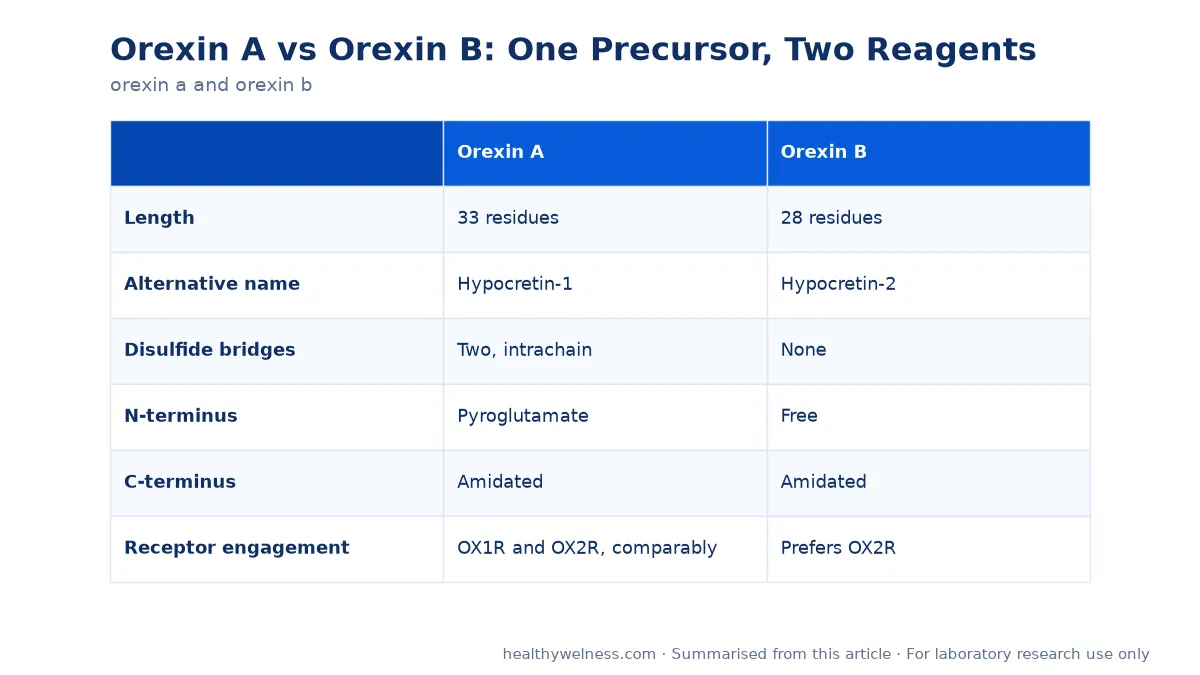
Side by side
| Orexin A | Orexin B | |
|---|---|---|
| Length | 33 residues | 28 residues |
| Alternative name | Hypocretin-1 | Hypocretin-2 |
| Disulfide bridges | Two, intrachain | None |
| N-terminus | Pyroglutamate | Free |
| C-terminus | Amidated | Amidated |
| Receptor engagement | OX1R and OX2R, comparably | Prefers OX2R |
| Identity confirmable by mass | No — isomers share mass | Largely yes |
| Proteolytic exposure at N-terminus | Blocked by pyroglutamate | Exposed |
Why do the disulfide bridges matter so much?
Because they create an ambiguity that no routine analysis resolves.
Orexin A contains four cysteines. Four cysteines can form two disulfide bonds in three different pairing arrangements, only one of which is the native fold. Critically, all three arrangements have exactly the same molecular formula and therefore the same mass. A mass spectrum returning the expected value is consistent with the correct peptide and with two incorrect ones.
What separates them is chromatographic behaviour: differently folded isomers have different shapes and different retention. So for orexin A the chromatogram is not supporting evidence, it is the primary evidence.
Orexin B sidesteps the question. With no cysteines there is one covalent arrangement, and a correct mass plus a single clean peak is strong evidence of identity. That makes orexin B the more verifiable reagent by a clear margin — a practical advantage that rarely appears in catalogue descriptions.
What does “prefers OX2R” actually license?
Less than it is often taken to. The 1998 paper by Sakurai and colleagues in Cell reported both peptides and both receptors together, and the asymmetry has been part of the field since: orexin A engages both receptors comparably, orexin B prefers OX2R.
Preference is a difference in affinity, not an absence of activity. Two cautions follow:
- At high enough concentration, OX1R engagement is not excluded. A preference narrows what you can assume; it does not guarantee a clean single-receptor result.
- Receptor expression must be established in the system. A peptide that prefers OX2R produces nothing in a preparation expressing only OX1R, and that null says nothing about the peptide.
The 2021 chapter by Sun and colleagues is the most direct source on receptor pharmacology; the 2020 review by Li and colleagues takes the circuitry view of where those receptors sit. Reading both is what makes a receptor-preference argument concrete rather than abstract.
Which is the better experimental choice?
| If the question is | Use | Why |
|---|---|---|
| Is this effect OX2R-mediated? | Orexin B | Receptor preference plus no folding ambiguity |
| Comparison with the published literature | Orexin A | Most published work uses it |
| Does receptor subtype matter here? | Both, in parallel | The contrast is the experiment |
| A reagent whose identity you can verify | Orexin B | Mass plus chromatogram is close to definitive |
| Work in a protease-containing medium | Orexin A | Pyroglutamate blocks aminopeptidase attack |
That last row is the one argument that runs the other way. Orexin A’s N-terminal pyroglutamate blocks aminopeptidases; orexin B’s free N-terminus does not. In serum-containing medium orexin B is the more exposed of the two at that end, which partly offsets its verification advantage.
Why does the two-name problem matter in practice?
Because it biases literature searches in a way that is invisible unless you know to check.
Two groups reported the system independently in 1998. One named the peptides orexins after an association with feeding; the other named them hypocretins after their hypothalamic origin. Both names survived, and they are not evenly distributed: the sleep and clinical diagnostic literature favours hypocretin, while the pharmacology literature favours orexin.
So a search for one term returns a systematically skewed slice of the field. Anyone assembling background for an experiment should run both, and should note that orexin A is hypocretin-1 and orexin B is hypocretin-2 rather than assuming the mapping. The individual profiles are in what orexin A is and what orexin B is.
Where has the field moved?
Towards non-peptide agonists, which changes what a peptide experiment should be compared against.
The 2023 review by Saitoh and colleagues in Peptides surveys synthetic orexin receptor agonists as a class, and the 2022 study by Yin and colleagues in Nature Communications describes the molecular mechanism of a non-peptide OX2R agonist.
For a laboratory the practical consequence is a better control set. A selective non-peptide OX2R agonist run alongside orexin B is informative precisely because it is chemically unrelated: if an effect appears with both, peptide-specific artefacts such as aggregation or adsorption are unlikely to explain it.
How do they differ in handling?
- Orexin A: never use a reducing agent or thiol-containing buffer component — it will attack the disulfides. Aliquot strictly on first reconstitution, since repeated freeze–thaw promotes scrambling. Request the chromatogram.
- Orexin B: no disulfide constraints, so buffer choice is freer. Still aliquot on first use, and prepare dilute solutions close to use because proteolysis at the free N-terminus is the dominant route in serum-containing medium.
- Both: store sealed, dry and dark at −20 °C; warm the vial before opening; swirl rather than vortex, since peptides of this length aggregate under shear; expect surface loss when dilute.
- Both: compute molarity from net peptide content rather than vial weight — our reconstitution calculator takes molecular weight and net mass, which differ between the two.
Our orexin A research material is supplied for laboratory research use. Certificates are available for listed products — contact us for the latest report. What a report should contain is set out in how to read a certificate of analysis.
A note on fragments
Both peptides appear in the literature alongside shorter derived forms, and a 16-mer form of hypocretin-1 has been studied in cerebrospinal fluid for diagnostic measurement. A report naming a residue range rather than the full peptide is describing a different molecule, so the stated length on a certificate is worth reading rather than inferring from the product name.
Scope note
This material is supplied for laboratory research use only. It is not a medicine, not a supplement, and not for human or veterinary use. The content above concerns peptide structure, receptor pharmacology and handling chemistry.
Open questions
- How complete is orexin B’s OX2R preference across the usual concentration range?
- What proportion of published orexin A work used material with verified disulfide pairing?
- Does the absence of disulfides make orexin B measurably more stable in matched conditions?
Related research
Frequently asked questions
What is the difference between orexin A and orexin B?
Three things: length, disulfide bridges and receptor preference. Orexin A is 33 residues with two intrachain disulfide bridges and engages OX1R and OX2R comparably. Orexin B is 28 residues with no disulfide bridges and is described as preferring OX2R.
Do they come from the same gene?
Yes. Both are cleaved from a single precursor, prepro-orexin. Sharing a precursor is not the same as sharing a structure, and the two mature peptides differ enough to behave as separate reagents.
Which is easier to verify analytically?
Orexin B. Orexin A’s four cysteines can pair three ways, all with identical molecular mass, so a mass spectrum cannot confirm correct folding. Orexin B has no such ambiguity, and mass plus a clean chromatogram settles its identity.
Why do both have two names?
Two groups reported the system independently in 1998. One named the peptides orexins, the other hypocretins. Orexin A is hypocretin-1 and orexin B is hypocretin-2, and searching only one term returns a biased slice of the literature.
Which should an experiment use?
Orexin B when the question concerns OX2R and a cleaner attribution is wanted. Orexin A when the comparison is with the larger body of published work, which mostly uses it. Receptor expression in the system has to be confirmed either way.
References
- Sakurai T, et al. Orexins and orexin receptors: a family of hypothalamic neuropeptides and G protein-coupled receptors that regulate feeding behavior. Cell. 1998. PMID: 9491897 https://pubmed.ncbi.nlm.nih.gov/9491897/
- Li SB, et al. The hypocretin (orexin) system: from a neural circuitry perspective. Neuropharmacology. 2020. PMID: 32135427 https://pubmed.ncbi.nlm.nih.gov/32135427/
- Sun Y, et al. Hypocretin/Orexin Receptor Pharmacology and Sleep Phases. Front Neurol Neurosci. 2021. PMID: 34052813 https://pubmed.ncbi.nlm.nih.gov/34052813/
- Saitoh T, et al. The present and future of synthetic orexin receptor agonists. Peptides. 2023. PMID: 37422012 https://pubmed.ncbi.nlm.nih.gov/37422012/
- Yin J, et al. Molecular mechanism of the wake-promoting agent TAK-925. Nat Commun. 2022. PMID: 35614071 https://pubmed.ncbi.nlm.nih.gov/35614071/
For laboratory research use only. The research materials supplied by HealthyWelness are not approved medicines, foods or cosmetics and are not for human or veterinary use. This article summarises published research and is not medical advice.
Sources
- Sakurai T, et al. Orexins and orexin receptors: a family of hypothalamic neuropeptides and G protein-coupled receptors that regulate feeding behavior. Cell. 1998. PMID: 9491897
- Li SB, et al. The hypocretin (orexin) system: from a neural circuitry perspective. Neuropharmacology. 2020. PMID: 32135427
- Sun Y, et al. Hypocretin/Orexin Receptor Pharmacology and Sleep Phases. Front Neurol Neurosci. 2021. PMID: 34052813
- Saitoh T, et al. The present and future of synthetic orexin receptor agonists. Peptides. 2023. PMID: 37422012
- Yin J, et al. Molecular mechanism of the wake-promoting agent TAK-925. Nat Commun. 2022. PMID: 35614071