Sermorelin vs CJC-1295: What Actually Differs
Sermorelin and CJC-1295 act at the same receptor. The difference is degradation resistance and circulating duration, not mechanism. A side-by-side comparison.

Cover illustration: AI-generated editorial artwork. Conceptual only; not an exact molecular structure, actual laboratory result or evidence of clinical effects.
Sermorelin and CJC-1295 act at the same receptor. Comparisons that frame them as competing mechanisms have the relationship wrong: CJC-1295 is what you get when you take sermorelin and solve its degradation problem. The comparison is about duration of receptor exposure, and about what that change does.
For laboratory research use only. The research materials supplied by HealthyWelness are not approved medicines, foods or cosmetics and are not for human or veterinary use. This article summarises published research and is not medical advice.
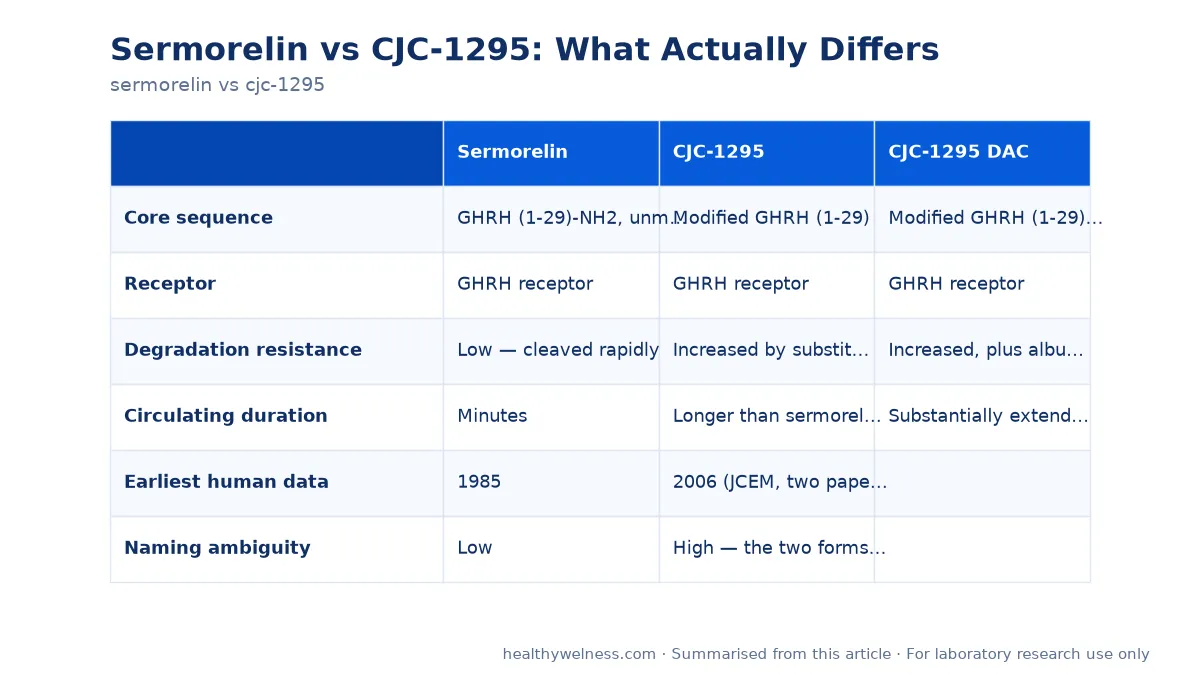
Side by side
| Sermorelin | CJC-1295 | CJC-1295 DAC | |
|---|---|---|---|
| Core sequence | GHRH (1-29)-NH2, unmodified | Modified GHRH (1-29) | Modified GHRH (1-29) + linker |
| Receptor | GHRH receptor | GHRH receptor | GHRH receptor |
| Degradation resistance | Low — cleaved rapidly | Increased by substitutions | Increased, plus albumin binding |
| Circulating duration | Minutes | Longer than sermorelin | Substantially extended |
| Earliest human data | 1985 | 2006 (JCEM, two papers) | |
| Naming ambiguity | Low | High — the two forms are frequently conflated | |
The problem CJC-1295 was built to solve
Sermorelin is GHRH (1-29)-NH2, the shortest N-terminal fragment of growth hormone-releasing hormone that retains receptor activity. Its weakness is documented: rapid cleavage in plasma, with dipeptidyl peptidase-4 acting near the N-terminus one principal route.
The engineering history is visible in the literature. Barron and colleagues in 1985 already compared GHRH (1-29)-NH2 against a D-Ala2 analogue — position 2 being exactly where DPP-4 cuts. That substitution strategy is the ancestor of every modified GHRH analogue since. CJC-1295 applies several such substitutions at once.
The DAC distinction, which is where most confusion lives
DAC stands for Drug Affinity Complex. It is a maleimide-based linker that reacts with a free cysteine thiol on serum albumin, forming a covalent bond. Because albumin circulates for weeks, the bound peptide circulates with it.
So there are two distinct materials in circulation under one name:
- With DAC: the albumin-binding version. This is the compound in the 2006 JCEM studies describing prolonged stimulation.
- Without DAC: the modified peptide alone. More degradation-resistant than sermorelin, but without the albumin anchor it does not reach the same durations.
Two practical consequences. First, when reading a study, confirm which form was used before transferring any conclusion about duration. Second, when comparing certificates of analysis, the molecular weights differ — the linker adds mass, so the stated MW is a quick way to tell the forms apart. See CJC-1295 with DAC for more on that distinction.
What changes when exposure becomes continuous
This is the genuinely interesting scientific content of the comparison, and it is more subtle than “longer is better”.
The growth hormone axis is pulsatile. Native GHRH arrives in bursts, and the pituitary response is itself episodic. A short-acting analogue such as sermorelin produces a transient stimulus that is at least broadly compatible with that pattern. An albumin-bound analogue produces something closer to continuous receptor occupancy, a different regime altogether.
The reasonable prior would be that continuous stimulation flattens pulsatility, since persistent agonism at GPCRs commonly leads to desensitisation and receptor downregulation. Ionescu and colleagues (2006) reported the opposite: pulsatile secretion persisted during continuous CJC-1295 stimulation. That result implies the pulse generator is not simply reading GHRH concentration, and that pituitary-level mechanisms shape the output. The companion paper by Teichman and colleagues reported prolonged stimulation of both GH and IGF-I.
These two papers are therefore the load-bearing human references for the whole modified-GHRH class, and both are worth reading in full rather than through secondary summaries.
Choosing between them for study design
| If the study question is | The more informative tool is | Why |
|---|---|---|
| Acute receptor response and its time course | Sermorelin | Short exposure gives a resolvable on/off signal |
| Effects of sustained receptor occupancy | CJC-1295 DAC | That is the regime the molecule creates |
| Degradation and metabolite identification | Both, in parallel | The contrast is the measurement |
| Analytical method development | Both | Detection work covers the class, as in Memdouh et al. 2021 |
Handling differences in the lab
- Both arrive lyophilized; store sealed at −20 °C, protected from light and moisture.
- The DAC form carries a reactive maleimide group. It will react with free thiols in the diluent or the sample, so avoid thiol-containing buffers — DTT and beta-mercaptoethanol among them — unless the design intends that reaction.
- Reconstitute gently down the vial wall and swirl; aliquot rather than freeze–thawing repeatedly. See storing reconstituted peptides.
- Because the two forms differ in molecular weight, recalculate concentrations per form rather than reusing a figure — our reconstitution calculator takes the MW from the certificate.
Our sermorelin research material ships with HPLC and MS data per lot.
Open questions
- What mechanism preserves pulsatility under continuous receptor stimulation?
- How does the albumin-bound fraction distribute into tissues compared with the free peptide?
- Does the linker chemistry affect receptor binding affinity measurably?
Related research
- What is sermorelin?
- CJC-1295 with DAC explained
- Tesamorelin compared with CJC-1295
Frequently asked questions
Do sermorelin and CJC-1295 work through the same receptor?
Yes. Both are GHRH analogues acting at the GHRH receptor on pituitary somatotrophs. The difference between them is pharmacokinetic rather than mechanistic.
What makes CJC-1295 longer acting?
CJC-1295 is a modified GHRH (1-29) analogue carrying amino acid substitutions that resist enzymatic cleavage. The DAC version additionally bears a reactive linker that binds covalently to serum albumin, which extends circulation substantially further.
Is CJC-1295 the same as CJC-1295 DAC?
Not necessarily, and the naming is inconsistent across sources. DAC refers to the Drug Affinity Complex, the albumin-binding linker. Material labelled CJC-1295 without DAC is usually the modified peptide without that linker, which behaves very differently. Always check which form a paper or a data sheet refers to.
Which one has more human data?
Both have published human studies. Sermorelin, as GHRH (1-29)-NH2, has human data going back to 1985. CJC-1295 has two 2006 Journal of Clinical Endocrinology and Metabolism papers in healthy adults.
Does continuous receptor stimulation abolish pulsatile secretion?
A 2006 study by Ionescu and colleagues reported that pulsatile growth hormone secretion persisted during continuous stimulation by CJC-1295, which is a notable finding given that pulsatility is a defining feature of this axis.
References
- Teichman SL, et al. Prolonged stimulation of growth hormone (GH) and insulin-like growth factor I secretion by CJC-1295, a long-acting analog of GH-releasing hormone, in healthy adults. J Clin Endocrinol Metab. 2006. PMID: 16352683 https://pubmed.ncbi.nlm.nih.gov/16352683/
- Ionescu M, et al. Pulsatile secretion of growth hormone (GH) persists during continuous stimulation by CJC-1295, a long-acting GH-releasing hormone analog. J Clin Endocrinol Metab. 2006. PMID: 17018654 https://pubmed.ncbi.nlm.nih.gov/17018654/
- Barron JL, et al. Growth hormone responses to growth hormone-releasing hormone (1-29)-NH2 and a D-Ala2 analog in normal men. Peptides. 1985. PMID: 2866496 https://pubmed.ncbi.nlm.nih.gov/2866496/
- Halmos G, et al. Growth hormone-releasing hormone receptor (GHRH-R) and its signaling. Rev Endocr Metab Disord. 2025. PMID: 39934495 https://pubmed.ncbi.nlm.nih.gov/39934495/
- Memdouh S, et al. Advances in the detection of growth hormone releasing hormone synthetic analogs. Drug Test Anal. 2021. PMID: 34665524 https://pubmed.ncbi.nlm.nih.gov/34665524/
For laboratory research use only. The research materials supplied by HealthyWelness are not approved medicines, foods or cosmetics and are not for human or veterinary use. This article summarises published research and is not medical advice.
Sources
- Teichman SL, et al. Prolonged stimulation of growth hormone (GH) and insulin-like growth factor I secretion by CJC-1295, a long-acting analog of GH-releasing hormone, in healthy adults. J Clin Endocrinol Metab. 2006. PMID: 16352683
- Ionescu M, et al. Pulsatile secretion of growth hormone (GH) persists during continuous stimulation by CJC-1295, a long-acting GH-releasing hormone analog. J Clin Endocrinol Metab. 2006. PMID: 17018654
- Barron JL, et al. Growth hormone responses to growth hormone-releasing hormone (1-29)-NH2 and a D-Ala2 analog in normal men. Peptides. 1985. PMID: 2866496
- Halmos G, et al. Growth hormone-releasing hormone receptor (GHRH-R) and its signaling. Rev Endocr Metab Disord. 2025. PMID: 39934495
- Memdouh S, et al. Advances in the detection of growth hormone releasing hormone synthetic analogs. Drug Test Anal. 2021. PMID: 34665524