Sermorelin vs HGH: Secretagogue or Direct Replacement
Sermorelin stimulates an axis; somatropin replaces its product. The difference in pulsatility, feedback and regulatory status, for research context.

Cover illustration: AI-generated editorial artwork. Conceptual only; not an exact molecular structure, actual laboratory result or evidence of clinical effects.
The distinction here is the clearest in endocrine pharmacology: stimulate the gland, or supply the product. Sermorelin does the first, somatropin the second. Everything else that differs between them — pulsatility, feedback, molecular size, regulatory status — follows from that one choice.
For laboratory research use only. The research materials supplied by HealthyWelness are not approved medicines, foods or cosmetics and are not for human or veterinary use. This article summarises published research and is not medical advice.
A note on scope before anything else. Recombinant growth hormone is a prescription-class product and is not offered here. What follows is mechanistic context for researchers working with secretagogues, not a product comparison.
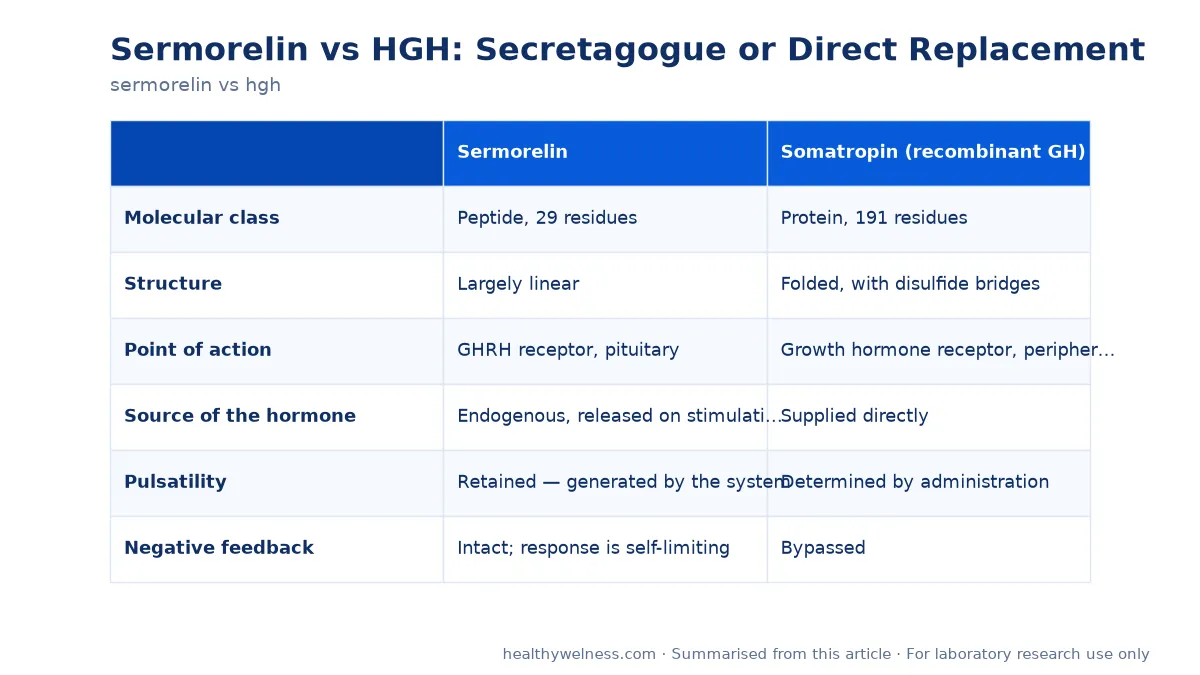
Side by side
| Sermorelin | Somatropin (recombinant GH) | |
|---|---|---|
| Molecular class | Peptide, 29 residues | Protein, 191 residues |
| Structure | Largely linear | Folded, with disulfide bridges |
| Point of action | GHRH receptor, pituitary | Growth hormone receptor, peripheral tissue |
| Source of the hormone | Endogenous, released on stimulation | Supplied directly |
| Pulsatility | Retained — generated by the system | Determined by administration |
| Negative feedback | Intact; response is self-limiting | Bypassed |
| Ceiling on response | Pituitary capacity | Amount supplied |
| Offered as research material | Yes | No — prescription class |
Pulsatility is a signal, not a side effect
Growth hormone is released in pulses, and the pattern carries information: downstream responses depend on the temporal profile and not only on the integrated amount. This is the same principle that governs GnRH signalling, where intermittent and continuous receptor engagement produce opposite outcomes — discussed in what gonadorelin is.
A secretagogue acts on the mechanism that produces pulses. Direct supply of the hormone replaces that mechanism with whatever profile the administration produces.
There is a genuinely interesting published result on this. The 2006 study by Ionescu and colleagues in the Journal of Clinical Endocrinology and Metabolism found that pulsatile secretion persisted during continuous stimulation by a long-acting GHRH analogue. In other words, continuous input to the top of the axis did not flatten the output: the pulse generator kept working. The companion study by Teichman and colleagues characterised the prolonged stimulation itself.
That finding is the strongest available argument that the two approaches are not equivalent. A secretagogue, even a long-acting one, delivers a patterned output because the system patterns it. Supplying the hormone does not.
Feedback, and the experimental consequence
An intact axis has negative feedback: downstream products restrain further release. A secretagogue operates inside that loop, so the response is self-limiting and the ceiling is set by pituitary capacity.
Direct supply of the hormone sits outside the loop. The amount present is the amount supplied, and the system’s own regulation does not modulate it.
For experimental design, this produces a straightforward decision rule:
- Studying regulation? The secretagogue keeps the regulation in the experiment.
- Studying the growth hormone receptor or something downstream of it? Direct supply removes variability contributed by the upstream steps — which is why that approach is used where it is permitted.
- Comparing the two? Expect different downstream signatures even at matched integrated exposure, because the temporal profiles differ.
The 1985 study by Barron and colleagues and the 1997 study by Khorram and colleagues are both examples of the first kind of work: stimulate at the top, measure further down, with the intervening steps intact.
Why the size difference is more than a number
Twenty-nine residues versus 191 is a difference in kind. A 191-residue folded protein with disulfide bridges is handled as a protein: gentle reconstitution, no vortexing, carrier protein at low concentrations, minimal freeze–thaw, and the knowledge that denaturation destroys activity without changing the mass.
The 1992 study by Pikal and colleagues is directly on point here, examining freeze-dried human growth hormone formulations and finding stability governed by moisture and oxygen content. It is a useful reminder that the larger molecule is the more fragile one in storage despite being the more biologically potent.
Sermorelin’s own handling is less demanding but not trivial: methionine and tryptophan make it oxidation-sensitive and asparagine makes it prone to deamidation, across 29 residues. The practice is set out in sermorelin reconstitution and storage, and concentration maths should run from net peptide content, which our reconstitution calculator takes as an input.
What the comparison cannot tell you
Being explicit about the limits:
- It is not a potency comparison. The two act at different receptors at different points in a pathway.
- It is not an efficacy comparison. Nothing in the mechanistic contrast above speaks to outcomes, and this article makes no such claim.
- It does not transfer across species. Pituitary capacity and axis regulation differ, and a secretagogue depends on both.
Our sermorelin acetate research material is supplied for laboratory research use. Certificates are available for listed products — contact us for the latest report.
Scope note
This material is supplied for laboratory research use only. It is not a medicine and is not for human or veterinary use. Recombinant growth hormone is discussed here as mechanistic context and is not offered.
Open questions
- How much of the downstream difference between the two approaches is attributable to pulsatility alone?
- What sets the ceiling on secretagogue-stimulated release in a given model?
- Can pulse pattern be reproduced closely enough with direct supply to isolate the variable?
Related research
- What is sermorelin?
- Tesamorelin compared with growth hormone
- IGF-1 LR3 compared with sermorelin
Frequently asked questions
What is the basic difference between sermorelin and somatropin?
Sermorelin is a GHRH fragment that acts on the pituitary to stimulate release of endogenous growth hormone. Somatropin is recombinant human growth hormone itself. One stimulates a step in an axis; the other supplies the axis product directly.
Why is pulsatility part of the comparison?
Because growth hormone is released in pulses rather than continuously, and that pattern is part of the signal. A secretagogue acts on the mechanism that generates pulses; supplying the hormone directly imposes a profile set by administration instead.
Is somatropin a peptide?
It is a protein: 191 amino acids, with disulfide bridges and a defined fold. Sermorelin is a 29-residue peptide. The two differ in size by a factor of more than six and require entirely different handling.
Is somatropin available as a research reagent here?
No. Recombinant growth hormone is a prescription-class product and is not offered. The comparison in this article is mechanistic context for researchers working with secretagogues, not a product comparison.
Does feedback regulation differ between them?
Yes, and it is the most important experimental difference. A secretagogue acts within a system that retains its negative feedback, so the response is self-limiting. Direct supply of the hormone bypasses that constraint.
References
- Barron JL, et al. Growth hormone responses to growth hormone-releasing hormone (1-29)-NH2 and a D-Ala2 analog in normal men. Peptides. 1985. PMID: 2866496 https://pubmed.ncbi.nlm.nih.gov/2866496/
- Khorram O, et al. Effects of [norleucine27]growth hormone-releasing hormone (GHRH) (1-29)-NH2 administration on the immune system of aging men and women. J Clin Endocrinol Metab. 1997. PMID: 9360512 https://pubmed.ncbi.nlm.nih.gov/9360512/
- Ionescu M, et al. Pulsatile secretion of growth hormone (GH) persists during continuous stimulation by CJC-1295, a long-acting GH-releasing hormone analog. J Clin Endocrinol Metab. 2006. PMID: 17018654 https://pubmed.ncbi.nlm.nih.gov/17018654/
- Teichman SL, et al. Prolonged stimulation of growth hormone (GH) and insulin-like growth factor I secretion by CJC-1295, a long-acting analog of GH-releasing hormone, in healthy adults. J Clin Endocrinol Metab. 2006. PMID: 16352683 https://pubmed.ncbi.nlm.nih.gov/16352683/
- Pikal MJ, et al. Formulation and stability of freeze-dried proteins: effects of moisture and oxygen on the stability of freeze-dried formulations of human growth hormone. Dev Biol Stand. 1992. PMID: 1592171 https://pubmed.ncbi.nlm.nih.gov/1592171/
For laboratory research use only. The research materials supplied by HealthyWelness are not approved medicines, foods or cosmetics and are not for human or veterinary use. This article summarises published research and is not medical advice.
Sources
- Barron JL, et al. Growth hormone responses to growth hormone-releasing hormone (1-29)-NH2 and a D-Ala2 analog in normal men. Peptides. 1985. PMID: 2866496
- Khorram O, et al. Effects of [norleucine27]growth hormone-releasing hormone (GHRH) (1-29)-NH2 administration on the immune system of aging men and women. J Clin Endocrinol Metab. 1997. PMID: 9360512
- Ionescu M, et al. Pulsatile secretion of growth hormone (GH) persists during continuous stimulation by CJC-1295, a long-acting GH-releasing hormone analog. J Clin Endocrinol Metab. 2006. PMID: 17018654
- Teichman SL, et al. Prolonged stimulation of growth hormone (GH) and insulin-like growth factor I secretion by CJC-1295, a long-acting analog of GH-releasing hormone, in healthy adults. J Clin Endocrinol Metab. 2006. PMID: 16352683
- Pikal MJ, et al. Formulation and stability of freeze-dried proteins: effects of moisture and oxygen on the stability of freeze-dried formulations of human growth hormone. Dev Biol Stand. 1992. PMID: 1592171