SS-31 vs MOTS-c: Targeting Mitochondria Two Ways
SS-31 accumulates in mitochondria and binds cardiolipin; MOTS-c is encoded by mitochondrial DNA. Opposite relationships to the same organelle.


Cover illustration: AI-generated editorial artwork. Conceptual only; not an exact molecular structure, actual laboratory result or evidence of clinical effects.
Both peptides are filed under mitochondrial research, and their relationships to the organelle are opposites. SS-31 is a synthetic peptide that travels into mitochondria and acts on a membrane lipid there. MOTS-c is encoded by mitochondrial DNA and acts outside the organelle that made it. One goes in; the other comes out.
For laboratory research use only. The research materials supplied by HealthyWelness are not approved medicines, foods or cosmetics and are not for human or veterinary use. This article summarises published research and is not medical advice.
- SS-31, also called elamipretide, accumulates in mitochondria through a motif of alternating aromatic and cationic residues.
- Cardiolipin, a lipid of the mitochondrial inner membrane, is described in the literature as SS-31’s binding target (Szeto, Br J Pharmacol 2014, PMID 24117165).
- A 2020 PNAS study mapped the mitochondrial protein interaction landscape of SS-31 (Chavez et al., PMID 32554501).
- MOTS-c is a 16-residue peptide encoded within the mitochondrial genome rather than in nuclear DNA.
- MOTS-c has no established proximal receptor, although AMPK-linked signalling is repeatedly implicated.
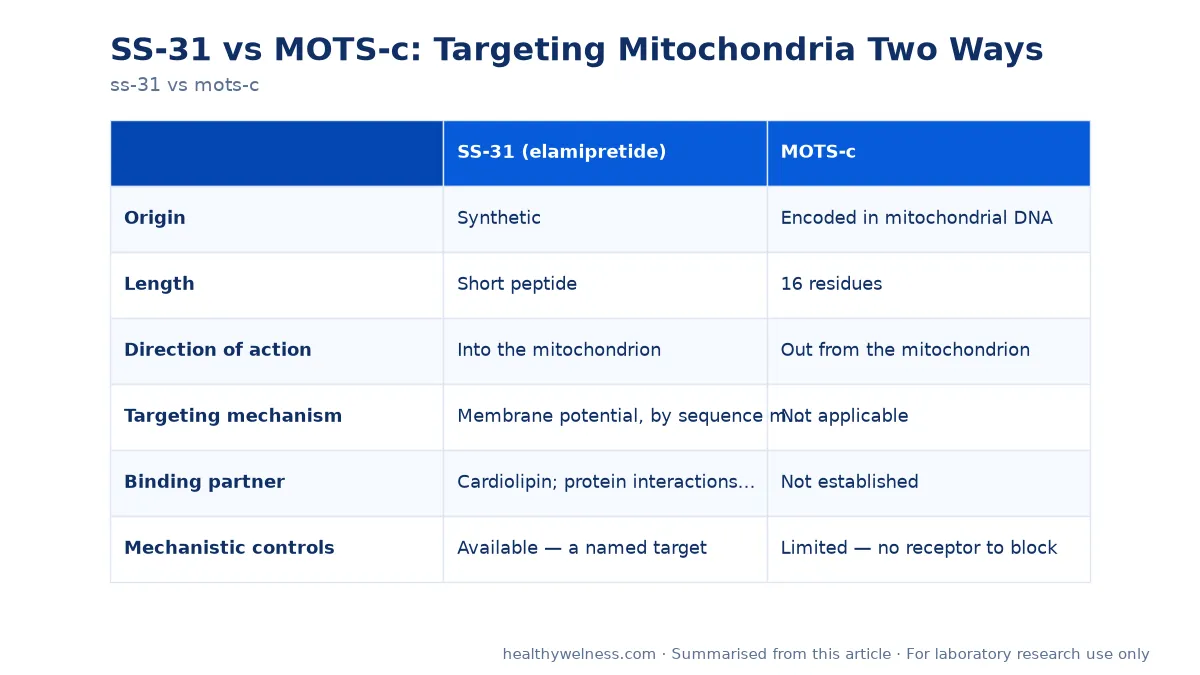
Side by side
| SS-31 (elamipretide) | MOTS-c | |
|---|---|---|
| Origin | Synthetic | Encoded in mitochondrial DNA |
| Length | Short peptide | 16 residues |
| Direction of action | Into the mitochondrion | Out from the mitochondrion |
| Targeting mechanism | Membrane potential, by sequence motif | Not applicable |
| Binding partner | Cardiolipin; protein interactions mapped | Not established |
| Mechanistic controls | Available — a named target | Limited — no receptor to block |
| Charge | Cationic | Short peptide, aqueous |
How does SS-31 find mitochondria without a targeting group?
By being built from residues that do it. The motif — aromatic and cationic residues alternating along a short chain — accumulates in mitochondria because the inner membrane maintains a negative potential that draws cationic species inward.
Two consequences follow that are easy to overlook when reading the literature:
- Accumulation depends on membrane potential. In cells where that potential has collapsed, accumulation falls. The compound reaches healthy mitochondria more readily than fully compromised ones, which matters when an injury model’s severity varies between arms.
- Cationic amphipathic peptides interact with membranes generally. Not every effect is necessarily mitochondrial, and controls distinguishing targeted accumulation from general membrane interaction are not always reported.
The 2025 review by Tung and colleagues in the International Journal of Molecular Sciences covers structure and mechanism together and is the right single entry point.
What does having a named target change?
This is the sharpest difference between the two, and it is methodological rather than biological.
SS-31 has cardiolipin. The 2014 paper by Szeto in the British Journal of Pharmacology frames the compound as cardiolipin-protective, and the 2020 study by Chavez and colleagues went further by mapping its protein interaction landscape inside mitochondria. A named target and a mapped interaction set give an experiment somewhere to look.
MOTS-c does not have one. The 2016 review by Lee and colleagues and the 2023 review by Zheng and colleagues document downstream effects in detail, and AMPK-linked signalling appears repeatedly, but the proximal binding partner is unidentified.
| Experimental resource | SS-31 | MOTS-c |
|---|---|---|
| Named molecular target | Yes | No |
| Antagonist or competitor | Not straightforward for a lipid | None |
| Interaction map published | Yes, 2020 | No |
| Scrambled-sequence control | Useful | Essential |
| Readout that reports engagement | Membrane and bioenergetic measures | Downstream signalling only |
The scrambled-control row is the practical takeaway. Without a receptor to block, a scrambled-sequence peptide of identical composition is close to the only way to argue that a MOTS-c result depends on the sequence rather than on the presence of a short cationic peptide.
Why the provenance of MOTS-c is more than trivia
Almost every signalling peptide in a research catalogue is encoded in nuclear DNA. MOTS-c is encoded within the mitochondrial genome — a small, separate, maternally inherited genome that mostly codes for components of the respiratory chain.
A signalling peptide emerging from that genome implies the organelle communicates outward about its own state. That framing is what makes MOTS-c interesting to mitochondrial biologists and what explains why its literature sits alongside exercise physiology and metabolic regulation rather than alongside receptor pharmacology.
It also sets a limit on the comparison with SS-31: a reagent designed to protect mitochondria and a molecule mitochondria use to report on themselves are not two versions of one idea.
What can a side-by-side experiment show?
- Whether both move a shared mitochondrial readout — respiration, membrane potential, a bioenergetic measure. Legitimate and useful.
- Not which is more potent. Potency is defined against a target, and only one of them has a defined target.
- Not a combination rationale. There is no published co-administration work for this pair that we can find.
- Molar equivalence is required, and each compound needs its own molecular weight and net content figure.
How do they differ in handling?
- SS-31: cationic, so surface loss at low working concentrations is real and material is lost to glass and plastic. Its aromatic residues make it light-sensitive, so store sealed, dry and dark. Prepare dilute solutions close to use. The renal literature and its handling notes are in the SS-31 kidney research review.
- MOTS-c: a short unmodified peptide in aqueous diluent, among the more forgiving reagents in this category. Detail in what MOTS-c is.
- Both: aliquot on first reconstitution, and compute molarity from net peptide content rather than vial weight — the correction is proportionally larger for short peptides, and our reconstitution calculator applies it.
Our SS-31 research material is supplied for laboratory research use. Certificates are available for listed products — contact us for the latest report.
What the interaction map changed for SS-31
The 2020 study by Chavez and colleagues deserves separate attention because of what it did methodologically rather than what it concluded. It mapped the compound’s mitochondrial protein interaction landscape — that is, it asked what SS-31 is near inside the organelle, rather than assuming the cardiolipin interaction explains everything downstream of it.
For a research peptide that is an unusual level of evidence, and it has two practical consequences:
- It gives an experiment somewhere specific to look. A named set of interacting proteins is a list of candidate readouts, which is more actionable than a general statement about membrane protection.
- It constrains over-interpretation. A mapped interaction set is also a boundary: proteins outside it are less likely to be directly involved, so an effect on one of them probably runs through several steps.
MOTS-c has no equivalent. That is not a criticism of the MOTS-c literature, which is larger and spans more models; it is a statement about what kind of question each compound is currently equipped to answer. SS-31 is the better tool for asking how, and MOTS-c is the better tool for asking whether.
One shared caution about short cationic peptides
SS-31 is cationic, and a short cationic peptide behaves in ways that are easy to mistake for pharmacology. Three in particular are worth controlling for in any experiment that compares it against another compound:
- Surface loss. Cationic peptides bind negatively charged glass and plastic, so a dilute working solution can be meaningfully below its nominal concentration before it reaches the cells.
- General membrane interaction. Amphipathic cationic peptides interact with membranes as a class, which is a different thing from targeted accumulation and is not always separated from it in published work.
- Concentration-dependent artefacts. Effects that appear only at the top of a concentration series deserve a second look, because that is where non-specific membrane interaction becomes most likely.
None of these applies in the same way to MOTS-c, which is why a side-by-side experiment needs its controls chosen per arm rather than shared.
Scope note
This material is supplied for laboratory research use only. It is not a medicine, not a supplement, and not for human or veterinary use. The work described above is in cells and animal models.
Open questions
- How much SS-31 accumulates in mitochondria whose membrane potential has collapsed?
- What is MOTS-c’s proximal receptor or binding partner?
- Do the two converge on any shared bioenergetic readout under matched conditions?
Related research
Frequently asked questions
What is the difference between SS-31 and MOTS-c?
Their relationship to the mitochondrion. SS-31 is a synthetic peptide that accumulates inside mitochondria and interacts with the membrane lipid cardiolipin. MOTS-c is encoded by mitochondrial DNA itself and acts as a signalling peptide outside the organelle that produced it.
How does SS-31 reach mitochondria?
Through its sequence. It has alternating aromatic and cationic residues, a motif that accumulates in mitochondria driven by the membrane potential. No attached targeting group is required; the targeting is a property of the peptide itself.
Does SS-31 have an identified binding partner?
Yes, more than most research peptides. Published work describes cardiolipin, a mitochondrial inner membrane lipid, as its binding target, and a 2020 PNAS study mapped its mitochondrial protein interaction landscape.
Does MOTS-c have an identified receptor?
No. Its downstream effects are well documented and AMPK-linked signalling is repeatedly implicated, but no proximal receptor or binding partner has been established.
Can they be used in the same experiment?
Yes, on a shared mitochondrial readout, and the contrast is informative because one acts on the organelle and the other is a product of it. What such a comparison cannot do is rank their potency, since the targets differ.
References
- Tung C, et al. Elamipretide: A Review of Its Structure, Mechanism of Action, and Therapeutic Potential. Int J Mol Sci. 2025. PMID: 39940712 https://pubmed.ncbi.nlm.nih.gov/39940712/
- Chavez JD, et al. Mitochondrial protein interaction landscape of SS-31. Proc Natl Acad Sci U S A. 2020. PMID: 32554501 https://pubmed.ncbi.nlm.nih.gov/32554501/
- Szeto HH. First-in-class cardiolipin-protective compound as a therapeutic agent to restore mitochondrial bioenergetics. Br J Pharmacol. 2014. PMID: 24117165 https://pubmed.ncbi.nlm.nih.gov/24117165/
- Lee C, et al. MOTS-c: A novel mitochondrial-derived peptide regulating muscle and fat metabolism. Free Radic Biol Med. 2016. PMID: 27216708 https://pubmed.ncbi.nlm.nih.gov/27216708/
- Zheng Y, et al. MOTS-c: A promising mitochondrial-derived peptide for therapeutic exploitation. Front Endocrinol (Lausanne). 2023. PMID: 36761202 https://pubmed.ncbi.nlm.nih.gov/36761202/
For laboratory research use only. The research materials supplied by HealthyWelness are not approved medicines, foods or cosmetics and are not for human or veterinary use. This article summarises published research and is not medical advice.
Sources
- Tung C, et al. Elamipretide: A Review of Its Structure, Mechanism of Action, and Therapeutic Potential. Int J Mol Sci. 2025. PMID: 39940712
- Chavez JD, et al. Mitochondrial protein interaction landscape of SS-31. Proc Natl Acad Sci U S A. 2020. PMID: 32554501
- Szeto HH. First-in-class cardiolipin-protective compound as a therapeutic agent to restore mitochondrial bioenergetics. Br J Pharmacol. 2014. PMID: 24117165
- Lee C, et al. MOTS-c: A novel mitochondrial-derived peptide regulating muscle and fat metabolism. Free Radic Biol Med. 2016. PMID: 27216708
- Zheng Y, et al. MOTS-c: A promising mitochondrial-derived peptide for therapeutic exploitation. Front Endocrinol (Lausanne). 2023. PMID: 36761202