Thymalin vs Thymulin: Two Different Compounds
Thymalin is a Russian thymic peptide preparation; thymulin is a defined zinc-dependent nonapeptide. Similar names, unrelated chemistry.

Cover illustration: AI-generated editorial artwork. Conceptual only; not an exact molecular structure, actual laboratory result or evidence of clinical effects.
Two letters separate these names and very little else connects the compounds. One is a defined nonapeptide that does not work without a bound zinc ion; the other is a peptide preparation from a different research tradition, described through its constituent fragments. Anyone searching for one will find papers about the other, and the two literatures do not transfer.
For laboratory research use only. The research materials supplied by HealthyWelness are not approved medicines, foods or cosmetics and are not for human or veterinary use. This article summarises published research and is not medical advice.
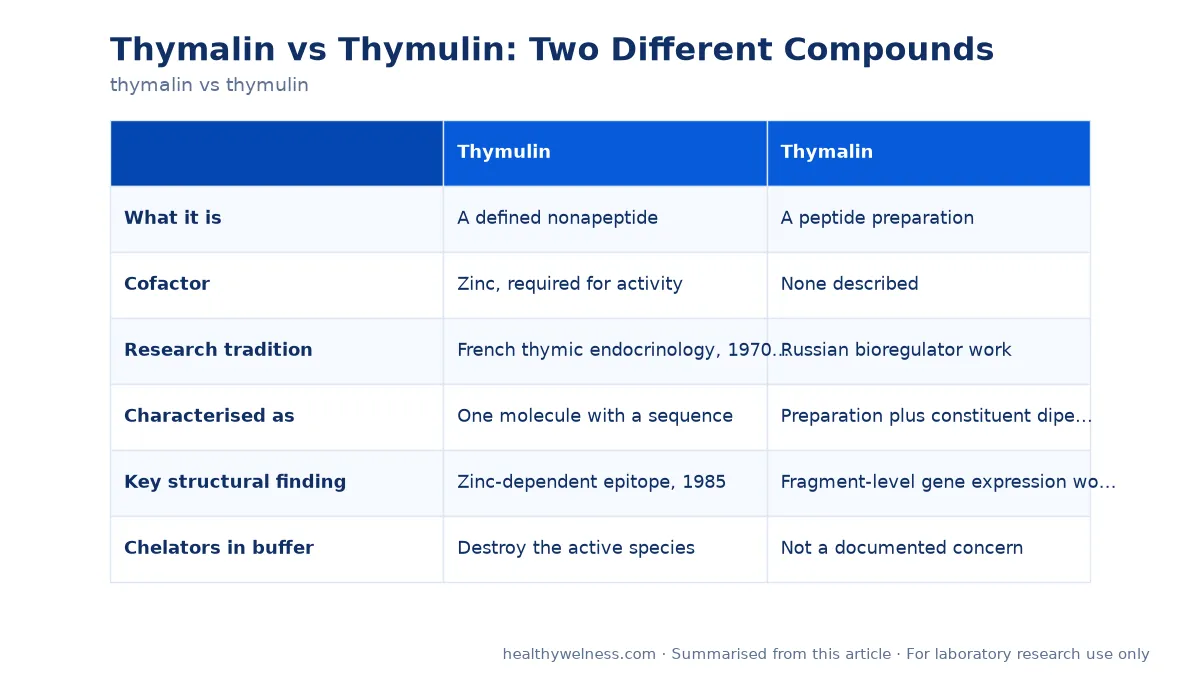
Side by side
| Thymulin | Thymalin | |
|---|---|---|
| What it is | A defined nonapeptide | A peptide preparation |
| Cofactor | Zinc, required for activity | None described |
| Research tradition | French thymic endocrinology, 1970s–90s | Russian bioregulator work |
| Characterised as | One molecule with a sequence | Preparation plus constituent dipeptides |
| Key structural finding | Zinc-dependent epitope, 1985 | Fragment-level gene expression work |
| Chelators in buffer | Destroy the active species | Not a documented concern |
Thymulin: a cofactor that is part of the molecule
The 1985 PNAS paper by Dardenne and colleagues is the finding that defines this compound. It identified a zinc-dependent epitope on thymulin — that is, the shape recognised by antibodies exists only when zinc is bound.
That is a stronger statement than “zinc helps”. It means the apo-peptide and the zinc complex are different entities as far as recognition is concerned. The 1989 review by Bach and colleagues, titled simply “Thymulin, a zinc-dependent hormone”, places that finding in its wider context, and the 1995 study by Saha and colleagues examined the relationship from the other direction, reporting that zinc induces thymulin secretion from human thymic epithelial cells.
The experimental consequence is specific and easy to get backwards. Peptide handling guidance generally says keep trace metals out of solutions, because metal ions catalyse oxidation at histidine and tryptophan. For thymulin, removing the metal removes the compound. A chelating buffer component does not merely risk degradation; it converts the active species into something else.
This is the same structural logic as GHK-Cu, where the copper is part of the defined complex rather than an additive — see the peptide versus metal complex comparison. Metallopeptides are a small category with its own rules.
Thymalin: a preparation, characterised through its fragments
Thymalin belongs to the Russian bioregulator tradition, where thymic and other tissue-derived peptide preparations have been studied for several decades. The 2020 study by Khavinson and colleagues in Bulletin of Experimental Biology and Medicine examined effects on differentiation of human haematopoietic stem cells.
The 2023 study by Linkova and colleagues is the more informative one for understanding what thymalin is. It addresses the influence of constituent dipeptides — KE and EW — on gene expression and protein synthesis. That design tells you something important: the preparation is being understood by asking what its short peptide components do.
This is a legitimate approach and a less precise one than working with a single defined molecule. For experimental purposes it means:
- Batch composition is a variable. A preparation characterised through its fragments can differ between batches in ways a single-sequence peptide cannot.
- Attribution is harder. An effect of the preparation is not necessarily an effect of any one component.
- Dipeptide controls are informative. If the fragments carry activity, testing them individually is a reasonable way to decompose the result.
The wider family is covered in Russian bioregulator peptides.
Why the two literatures do not transfer
The 1998 review by Hadden on thymic endocrinology is a useful place to see both strands discussed in one frame. Reading it makes the practical point obvious: these compounds were developed in different places, characterised by different methods, and published in different journals.
| If you are looking for | Search for |
|---|---|
| A defined sequence and a cofactor requirement | Thymulin, and “zinc-dependent” |
| Preparation-level and dipeptide work | Thymalin, Khavinson |
| A different compound again | Thymosin alpha-1, which is neither of these |
That third row is worth stating because the names converge further. Thymosin alpha-1 is a separate, N-terminally acetylated 28-residue peptide with its own clinical literature — see the thymosin alpha-1 research review. Three similar names, three different compounds.
Handling
- Store sealed, dry and dark at −20 °C; warm the vial before opening.
- For a zinc-dependent peptide, read the buffer composition before use. EDTA and similar chelators are incompatible, which inverts the usual advice.
- Aliquot on first reconstitution and record the diluent. See storing reconstituted peptides.
- For a preparation rather than a single molecule, keep a retained sample of a batch that performed as expected, so a new batch can be compared against it.
- Compute molarity from net peptide content where a defined sequence exists; our reconstitution calculator takes molecular weight and net mass as inputs.
Our Thymalin research material is supplied for laboratory research use. Certificates are available for listed products — contact us for the latest report.
Scope note
This material is supplied for laboratory research use only. It is not a medicine, not a supplement, and not for human or veterinary use.
Open questions
- How much does thymalin’s composition vary between batches?
- Does thymulin without zinc retain any measurable activity?
- Have the fragment-level findings been reproduced outside the originating group?
Related research
- Russian bioregulator peptides
- What is thymosin alpha-1?
- Thymosin fragments compared
Frequently asked questions
Are thymalin and thymulin the same thing?
No. The names differ by two letters and the compounds differ by almost everything. Thymulin is a defined nonapeptide whose activity depends on a bound zinc ion. Thymalin is a peptide preparation from the Russian bioregulator tradition, characterised at the level of its constituent short peptides rather than as a single molecule.
What makes thymulin zinc-dependent?
The zinc ion is part of the active species, not an additive. Published work from the 1980s identified a zinc-dependent epitope on the molecule, meaning the conformation that antibodies and receptors recognise exists only when zinc is bound. Remove the zinc and the biological identity changes.
What is thymalin characterised as?
As a preparation. Recent work describes the influence of its constituent dipeptides, such as KE and EW, on gene expression, which is a different kind of characterisation from a single defined molecule with a known sequence.
Does the zinc dependence affect laboratory handling?
Considerably. A chelating agent such as EDTA in a buffer will strip zinc from thymulin, and a preparation without zinc is not the active species. This is the opposite of the usual advice to keep metals out of peptide solutions.
Which has the better-defined chemistry?
Thymulin. It has a known sequence, a known cofactor and structural work from the 1980s. Thymalin’s literature describes a preparation and its fragments, which is a legitimate approach but a less precise one.
References
- Bach JF, et al. Thymulin, a zinc-dependent hormone. Med Oncol Tumor Pharmacother. 1989. PMID: 2657247 https://pubmed.ncbi.nlm.nih.gov/2657247/
- Dardenne M, et al. A zinc-dependent epitope on the molecule of thymulin, a thymic hormone. Proc Natl Acad Sci U S A. 1985. PMID: 2413455 https://pubmed.ncbi.nlm.nih.gov/2413455/
- Saha AR, et al. Zinc induces thymulin secretion from human thymic epithelial cells in vitro and augments splenocyte and thymocyte responses in vivo. Int J Immunopharmacol. 1995. PMID: 8582784 https://pubmed.ncbi.nlm.nih.gov/8582784/
- Hadden JW. Thymic endocrinology. Ann N Y Acad Sci. 1998. PMID: 9629262 https://pubmed.ncbi.nlm.nih.gov/9629262/
- Khavinson VK, et al. Thymalin: Activation of Differentiation of Human Hematopoietic Stem Cells. Bull Exp Biol Med. 2020. PMID: 33237528 https://pubmed.ncbi.nlm.nih.gov/33237528/
- Linkova N, et al. The Influence of KE and EW Dipeptides in the Composition of the Thymalin Drug on Gene Expression and Protein Synthesis Involved in the Pathogenesis of COVID-19. Int J Mol Sci. 2023. PMID: 37686182 https://pubmed.ncbi.nlm.nih.gov/37686182/
For laboratory research use only. The research materials supplied by HealthyWelness are not approved medicines, foods or cosmetics and are not for human or veterinary use. This article summarises published research and is not medical advice.
Sources
- Bach JF, et al. Thymulin, a zinc-dependent hormone. Med Oncol Tumor Pharmacother. 1989. PMID: 2657247
- Dardenne M, et al. A zinc-dependent epitope on the molecule of thymulin, a thymic hormone. Proc Natl Acad Sci U S A. 1985. PMID: 2413455
- Saha AR, et al. Zinc induces thymulin secretion from human thymic epithelial cells in vitro and augments splenocyte and thymocyte responses in vivo. Int J Immunopharmacol. 1995. PMID: 8582784
- Hadden JW. Thymic endocrinology. Ann N Y Acad Sci. 1998. PMID: 9629262
- Khavinson VK, et al. Thymalin: Activation of Differentiation of Human Hematopoietic Stem Cells. Bull Exp Biol Med. 2020. PMID: 33237528
- Linkova N, et al. The Influence of KE and EW Dipeptides in the Composition of the Thymalin Drug on Gene Expression and Protein Synthesis Involved in the Pathogenesis of COVID-19. Int J Mol Sci. 2023. PMID: 37686182