Selank Storage and Stability in the Laboratory
Selank is a tuftsin analogue extended with a Pro-Gly-Pro tail. What that design does for stability, and how the peptide should be stored.

Cover illustration: AI-generated editorial artwork. Conceptual only; not an exact molecular structure, actual laboratory result or evidence of clinical effects.
Selank’s structure contains a deliberate stability feature, and it is useful to be precise about what that feature does and does not protect against. The Pro-Gly-Pro tail addresses enzymatic degradation. It does nothing about moisture, oxygen or hydrolysis. Storage practice is governed by the second set of problems, not the first.
For laboratory research use only. The research materials supplied by HealthyWelness are not approved medicines, foods or cosmetics and are not for human or veterinary use. This article summarises published research and is not medical advice.
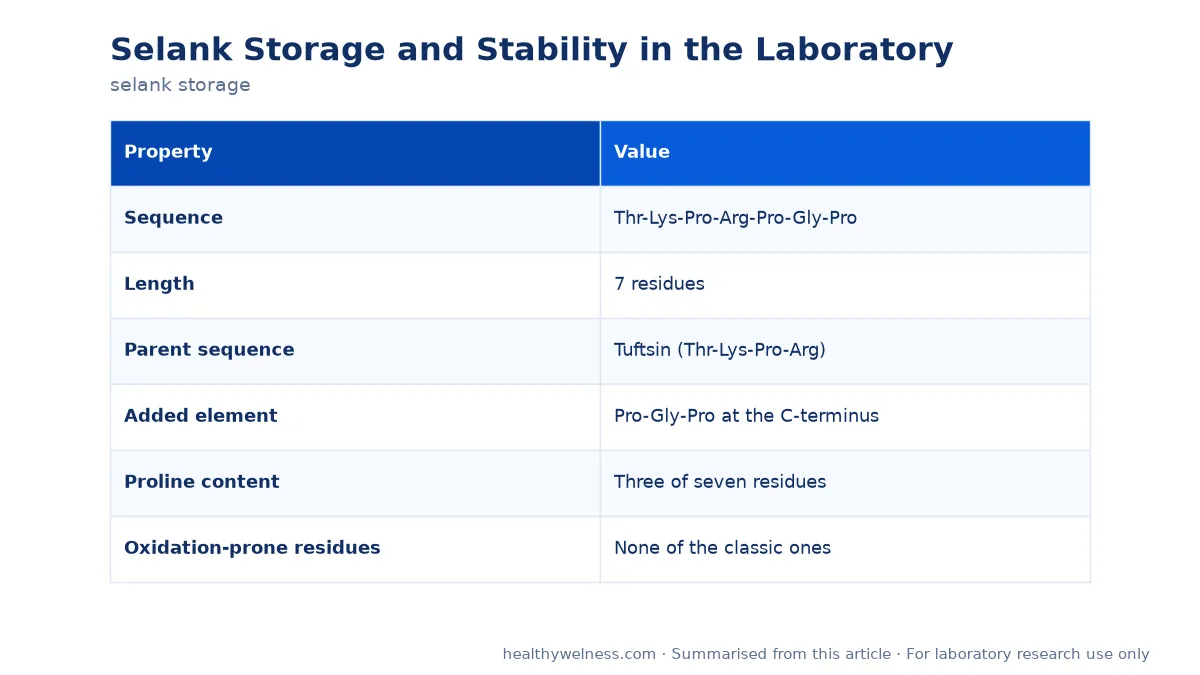
The structure and its design logic
| Property | Value |
|---|---|
| Sequence | Thr-Lys-Pro-Arg-Pro-Gly-Pro |
| Length | 7 residues |
| Parent sequence | Tuftsin (Thr-Lys-Pro-Arg) |
| Added element | Pro-Gly-Pro at the C-terminus |
| Proline content | Three of seven residues |
| Oxidation-prone residues | None of the classic ones |
| Usual salt form | Acetate |
Tuftsin is a four-residue immunomodulatory peptide. Selank is that sequence with a three-residue proline-containing tail attached. The 2003 review by Kozlovskaya and colleagues places Selank within the tuftsin family and is the right background reference for the lineage.
Proline is conformationally restrictive and many peptidases will not cleave adjacent to it, which is why proline-rich tails appear repeatedly as a stabilisation strategy. The same Pro-Gly-Pro extension appears on Semax, derived from a completely different parent sequence — evidence that the tail is a general-purpose device rather than something specific to tuftsin biology. The two peptides are compared in Semax compared with Selank.
Good news for storage, and the limits of it
Selank’s composition is favourable in one respect that genuinely matters. It contains no methionine, no tryptophan, no cysteine and no histidine — the four residues responsible for most of the chemical degradation seen in peptide reagents. Oxidation is therefore a smaller concern than for, say, a tryptophan-rich secretagogue.
What remains:
- Moisture uptake in the solid. Universal for lyophilized peptides and independent of sequence.
- Hydrolysis in solution. Slow, but not zero, and proline-containing bonds are not immune to chemistry even where they resist enzymes.
- Trace metal catalysis. Less consequential without histidine present, but still a reason to use a clean diluent. The mechanism is documented in detail by Khossravi and colleagues for model peptides.
- Surface loss when dilute. A short, charged peptide in a very dilute solution loses material to plasticware.
The moisture point is the one worth taking seriously, and the reason is subtler than “water causes degradation”. The 1999 study by Lai and colleagues separated two distinct roles water plays in a solid: it is the solvent in which degradation chemistry occurs, and it is a plasticiser that gives molecules enough mobility to react at all. A solid kept dry is protected on both counts; one that has taken up a few percent water is protected on neither.
Storage practice
| State | Condition | Note |
|---|---|---|
| Sealed lyophilized | −20 °C, desiccated, dark | The default for long-term storage |
| Before each opening | Warm the sealed vial to room temperature | Prevents condensation into the powder |
| Opened lyophilized | Reseal with desiccant; return to −20 °C | Hygroscopic once exposed |
| Reconstituted, in use | Refrigerated, short period | For days of working use, not months |
| Reconstituted, stored | Aliquoted, frozen, dated | One warming round per aliquot |
| Dilute working solution | Prepare fresh | Surface loss and faster degradation |
The aliquoting step is the one that repays itself. A single tube thawed twenty times has had twenty opportunities to warm, concentrate at an ice interface and take up moisture when opened; twenty aliquots thawed once each have had one. Nothing else in this list has as large an effect for as little effort. The general practice is set out in storing reconstituted peptides.
Why material quality is worth checking here specifically
There is a reason beyond general diligence. The 2011 study by Kolomin and colleagues examined gene expression changes in response to Selank and its fragments — that is, the fragments were studied as distinct entities with their own activity profiles.
If fragments are biologically active, then a partly degraded preparation is not simply a weaker preparation. It is a mixture of the intended peptide and other species that may themselves do something. A null result and an anomalous result both become harder to interpret, and the usual assumption that degradation only attenuates an effect does not hold.
That raises the value of two routine checks: confirming the observed mass against the expected value for the stated sequence, and looking at the chromatogram rather than the purity percentage alone. For a seven-residue peptide, mass is close to definitive for identity, because there are few same-mass alternatives; the chromatogram is what shows whether anything else is present. See how to read a certificate of analysis.
Concentration maths
Three of seven residues being proline makes Selank a compact molecule, and the counterion is a proportionally larger share of vial weight than it would be for a long peptide. Use the net peptide content from the certificate rather than the nominal vial weight; our reconstitution calculator takes that figure together with the molecular weight.
Our Selank research material is supplied for laboratory research use. Certificates are available for listed products — contact us for the latest report. The 2019 study by Kolik and colleagues is a representative example of the current primary literature, for anyone wanting to see the conditions used in recent rodent work.
Open questions
- How much hydrolysis occurs in an aqueous Selank solution at refrigerator temperature over weeks?
- Which fragments form preferentially, and are they detectable by routine HPLC?
- Does the Pro-Gly-Pro tail affect surface adsorption as well as enzymatic stability?
Related research
Frequently asked questions
What is Selank, structurally?
A heptapeptide: the tuftsin sequence Thr-Lys-Pro-Arg extended at the C-terminus with Pro-Gly-Pro. The added tripeptide is a stabilising tail, a design approach shared with Semax, where the same Pro-Gly-Pro extension appears.
Does the Pro-Gly-Pro tail make Selank stable in storage?
It addresses enzymatic degradation, not chemical degradation. Proline-rich sequences resist many peptidases, which is the point of the design. Oxidation, moisture uptake in the solid and hydrolysis in solution are unaffected and still govern storage practice.
How should the lyophilized powder be stored?
Sealed, dry and dark at minus 20 degrees Celsius, with desiccant. Let the vial reach room temperature before opening so that atmospheric moisture does not condense into the powder.
How long does reconstituted Selank keep?
Aliquot on first reconstitution and freeze what is not in immediate use; keep the working aliquot refrigerated over a short period. The useful measure is not a number of days but how many warming and cooling rounds a given tube has been through.
Is Selank related to Semax?
By design strategy rather than by sequence. Both are short Russian-developed peptides carrying a Pro-Gly-Pro extension for stability, but Selank derives from tuftsin and Semax from an ACTH fragment. They are siblings in approach, not in origin.
References
- Kozlovskaya MM, et al. Selank and short peptides of the tuftsin family in the regulation of adaptive behavior in stress. Neurosci Behav Physiol. 2003. PMID: 14969422 https://pubmed.ncbi.nlm.nih.gov/14969422/
- Kolomin TA, et al. Changes in expression of the genes for chemokines, cytokines, and their receptors in response to selank and its fragments. Genetika. 2011. PMID: 21786679 https://pubmed.ncbi.nlm.nih.gov/21786679/
- Kolik LG, et al. Selank, Peptide Analogue of Tuftsin, Protects Against Ethanol-Induced Memory Impairment by Regulating of BDNF Content in the Hippocampus and Prefrontal Cortex in Rats. Bull Exp Biol Med. 2019. PMID: 31625062 https://pubmed.ncbi.nlm.nih.gov/31625062/
- Lai MC, et al. Chemical stability of peptides in polymers. 2. Discriminating between solvent and plasticizing effects of water on peptide deamidation in poly(vinylpyrrolidone). J Pharm Sci. 1999. PMID: 10514359 https://pubmed.ncbi.nlm.nih.gov/10514359/
- Khossravi M, et al. Chemical pathways of peptide degradation: IX. Metal-catalyzed oxidation of histidine in model peptides. Pharm Res. 1998. PMID: 9688066 https://pubmed.ncbi.nlm.nih.gov/9688066/
For laboratory research use only. The research materials supplied by HealthyWelness are not approved medicines, foods or cosmetics and are not for human or veterinary use. This article summarises published research and is not medical advice.
Sources
- Kozlovskaya MM, et al. Selank and short peptides of the tuftsin family in the regulation of adaptive behavior in stress. Neurosci Behav Physiol. 2003. PMID: 14969422
- Kolomin TA, et al. Changes in expression of the genes for chemokines, cytokines, and their receptors in response to selank and its fragments. Genetika. 2011. PMID: 21786679
- Kolik LG, et al. Selank, Peptide Analogue of Tuftsin, Protects Against Ethanol-Induced Memory Impairment by Regulating of BDNF Content in the Hippocampus and Prefrontal Cortex in Rats. Bull Exp Biol Med. 2019. PMID: 31625062
- Lai MC, et al. Chemical stability of peptides in polymers. 2. Discriminating between solvent and plasticizing effects of water on peptide deamidation in poly(vinylpyrrolidone). J Pharm Sci. 1999. PMID: 10514359
- Khossravi M, et al. Chemical pathways of peptide degradation: IX. Metal-catalyzed oxidation of histidine in model peptides. Pharm Res. 1998. PMID: 9688066