ARA-290 vs BPC-157: Receptor Known, Receptor Unknown
ARA-290 was designed to hit one receptor and avoid another. BPC-157 has no identified receptor but published pharmacokinetics. A comparison.


Cover illustration: AI-generated editorial artwork. Conceptual only; not an exact molecular structure, actual laboratory result or evidence of clinical effects.
These two are paired in searches because both appear in tissue-repair contexts. The comparison is worth making because they are almost exact complements in what is known about them: ARA-290 has a defined target and no published disposition data; BPC-157 has published disposition data and no defined target. Each has what the other lacks.
For laboratory research use only. The research materials supplied by HealthyWelness are not approved medicines, foods or cosmetics and are not for human or veterinary use. This article summarises published research and is not medical advice.
- ARA-290, also called cibinetide, is an eleven-residue peptide designed to engage the innate repair receptor rather than the classical erythropoietin receptor.
- BPC-157 is a 15-residue peptide corresponding to a partial sequence of a protein found in gastric juice, with no established receptor.
- A 2022 study characterised BPC-157’s pharmacokinetics, distribution, metabolism and excretion in rats and dogs (He et al., PMID 36588717).
- ARA-290’s activity depends on reproducing a helical surface that erythropoietin normally holds in place as part of a folded protein.
- Neither compound has a published human trial literature of the kind the incretin peptides have.
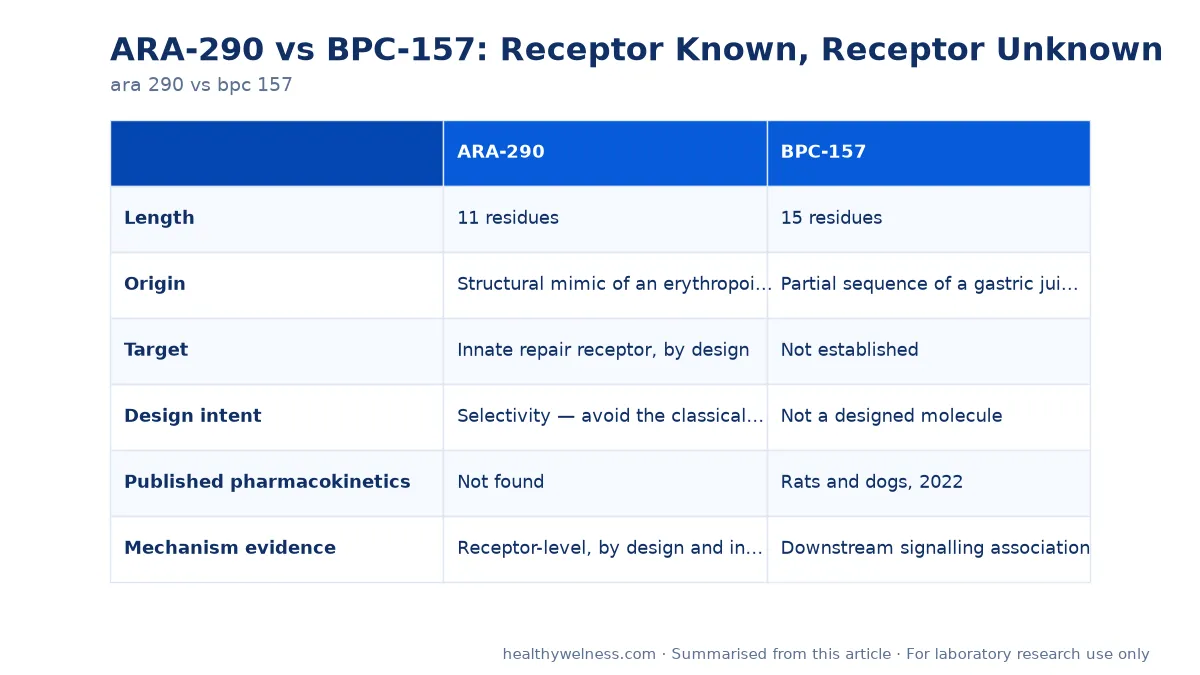
Side by side
| ARA-290 | BPC-157 | |
|---|---|---|
| Length | 11 residues | 15 residues |
| Origin | Structural mimic of an erythropoietin surface | Partial sequence of a gastric juice protein |
| Target | Innate repair receptor, by design | Not established |
| Design intent | Selectivity — avoid the classical EPO receptor | Not a designed molecule |
| Published pharmacokinetics | Not found | Rats and dogs, 2022 |
| Mechanism evidence | Receptor-level, by design and in models | Downstream signalling association |
| Conformational dependence | High — shape mimic | Lower |
| Handling difficulty | Higher | Moderate |
Why is ARA-290’s target defined and BPC-157’s not?
Because one was designed against a target and the other was found by activity.
ARA-290 exists to answer a specific question: can the tissue-protective signalling attributed to erythropoietin be separated from its effect on red cell production? The design answer was to build a short peptide reproducing a particular helical surface of the parent protein, aimed at the innate repair receptor rather than the classical erythropoietin receptor. Selectivity is the whole point of the molecule, which means an experiment with it is testing a selectivity claim.
The 2018 study by Bitto and colleagues examined activation of the EPOR–beta common receptor complex by cibinetide in a mouse model, and the 2017 study by Nairz and colleagues reported effects on innate immune cell function in experimental colitis. Both are receptor-aware designs.
BPC-157 came from the opposite direction. It is a partial sequence of a protein found in gastric juice, studied because it produced effects in models, with mechanism reconstructed afterwards from downstream signalling — the 2017 study by Hsieh and colleagues associated its pro-angiogenic activity with VEGFR2 activation, which is an association with a pathway rather than identification of a binding site.
What does BPC-157’s pharmacokinetic data buy?
The ability to plan exposure from measurement rather than assumption, which is rarer in this product category than it should be.
The 2022 study by He and colleagues characterised distribution, metabolism and excretion in rats and dogs. Two species, measured rather than inferred. For anyone designing an animal experiment that is directly actionable: sampling times, expected exposure window and clearance behaviour all follow from it.
ARA-290 has no equivalent that we can find. So a design using it has to establish exposure empirically in the system being used, or accept that the timing is a guess. That is not a reason to avoid the compound, but it is a reason to build a time course into the first experiment rather than picking a single endpoint.
The 2025 narrative review by McGuire and colleagues, titled “Regeneration or Risk?”, is worth reading for its framing: a review that poses the question that way is not treating BPC-157’s evidence as settled, and the human picture is covered in BPC-157 human trials.
Why is a short shape-mimic harder to handle?
Because the property it depends on is not covalent.
In erythropoietin, the surface ARA-290 reproduces is held in position by the rest of the protein fold. Strip it to eleven residues and the molecule is largely flexible in solution, sampling many conformations of which the active one is a fraction. Anything that depletes that fraction reduces activity.
| Event | Changes the mass? | Changes activity? |
|---|---|---|
| Aggregation | No | Yes |
| Surface adsorption | No | Yes — lower real concentration |
| Partial precipitation | No | Yes — unknown concentration |
| Oxidation | Yes, +16 Da per event | Depends on the residue |
| Hydrolysis | Yes, as fragments | Yes |
The first three rows are invisible to a mass measurement, which is the standard confirmation most laboratories perform. For a conformationally dependent peptide, that is the category of failure to design against, and it is why the handling detail in reconstituting ARA-290 is more prescriptive than its eleven residues suggest.
What would a side-by-side experiment establish?
Something narrower than it appears, and worth stating before the wells are plated.
- It can show whether both move a chosen functional endpoint. That is a legitimate question in a repair-related assay.
- It cannot rank their potency. Potency is defined against a target, and only one of them has a defined target.
- Molar equivalence is required, not mass equivalence: eleven and fifteen residues differ enough in molecular weight to matter, and both are supplied as salts.
- Controls differ per arm. ARA-290’s arm needs a check that the material is intact, since its failures are silent. BPC-157’s arm needs a timing check against its published exposure data.
- No combination inference. There is no published co-administration work for this pair that we can find.
How does the handling differ in practice?
- ARA-290: add diluent down the vial wall and swirl, never vortex — shear and foaming drive aggregation at the air–liquid interface. Inspect against a dark background before use. Aliquot on first reconstitution. Expect surface loss at low concentrations and consider carrier protein where the assay permits.
- BPC-157: a conventional short peptide in aqueous diluent, more forgiving of ordinary handling, though still aliquoted on first use. Detail in BPC-157 reconstitution and storage.
- Both: store sealed, dry and dark at −20 °C; warm the vial before opening; compute molarity from net peptide content rather than vial weight, which our reconstitution calculator applies.
Our ARA-290 research material is supplied for laboratory research use. Certificates are available for listed products — contact us for the latest report.
A note on how each compound entered the catalogue
The two arrived by different routes, and that history explains the shape of their evidence. ARA-290 came out of a programme asking a specific separation question and was designed against an answer, so its literature is receptor-aware from the start. BPC-157 came from an observation in a biological material and was characterised afterwards, so its literature is model-rich and mechanism-poor.
Neither route is better. They produce different kinds of gap, and knowing which gap you are working with is what lets an experiment be designed around it rather than into it.
Scope note
This material is supplied for laboratory research use only. It is not a medicine, not a supplement, and not for human or veterinary use. The published work described above is in cells and animal models.
Open questions
- Are there published pharmacokinetics for ARA-290 in any species?
- Does BPC-157 have a primary receptor, or is its activity receptor-independent?
- How much ARA-290 activity is lost to aggregation under ordinary handling?
Related research
Frequently asked questions
What is the main difference between ARA-290 and BPC-157?
What is known about each. ARA-290 was designed to engage the innate repair receptor rather than the classical erythropoietin receptor, so its target is defined by design. BPC-157 has no established receptor, but it does have published pharmacokinetics in two species.
Is ARA-290 a fragment of erythropoietin?
Not exactly. It is an eleven-residue structural mimic of a helical surface that erythropoietin presents as part of its folded structure, rather than a sequence lifted unchanged from the parent protein.
Which has more published disposition data?
BPC-157. A 2022 study characterised its pharmacokinetics, distribution, metabolism and excretion in rats and dogs, which is uncommon for a research peptide. ARA-290 does not have an equivalent that we can find.
Which is harder to handle?
ARA-290, because its activity depends on reproducing a shape that a folded protein normally holds in place. A short peptide holds that shape only loosely, so aggregation and adsorption remove activity without changing the mass.
Can they be compared in one experiment?
Only on a shared functional readout, and the result would say nothing about relative potency because the targets differ. Each also needs its own positive control appropriate to its own proposed mechanism.
For laboratory research use only. The research materials supplied by HealthyWelness are not approved medicines, foods or cosmetics and are not for human or veterinary use. This article summarises published research and is not medical advice.
Sources
- Nairz M, et al. Cibinetide dampens innate immune cell functions thus ameliorating the course of experimental colitis. Sci Rep. 2017. PMID: 29026145
- Bitto A, et al. Activation of the EPOR-beta common receptor complex by cibinetide ameliorates impaired wound healing in mice with genetic diabetes. Biochim Biophys Acta Mol Basis Dis. 2018. PMID: 29223734
- He L, et al. Pharmacokinetics, distribution, metabolism, and excretion of body-protective compound 157, a potential drug for treating various wounds, in rats and dogs. Front Pharmacol. 2022. PMID: 36588717
- Hsieh MJ, et al. Therapeutic potential of pro-angiogenic BPC157 is associated with VEGFR2 activation and up-regulation. J Mol Med (Berl). 2017. PMID: 27847966
- McGuire FP, et al. Regeneration or Risk? A Narrative Review of BPC-157 for Musculoskeletal Healing. Curr Rev Musculoskelet Med. 2025. PMID: 40789979