Semax Reconstitution: 5 mg and 10 mg Vials in the Lab
Reconstituting Semax for research: concentration figures for 5 mg and 10 mg vials, why the N-terminal methionine matters, and handling that limits oxidation.

Cover illustration: AI-generated editorial artwork. Conceptual only; not an exact molecular structure, actual laboratory result or evidence of clinical effects.
Semax is reconstituted with a measured volume of aqueous diluent, swirled gently, and its concentration is calculated from net peptide content: 10 mg in 2 mL gives 5 mg/mL. Its N-terminal methionine makes oxidation the main thing handling should limit.
For laboratory research use only. The research materials supplied by HealthyWelness are not approved medicines, foods or cosmetics and are not for human or veterinary use. This article summarises published research and is not medical advice.
- Semax is the heptapeptide Met-Glu-His-Phe-Pro-Gly-Pro, combining ACTH residues 4–7 with a C-terminal Pro-Gly-Pro (Magri et al., 2016).
- A 10 mg Semax vial reconstituted with 2 mL gives 5 mg/mL, or 0.5 mg per 0.1 mL, when 10 mg is the net peptide content.
- Semax forms complexes with copper(II) and zinc(II) at physiological pH; N-terminal acetylation changes the copper complex from a CuN4 to a distorted CuN3O chromophore (Magri et al., 2016).
- Tritium-labelled Semax bound rat basal forebrain membranes specifically and reversibly with a dissociation constant of 2.4 nM, and binding required calcium (Dolotov et al., 2006).
- Lyophilisation can increase a peptide’s tendency to aggregate after reconstitution compared with never-dried solution (Merutka et al., 2016).
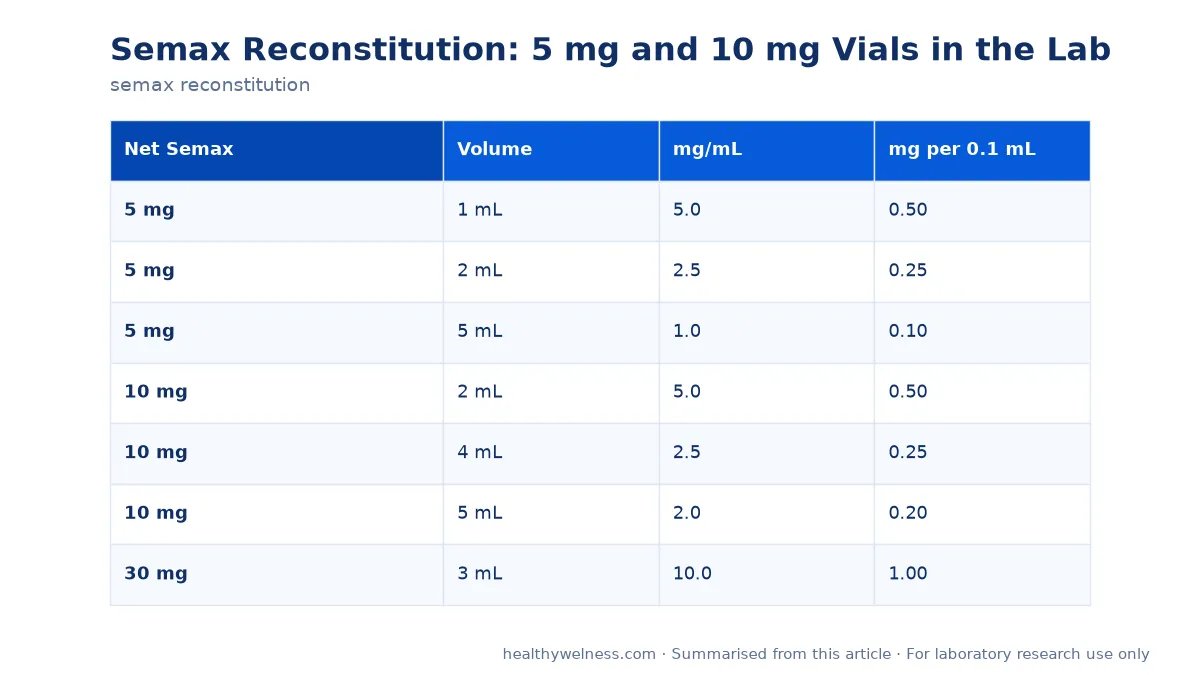
Concentration figures
| Net Semax | Volume | mg/mL | mg per 0.1 mL |
|---|---|---|---|
| 5 mg | 1 mL | 5.0 | 0.50 |
| 5 mg | 2 mL | 2.5 | 0.25 |
| 5 mg | 5 mL | 1.0 | 0.10 |
| 10 mg | 2 mL | 5.0 | 0.50 |
| 10 mg | 4 mL | 2.5 | 0.25 |
| 10 mg | 5 mL | 2.0 | 0.20 |
| 30 mg | 3 mL | 10.0 | 1.00 |
Each figure assumes the vial’s stated amount is net peptide. Semax is commonly supplied as an acetate salt, and the counter-ion plus residual moisture can account for a noticeable share of the cake weight. Start the arithmetic from the net figure on the certificate; the peptide calculator has a field for it.
Material from our Semax research peptide listing is supplied as lyophilised powder. Certificates are available for listed products — contact us for the latest report.
What the sequence tells you about handling
Short peptides are often treated as interchangeable on the bench. Semax’s sequence argues for some specific care.
| Residue or feature | Chemical liability | Handling response |
|---|---|---|
| Met at position 1 | Sulphur oxidation | Limit air and light; cold |
| Free N-terminal amine | Metal binding | Low-metal water, clean glass |
| His at position 3 | Metal binding | Same as above |
| Pro-Gly-Pro tail | Protease resistance | Helps in biological media |
| Glu at position 2 | Charge, solubility | Dissolves in water |
Methionine oxidation
Methionine oxidises to methionine sulphoxide in the presence of dissolved oxygen, peroxides or light, adding 16 Da to the mass. For a seven-residue peptide that is a significant change, easily detected by mass spectrometry and potentially enough to alter binding. Magri and colleagues observed the methionine sulphur making a weak apical interaction in the copper complex of acetylated Semax (Magri et al., 2016), which illustrates that this residue is not inert.
Practical consequences: do not leave a reconstituted vial open to air, avoid peroxide-forming excipients, keep solutions cold and dark, and prefer smaller volumes prepared closer to use over large volumes kept for weeks.
Metal binding
Semax forms complexes with copper(II) through its N-terminal amine and histidine, and with zinc(II) as well. Acetylating the N-terminus changes the copper complex and its redox potential, and the free amino terminus was crucial for protecting SH-SY5Y cells against copper-induced toxicity (Magri et al., 2016). In practice, trace metals in water or on glassware can form complexes that change what the assay sees. Use high-purity water and avoid metal spatulas in contact with solution.
Procedure
- Let the sealed vial reach room temperature before opening, to keep moisture off the cake.
- Confirm net peptide content and choose a volume from the table.
- Add diluent slowly down the inside wall of the vial.
- Roll gently until the cake is fully dissolved; Semax is a charged peptide and normally dissolves without difficulty.
- Check for clarity. Cloudiness in a seven-residue peptide solution suggests contamination or a wrong diluent, not normal behaviour.
- Divide into single-use portions if the solution will not be used promptly, and freeze those that are not needed in the short term, minimising headspace.
Diluent choices
Water-based diluents are the default. Bacteriostatic water is used when a vial will be accessed repeatedly; sterile water for single preparations. Non-aqueous or co-solvent systems are sometimes considered for peptide formulations, but their effects on solubility, chemical stability and activity have to be established case by case (Stevenson, 2000), and there is no reason to use them for a soluble peptide like Semax. The trade-offs between the aqueous options are covered in bacteriostatic versus sterile water.
What reconstitution can change
Drying and rehydration are not neutral. Merutka and colleagues found that reconstituted lyophilised teriparatide aggregated and precipitated within weeks under some conditions in which never-dried solutions remained clear for twelve weeks, and concluded that freezing and drying stresses can perturb peptide structure (Merutka et al., 2016). Semax is much smaller and unlikely to have the higher-order structure involved there, but the lesson carries over: stability of the dry powder is not evidence of stability in solution.
Checking that the solution is still Semax
For a small peptide with an oxidation-prone residue, a visual check is not enough: methionine sulphoxide is colourless and soluble, so an oxidised solution looks identical to a fresh one. The checks below are ordered from cheapest to most informative.
| Check | Detects | Misses |
|---|---|---|
| Visual clarity | Gross contamination | Oxidation, cleavage |
| pH reading | Wrong diluent, drift | Most chemical change |
| Reversed-phase HPLC | New peaks, purity loss | Co-eluting species |
| Mass spectrometry | +16 Da sulphoxide | Isobaric changes |
Mass spectrometry is the decisive test for this particular liability, because the oxidised form differs from the parent by the mass of one oxygen atom. A reference spectrum taken from freshly reconstituted material on day one makes later comparisons straightforward. The general principles of reading such data are covered on the COA and testing pages linked from the product listing.
A related point concerns the acetylated derivative. Magri and colleagues found that N-terminal acetylation changed Semax’s copper complex and redox potential and removed its protective effect against copper toxicity in SH-SY5Y neuroblastoma cells (Magri et al., 2016). Because acetylation adds 42 Da, mass spectrometry also distinguishes Semax from N-acetyl Semax, which is worth confirming when both are in use in the same laboratory.
Why the biology is not a handling guide
Semax’s published activity comes largely from rodent work. A single intranasal application raised BDNF protein 1.4-fold and trkB phosphorylation 1.6-fold in rat hippocampus (Dolotov et al., 2006, Brain Res), and it bound basal forebrain membranes with nanomolar affinity (Dolotov et al., 2006, J Neurochem). These describe what an intact molecule does. They make it more important, not less, to confirm that the material reaching an assay is still intact, which is where the oxidation and metal points above come in.
Related research
For pharmacology and history see the Semax overview. The acetylated derivative is covered in N-acetyl Semax amidate, and the closest comparator in Semax versus Selank.
Frequently asked questions
What concentration does 10 mg of Semax give in 2 mL?
5 mg/mL, or 0.5 mg in each 0.1 mL, if 10 mg is the net peptide content. A lower net content on the certificate lowers every figure proportionally, so concentration is always calculated from net content rather than the label weight.
Why is oxidation a particular concern for Semax?
Semax begins with methionine (Met-Glu-His-Phe-Pro-Gly-Pro), and methionine’s thioether sulphur is an oxidation-prone site. Coordination studies show the methionine sulphur participating weakly in copper binding by acetylated Semax (Magri et al., 2016), a reminder that this residue is chemically active.
Do trace metals matter when dissolving Semax?
They can. Semax forms complexes with copper(II) and zinc(II) at physiological pH, and the free N-terminal amino group shapes those complexes (Magri et al., 2016). Low-metal water and clean glassware reduce one source of variability.
Is N-acetyl Semax reconstituted the same way?
The procedure is the same, but the molecule is not. N-terminal acetylation changed copper coordination, redox behaviour and protection against copper-induced toxicity in SH-SY5Y cells compared with Semax (Magri et al., 2016). The two should not be treated as interchangeable in an assay.
What does Semax's published biology say about handling?
Rodent studies report effects at the level of BDNF and trkB expression within hours of intranasal application (Dolotov et al., 2006). Those findings concern the molecule’s activity; they make no claim about solution stability, which has to be judged on peptide chemistry.
For laboratory research use only. The research materials supplied by HealthyWelness are not approved medicines, foods or cosmetics and are not for human or veterinary use. This article summarises published research and is not medical advice.
Sources
- Magri A, et al. Influence of the N-terminus acetylation of Semax, a synthetic analog of ACTH(4-10), on copper(II) and zinc(II) coordination and biological properties. J Inorg Biochem. 2016. PMID: 27586814
- Dolotov OV, et al. Semax, an analogue of adrenocorticotropin (4-10), binds specifically and increases levels of brain-derived neurotrophic factor protein in rat basal forebrain. J Neurochem. 2006. PMID: 16635254
- Dolotov OV, et al. Semax, an analog of ACTH(4-10) with cognitive effects, regulates BDNF and trkB expression in the rat hippocampus. Brain Res. 2006. PMID: 16996037
- Merutka G, et al. Stability of lyophilized teriparatide, PTH(1-34), after reconstitution. Eur J Pharm Biopharm. 2016. PMID: 26620825
- Stevenson CL. Characterization of protein and peptide stability and solubility in non-aqueous solvents. Curr Pharm Biotechnol. 2000. PMID: 11467335