What Are Peptides? Structure, Origins and Biological Roles
Learn what peptides are, how they differ from amino acids and proteins, where they come from, and how to evaluate peptide research claims.

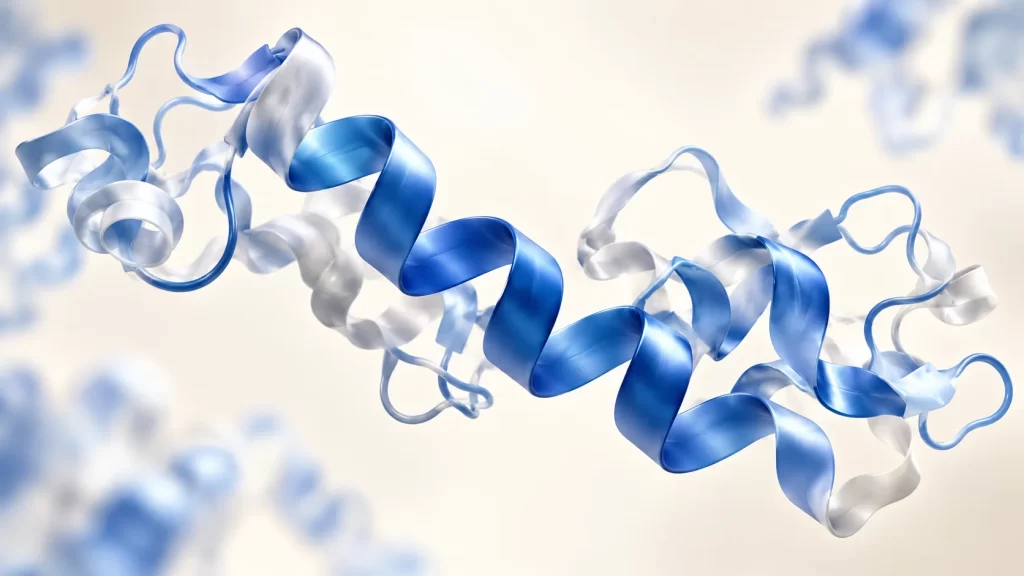
Peptides are molecules built from two or more amino-acid residues joined by peptide bonds. In biology, they include small signalling molecules, metabolites and fragments of larger proteins. The word describes a chemical family, not a single ingredient or a shared set of effects. Knowing that something is a peptide does not establish what it does, how it was tested or whether a particular material is suitable for an experiment. [1]
Peptides, amino acids and proteins: what is the difference?
An amino acid is a building block; a peptide contains linked residues of those building blocks. A protein is generally a longer polypeptide, or an assembly of polypeptide chains, described in a biological and structural context. There is no universal length at which a peptide suddenly becomes a protein. IUPAC nomenclature explicitly acknowledges that authors use these terms differently. [2]
| Term | What it describes | What it does not establish |
|---|---|---|
| Amino acid | An individual building block before incorporation into a chain | The identity or properties of a finished peptide |
| Dipeptide / tripeptide | A molecule containing two / three amino-acid residues | A particular biological function |
| Oligopeptide / polypeptide | Relatively short / longer residue chains; usage varies | A universally agreed numerical boundary |
| Protein | A polypeptide or chain assembly considered as a biological molecule | That every molecule has one rigid, unchanging shape |
“Residue” is useful here: the incorporated unit is not chemically identical to a free amino acid. A peptide sequence is normally written from the N-terminal end to the C-terminal end. For a familiar analogy, the identity of letters matters, but their order matters too. [2]
Why sequence matters more than the label “peptide”
A sequence records which residues occur, and in what order. It is the starting point for understanding the molecule’s chemical properties and possible interactions. Changing the order produces a different sequence, even when the list of component amino acids remains the same. EMBL-EBI’s introduction to primary structure explains how this information underlies higher levels of protein organisation. [3]
For example, Gly–Ala and Ala–Gly are different dipeptides, not two spellings of the same molecule. A sequence record should also state relevant modifications rather than relying on an abbreviated product name. When comparing two papers, first check whether they actually investigated the same molecular entity.
For the chemistry linking successive residues, see what a peptide bond is and why its geometry matters.
Where do peptides come from?
Peptide chains can be assembled by biological machinery. During ribosomal protein synthesis, amino acids carried by transfer RNAs participate in formation of the growing chain’s peptide bonds. This is a controlled catalytic process, not simply free amino acids joining whenever they encounter one another in water. Experimental work on ribosomal catalysis demonstrates the importance of the participating tRNA substrates. [4]
Peptides can also be prepared chemically. In solid-phase synthesis, an anchored chain is extended through successive coupling steps. Merrifield’s original experimental paper established this approach using a tetrapeptide. Chemical preparation makes it possible to study a specified sequence without isolating it directly from a biological sample. [5] Our solid-phase peptide synthesis guide covers assembly and purification in more detail.
“Natural” and “synthetic” therefore answer a question about origin or preparation. Those labels alone do not answer the separate questions of molecular identity, analytical quality or experimental suitability.
What do peptides do? Two examples with different roles
There is no single answer for the whole family. The useful question is: which peptide, in which biological system, measured with which method?
- Glutathione: ChEBI identifies this molecule as a tripeptide with a side-chain linkage involving glutamate, and classifies it as an antioxidant and metabolite. Its structure illustrates why “peptide” includes more than a simple chain drawn with identical backbone connections. [6] See our glutathione profile for a focused discussion.
- Oxytocin: ChEBI records it as a cyclic nine-residue peptide hormone. It illustrates a signalling molecule with a different structure and role from glutathione. [7]
Neither example supports treating all peptides as interchangeable. A published observation about one defined molecule is not evidence for another merely because both belong to this broad family.
How to evaluate a peptide research claim
Before comparing findings or selecting research material, use four questions:
- What exactly was studied? Record the sequence, modifications and molecular form stated in the paper.
- What was the experimental system? Separate purified-molecule experiments, cultured cells, animal models and human studies.
- What was actually measured? A binding result, a chemical measurement and a clinical outcome answer different questions.
- What documentation supports the material? Check which tests were performed, on which sample and batch, rather than interpreting a single headline percentage as a complete quality assessment.
The fourth question has an analytical basis: ICH Q2(R2) distinguishes identification, impurity testing and assay as different analytical purposes. Citing that distinction here does not mean a research supplier or product meets pharmaceutical manufacturing requirements. [8] Our guide to reading a peptide certificate of analysis explains how to interpret an available report.
Common questions
Is a peptide the same as a protein?
The terms overlap. Chain length is helpful context, but there is no universally enforced numerical dividing line. Use the name, sequence and structure of the molecule rather than a length rule alone.
Are all peptides hormones?
No. Oxytocin is a signalling example; glutathione is a chemically different tripeptide with a different biological role. “Peptide” is a structural category, not a synonym for hormone. [6] [7]
Does a peptide name tell me whether a research product is an approved medicine?
No. This article explains terminology; it does not establish the approval, safety or permitted use of any commercial material. A research label and a scientific publication cannot substitute for that separate assessment.
Continue through the peptide science library
Use the peptide science guide to choose a focused explanation of molecular structure, analytical data or research evidence. For the next step, learn how to read sequence notation and how cell, animal and human studies differ.
Scope: introductory chemistry and research literacy. This article does not report original experiments or a clinical review. HealthyWelness operates a commercial research-material catalog; these educational examples are not product endorsements.
Cover: AI-generated conceptual editorial artwork, not an exact molecular structure or a photograph of a HealthyWelness laboratory.
Sources
- IUPAC Gold Book — Peptides
- IUPAC–IUB — Nomenclature and Symbolism for Amino Acids and Peptides, 3AA-11 to 3AA-13
- EMBL-EBI Training — Primary structure: Why sequence matters
- Weinger JS et al. (2004). Substrate-assisted catalysis of peptide bond formation by the ribosome. DOI: 10.1038/nsmb841
- Merrifield RB (1963). Solid Phase Peptide Synthesis. I. The Synthesis of a Tetrapeptide. DOI: 10.1021/ja00897a025
- ChEBI — Glutathione (CHEBI:16856)
- ChEBI — Oxytocin (CHEBI:7872)
- EMA — ICH Q2(R2) Validation of analytical procedures