How to Read Peptide Sequences: Codes, Termini and Modifications
Read peptide sequences, compare one-letter and three-letter codes, and identify terminal modifications, stereochemistry and missing structural information.

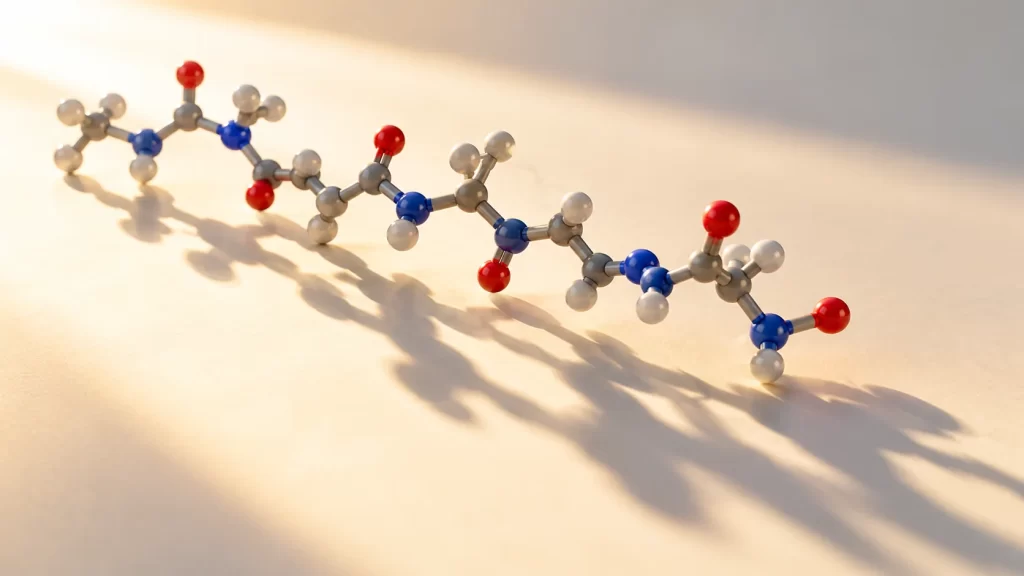
Read a conventional peptide sequence from the N-terminus to the C-terminus, identifying each amino-acid symbol in order. Then check the accompanying description for stereochemistry, terminal modifications and crosslinks. A string of letters records residue order; it is not always a complete description of the material. IUPAC’s one-letter system specifies this reading direction. [1]
A sequence you can read without guessing
Consider the hypothetical sequence AGSK. In the standard code, it represents Ala–Gly–Ser–Lys: alanine, glycine, serine and lysine in that order. It contains four residues, not four separate peptides. This teaching example is not a product specification or a reported experiment.
| Position | One-letter code | Three-letter code | Residue |
|---|---|---|---|
| 1 | A | Ala | Alanine |
| 2 | G | Gly | Glycine |
| 3 | S | Ser | Serine |
| 4 | K | Lys | Lysine |
The mapping follows the standard amino-acid symbols, not the first letter of every English name. Lysine is K; leucine is L. Likewise, D as an ordinary one-letter residue symbol means aspartic acid, not “a D-amino acid.” The notation system and its legend matter. [1]
N-terminus and C-terminus: direction is part of identity
The N-terminal residue is at the amino end of the conventional chain; the C-terminal residue is at the carboxyl end. AGSK and KSGA therefore describe different sequences. A terminal group can be chemically modified while its position is still referred to as the corresponding terminus. IUPAC nomenclature describes these terminal positions and their possible substitution. [2]
A useful document check is to expand both records into the same notation before comparing them. If one report gives AGSK and another gives Ala–Gly–Ser–Lys, their residue order agrees. If the second gives Lys–Ser–Gly–Ala, it does not. Agreement in residue order is only the first check; next compare modifications.
What do Ac–, –NH2 and D-residue labels mean?
Prefixes and suffixes can specify chemistry that is not contained in the bare residue string. Commercial notation often uses Ac– for N-terminal acetylation and –NH2 for C-terminal amidation; a free C-terminal acid may be written –OH. Bachem’s own notation guide explains these conventions. Read the supplier’s legend rather than treating every shorthand as universal. [3]
Thus AGSK and Ac–AGSK–NH2 should not be silently treated as the same complete molecule. Preserve the terminal annotation when you transcribe a sequence into a comparison table or an experimental record.
D and L designate stereochemical configuration, not the direction in which a chain is written. In conventional three-letter amino-acid notation, the L configuration is assumed for chiral residues unless indicated otherwise. A D-residue is explicitly annotated, for example D-Ala. If a paper uses lower-case letters or another convention, retain its legend. [4]
Sequence versus structure: the missing connection problem
A sequence listing alone may not tell you which cysteines form disulfides, whether a side-chain group is linked, or whether the backbone closes into a ring. For example, a list containing two cysteines does not itself prove that those residues are connected in the tested material. Request or consult the structure and connectivity annotation when that distinction matters.
Our linear-versus-cyclic peptide guide explains why a disulfide ring and a head-to-tail backbone ring require different descriptions. For the actual backbone linkage, see the peptide-bond guide.
A five-field identity record for comparing documents
Instead of copying only an abbreviated name, record the following fields together:
- Residue order: include a clear one-letter or three-letter representation.
- Stereochemistry: preserve D-residue and nonstandard-residue annotations.
- Termini: record acetylation, amidation or other stated changes.
- Connectivity: include the positions and kind of any crosslinks.
- Document context: keep the source record and batch identifier separate from the structural description.
This is a reading aid, not an analytical identity test. A perfectly transcribed specification does not demonstrate what is inside a particular vial. Mass spectrometry provides a different kind of evidence, with its own limitations.
Common questions
Does the same amino-acid composition mean the same peptide?
No. The order and chemical annotations also matter. AGSK and KSGA contain the same four residue types, but their order differs.
Should I reverse the sequence if it contains D-amino acids?
No. Stereochemical configuration and sequence direction are separate information. Follow the written order and the explicit stereochemical labels.
Continue with the peptide science reading guide for structure, testing and evidence interpretation.
Scope: educational interpretation of published methods and research. HealthyWelness operates a commercial research-material catalog. Examples are not batch test results, product endorsements or personal-use guidance. Cover: AI-generated conceptual editorial artwork, not an exact molecular structure, experimental data or a photograph of HealthyWelness facilities.