Peptide Vial Moisture: Stopper Transfer Versus Ingress
Read peptide vial moisture evidence by separating internal stopper water, outside permeation and leaks, with explicit mass-basis calculations.

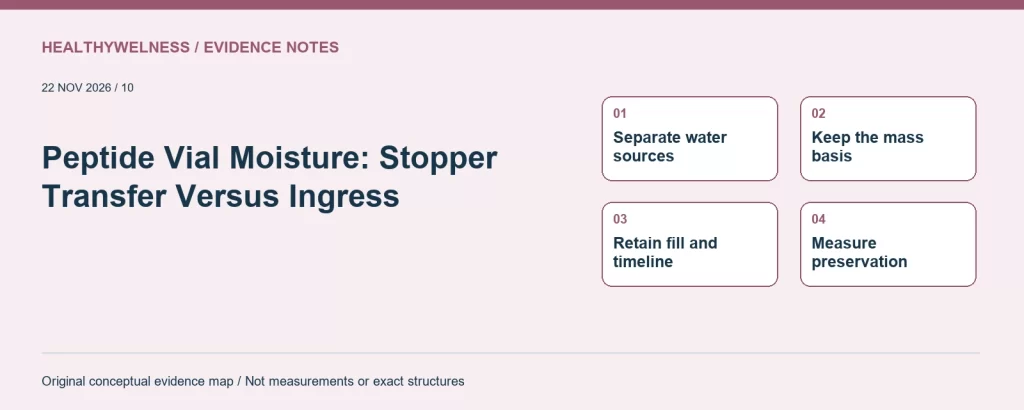
Moisture gained by a sealed lyophilized preparation can come from water already held in packaging components as well as from outside the container. Stopper water content, vapor permeation and leakage describe different processes. A dry starting cake, an intact-looking seal or a low-moisture stopper label does not independently establish the later water content or stability of a particular peptide.
For laboratory research use only. This article concerns evidence about research-material packaging. It supplies no human or veterinary use instructions. All water-mass calculations are invented illustrations, not measurements of HealthyWelness materials.
- Residual water in a cake is a measurement at a defined stage, not a complete future moisture history.
- A stopper can act as a source or reservoir of water inside a sealed system.
- Moisture uptake by an elastomer and moisture transmission through it are different properties.
- The same absolute water transfer causes a larger percentage change in a smaller dry fill.
Draw the compartments before diagnosing a wet cake
A lyophilized research material has a low initial water result. Months later, a new result is higher even though the vial was never opened. It is tempting to conclude that the seal leaked. That is one hypothesis, but not the only one. Water can move among the cake, headspace and closure components without requiring a new opening or an increase in the whole sealed system’s total water.
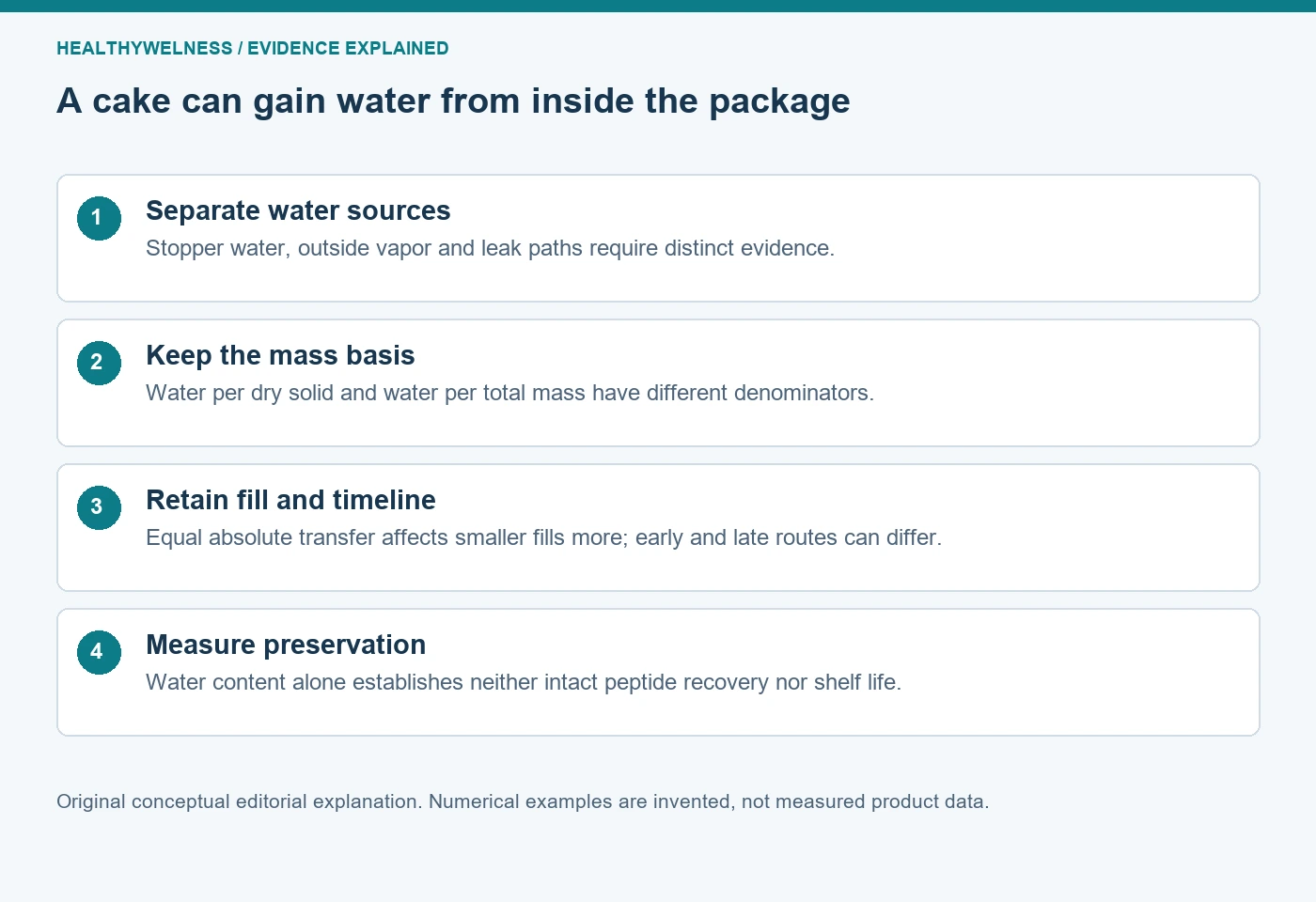
Separate the outside environment from the internal packaging components. A stopper may already contain water when the vial is closed. The cake can gain water while the stopper loses it. By contrast, permeation introduces water from outside through material, and a leak involves a different transport path. These routes can coexist and need not dominate during the same interval.
| Process | Water source or path | Useful distinction |
|---|---|---|
| Internal redistribution | Stopper or other internal reservoir | No external water required |
| Material permeation | Outside vapor through a barrier | Can occur without a gross opening |
| Leakage | Seal or defect pathway | Not equivalent to material permeability |
| Opening exposure | Changed contact with ambient air | Separate handling event |
The lyophilized storage overview introduces humidity as a concern. Here the question is more specific: which water source and transport process does a particular observation establish, and what would distinguish the alternatives?
Original stopper studies show why the time window matters
Pikal and Shah’s 1992 original research examined moisture transfer between butyl stoppers and amorphous vancomycin or lactose preparations. Its abstract reports increasing product moisture and apparent equilibration without evidence of transmission through the stopper under the studied conditions. This is a defined materials model, not evidence that outside ingress never occurs. Pikal and Shah, PMID 1592166.
Donovan and colleagues’ 2007 original study compared two stopper formulations and evaluated processing, ambient equilibration and transfer to a model lactose cake. The abstract describes differences in water uptake and the importance of initial stopper water content and storage temperature. Those observations show why a closure’s processing and storage history can matter alongside its material name. No drying procedure from that study is prescribed here. Donovan et al., PMID 17390704.
Sasaki and colleagues’ 2010 original study then compared stopper formulations during humid storage. Its abstract distinguishes early transfer from stoppers from later external moisture permeation, with formulation-dependent behavior. The distinction is important: a stopper that initially contributes less water need not provide the strongest long-term vapor barrier. Sasaki et al., PMID 21502005.
Only the actual abstracts of these three studies support this summary; full experimental datasets and supplementary materials were not assessed. Their formulations are not interchangeable with an untested short peptide. Together they establish plausible mechanisms and the importance of observation stage, without supplying a universal water-transfer rate or shelf life.
An internal mass balance can change the cake without changing the whole
Invented closed-system example: a dry solid contains 10.00 mg of nonwater material and 0.10 mg of water. A stopper contains a separate water reservoir. Suppose 0.20 mg moves from stopper to cake, with no outside exchange, no loss of nonwater material and no chemical reaction. The cake gains water, while the entire sealed system has gained none.
On a dry-mass basis, initial water is 0.10/10.00 × 100 = 1.00%. After the stipulated transfer, it is 0.30/10.00 × 100 = 3.00%. On a total wet-mass basis, the corresponding values are 0.10/10.10 × 100 = 0.990% and 0.30/10.30 × 100 = 2.913%. Both descriptions are internally consistent but use different denominators.
| Quantity | Initial cake | Later cake |
|---|---|---|
| Nonwater solid | 10.00 mg | 10.00 mg |
| Water in cake | 0.10 mg | 0.30 mg |
| Water per dry mass | 1.00% | 3.00% |
| Water per total mass | 0.990% | 2.913% |
The example shows two independent reporting issues. An increase in cake water does not uniquely locate the source, and a water percentage needs its mass basis. A comparison between different denominator conventions can create an apparent discrepancy even when the underlying water amounts agree.
The hypothetical transfer is stipulated rather than predicted. Real redistribution depends on the materials, their water-related thermodynamics, temperature and time. Equal water mass in two components does not mean they have the same tendency to exchange water. Nor can a simple total-water balance establish molecular mobility or the rate of a degradation pathway.
Small fills amplify the significance of absolute water transfer
Consider a second invented comparison with dry fills of 5.00 mg and 50.00 mg. If each receives 0.10 mg of additional water, the dry-basis percentage increases by 2.00 and 0.20 percentage points, respectively. The stopper transferred the same absolute amount; the relative impact differs tenfold because the denominator differs tenfold.
This is why fill mass belongs beside moisture percentage in a packaging record. A closure result obtained with a large model cake cannot be transferred to a small peptide fill merely because the vial diameter is unchanged. Surface contact, headspace, cake composition and initial component water may also differ, so even the shared absolute transfer must not be assumed.
The calculation does not establish that the smaller fill is less stable. Water content and chemical stability are distinct endpoints. A research conclusion needs evidence linking the relevant moisture state to the actual molecular or physical outcome. One material can respond differently from another at the same reported water percentage.
Separate a component label from the assembled package
A low-moisture uptake description concerns a particular property under stated conditions. Permeability concerns transport through a material. Seal performance concerns the assembled contact and its integrity. A good result in one category cannot silently stand in for the others.
FDA’s 1999 container-closure guidance distinguishes transport through permeable walls from diffusion past seals and notes that glass protection depends on a suitable closure. Its general protection framework concerns human drug packaging; it is used here only to clarify physical routes and evidence categories. It does not certify a research-material package or assign regulatory status to the website. FDA container-closure guidance, protection section.
A visually intact crimp supplies useful inspection information, but does not quantitatively measure water-vapor transmission. Conversely, detecting water uptake does not identify a gross leak. A discriminating study needs a method suited to the proposed route, with relevant environmental conditions and observation times.
The vial materials guide provides component context. For a specific comparison, retain exact vial and stopper identities, closure assembly, fill, processing history and the environment. The general terms glass vial and rubber stopper leave too many variables unresolved.
Measure water and molecular preservation as separate endpoints
A water assay can characterize the sample fraction and stage actually tested. Its suitability depends on the matrix and method. If a cake is exposed during sampling, distinguish that handling from the storage period being investigated. A destructive assay on one vial also does not follow the exact same cake through every later interval.
For the measurement basis, see Karl Fischer water in lyophilized peptides. Report dry or total-mass convention, sample amount and relevant method limitations. A measured water percentage does not determine peptide content, identity or oxidation state.
Then assess the molecular question with suitable evidence. Intact-target amount, chemical changes and physical-state changes can disagree. A normal-looking cake can have a different water content; an altered cake appearance does not identify a specific chemical reaction. Avoid converting appearance into an unmeasured moisture result.
A useful time series compares defined stages and preserves component histories. If early and late trends differ, consider whether the dominant water source changed. Do not force one constant-rate explanation onto a curve that may combine internal redistribution and outside transport. Conversely, a fitted two-stage curve is not proof of those mechanisms without discriminating evidence.
The COA lookup provides a route to available material documents. A release water result applies to its stated sample and time. It does not independently validate every future container, transport interval or storage condition, and this article assigns no product-specific moisture limit.
Questions about moisture in sealed peptide vials
Does higher cake water prove that outside humidity entered?
No. Internal packaging components can supply water already present in the sealed system. Outside permeation and leakage require separate assessment.
Are low water uptake and low water transmission the same property?
No. Uptake concerns water held by a material; transmission concerns transport through it. Their implications can differ across early and late storage periods.
Does a glass vial make the complete package moisture-impermeable?
No. The closure and seal remain part of the system. Glass-wall behavior alone does not establish the assembled package’s vapor protection.
Why does fill mass belong beside water percentage?
The same absolute water amount has a larger relative effect in a smaller dry fill. The percentage also depends on whether its denominator is dry or total mass.
Does a low release water result establish shelf life?
No. It records an initial analytical state. Later moisture history and material-specific stability endpoints are needed for a supported storage-period claim.
For laboratory research use only. These examples explain packaging evidence and do not report HealthyWelness container qualification, product shelf life or human or veterinary suitability.
Cover and evidence map: original conceptual editorial schematics, not measured results, exact molecular structures, or photographs of HealthyWelness facilities.
Sources
- Pikal MJ, Shah S. Moisture transfer from stopper to product and resulting stability implications. Dev Biol Stand. 1992. PMID1592166.
- Donovan PD, et al. Effect of stopper processing conditions on moisture content and ramifications for lyophilized products. PDA J Pharm Sci Technol. 2007. PMID17390704.
- Sasaki H, et al. Impact of Different Elastomer Formulations on Moisture Permeation through Stoppers Used for Lyophilized Products Stored under Humid Conditions. PDA J Pharm Sci Technol. 2010. PMID21502005.
- FDA. Container Closure Systems for Packaging Human Drugs and Biologics. May1999. Protection section.