Reconstituting and Storing BPC-157 in the Lab
How to reconstitute BPC-157, concentration tables for 5-20 mg vials, whether it needs refrigeration, and which parts of its sequence limit solution stability.

Cover illustration: AI-generated editorial artwork. Conceptual only; not an exact molecular structure, actual laboratory result or evidence of clinical effects.
BPC-157 is one of the more straightforward research peptides to prepare: short, water-soluble and not lipidated. The two questions that come up most are how much solvent to add and whether the result needs refrigeration. Both have practical answers, and the peptide’s sequence explains which degradation routes to watch.
For laboratory research use only. The research materials supplied by HealthyWelness are not approved medicines, foods or cosmetics and are not for human or veterinary use. This article summarises published research and is not medical advice.
Key points
- Dissolves readily in water; no special solvent needed.
- Bacteriostatic water for multi-entry vials, sterile water for single use or freezing.
- Powder: −20 °C long-term. Solution: 2–8 °C, protected from light.
- Two aspartate residues make hydrolysis and isomerisation the main chemical risks.
- No published in-use stability study, so date every vial.
Step by step
- Take the sealed vial out of cold storage and leave it 15–30 minutes to reach room temperature. Opening a cold vial lets moisture condense on the powder.
- Swab the stoppers of the peptide vial and the solvent vial; let the alcohol dry.
- Draw the planned volume of solvent.
- Insert the needle at an angle and let the solvent run slowly down the inside wall, not onto the powder cake.
- Swirl or roll gently until the solution is clear. Do not shake.
- Label with peptide, lot, solvent, volume, concentration and date. Refrigerate.
The general method, including why shaking matters, is in how to reconstitute peptides.
Concentration tables
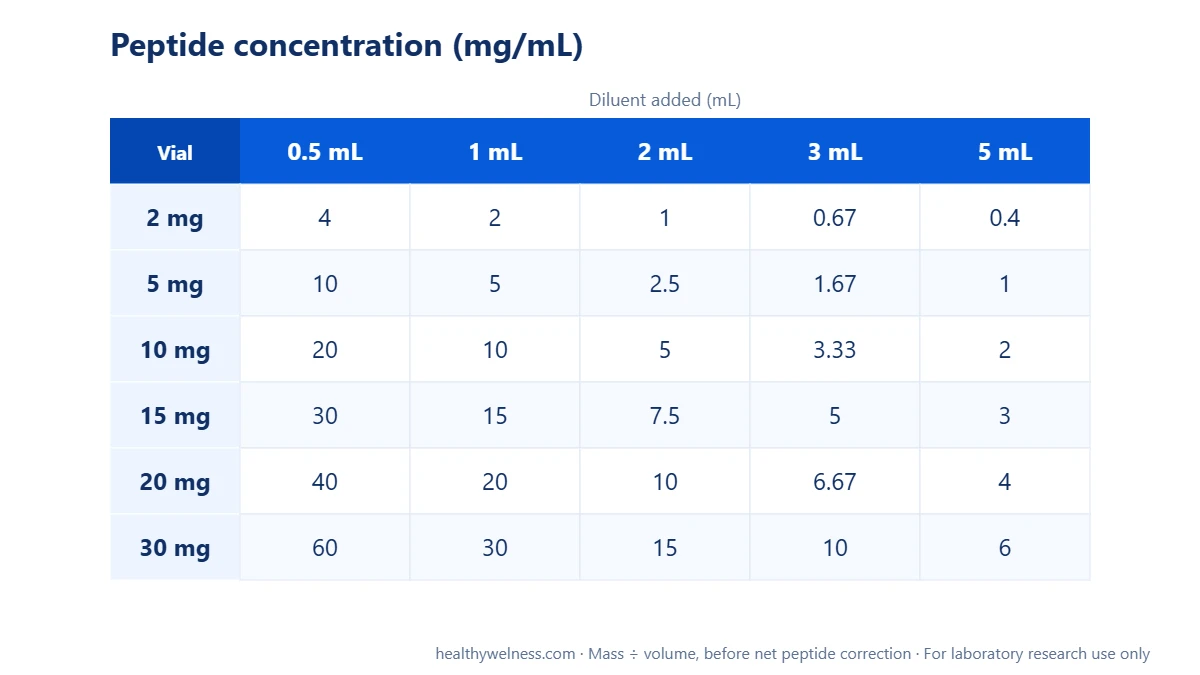
| Vial | 1 mL | 2 mL | 3 mL |
|---|---|---|---|
| 5 mg | 5 mg/mL | 2.5 mg/mL | 1.67 mg/mL |
| 10 mg | 10 mg/mL | 5 mg/mL | 3.33 mg/mL |
| 20 mg | 20 mg/mL | 10 mg/mL | 6.67 mg/mL |
In molar terms, at 1419.5 g/mol, 1 mg/mL is about 704 µM. For other combinations use the peptide reconstitution calculator. If the certificate reports net peptide content below 100%, apply that fraction for accurate molar work; see BPC-157 purity testing.
Which solvent
| Situation | Solvent | Why |
|---|---|---|
| Vial sampled repeatedly over days | Bacteriostatic water | 0.9% benzyl alcohol limits microbial growth between entries |
| Whole vial used at once | Sterile water | No preservative to interact with the peptide |
| Solution to be frozen in aliquots | Sterile water | Benzyl alcohol can worsen freeze–thaw damage |
| Reproducing a published method | As the paper states | The 2003 tendon study used saline with no carrier added |
Bacteriostatic water is supplied in multiple-dose containers precisely for repeated withdrawals (DailyMed prescribing information). Comparison of the options: bacteriostatic water vs sterile water.
What limits solution stability
BPC-157’s sequence is GEPPPGKPADDAGLV. Reading it for weak points:
| Feature | Risk | Practical implication |
|---|---|---|
| Asp-Asp (positions 10–11), Asp-Ala, Ala-Asp | Hydrolysis and isomerisation at aspartate | Avoid acidic conditions and heat in solution |
| No Met, Cys or Trp | Low oxidation risk | Less light- and air-sensitive than Semax or tesamorelin |
| No Asn or Gln | No classical deamidation site | One common degradation route is absent |
| Proline-rich N-terminus | Some resistance to proteases | Relevant in biological matrices, not in the vial |
Aspartate-containing bonds are among the best-documented sites of peptide hydrolysis (Reubsaet et al., 1998). Because research solutions are unbuffered, the salt form largely sets the pH, and formulation reviews identify pH control as the most practical stabilisation measure available (Nugrahadi et al., 2023).
Storage after reconstitution
- 2–8 °C, upright, dark. This is the default for reconstituted research peptides.
- Minimise time at room temperature. Exposure accumulates across repeated withdrawals.
- Avoid repeated freeze–thaw. Freeze–thaw is a recognised aggregation stress for biologics (Jain et al., 2021). If freezing is necessary, use single-use aliquots in sterile water.
- Date the vial. No published in-use stability study covers research-grade BPC-157, so the date is the only record you have.
Where the result depends on the peptide being intact, run an HPLC check against the lot’s certificate. BPC-157 is readily measurable: a validated urine method reached a 0.1 ng/mL limit of detection, and the peptide was stable in urine for at least four days (Cox et al., 2017). Detecting degradation in a vial is far less demanding than that.
Our BPC-157 research peptide comes in 5, 10 and 20 mg vials. General storage principles: storing reconstituted peptides.
Open questions
- How fast does BPC-157 degrade in unbuffered water at 2–8 °C? Published data cover biological matrices, not research solutions.
- Does the salt form change that rate?
- Which hydrolysis product appears first, and is it detectable before potency changes?
Related research
Frequently asked questions
How do you reconstitute BPC-157?
Let the vial reach room temperature, add a measured volume of bacteriostatic or sterile water slowly down the vial wall, and swirl gently until clear. Label with the volume, concentration and date, then refrigerate.
How much water for a 10 mg BPC-157 vial?
It depends on the concentration you want. 1 mL gives 10 mg/mL, 2 mL gives 5 mg/mL and 3 mL gives about 3.33 mg/mL. The peptide calculator handles any combination.
Does BPC-157 need to be refrigerated?
The lyophilized powder is best at −20 °C for long-term storage, with 2–8 °C acceptable short term. Once reconstituted, keep the solution at 2–8 °C and protect it from light.
How long does reconstituted BPC-157 last?
No peer-reviewed in-use stability study exists for research-grade BPC-157 in bacteriostatic water. Date the vial, keep it cold, and confirm by HPLC when results depend on the peptide being intact.
Can BPC-157 be frozen after reconstitution?
Freezing is possible but each freeze and thaw stresses the peptide. If needed, reconstitute in sterile water, split into single-use aliquots and freeze once.
For laboratory research use only. The research materials supplied by HealthyWelness are not approved medicines, foods or cosmetics and are not for human or veterinary use. This article summarises published research and is not medical advice.
Sources
- Staresinic M, et al. Gastric pentadecapeptide BPC 157 accelerates healing of transected rat Achilles tendon and in vitro stimulates tendocytes growth. J Orthop Res. 2003. PMID: 14554208
- Reubsaet JL, et al. Analytical techniques used to study the degradation of proteins and peptides: chemical instability. J Pharm Biomed Anal. 1998. PMID: 9884187
- Nugrahadi PP, et al. Designing Formulation Strategies for Enhanced Stability of Therapeutic Peptides in Aqueous Solutions: A Review. Pharmaceutics. 2023. PMID: 36986796
- Cox HD, et al. Detection and in vitro metabolism of the confiscated peptides BPC 157 and MGF R23H. Drug Test Anal. 2017. PMID: 28035768
- Jain K, et al. Freeze-thaw characterization process to minimize aggregation and enable drug product manufacturing of protein based therapeutics. Sci Rep. 2021. PMID: 34059716
- DailyMed. Bacteriostatic Water (water) injection, solution — prescribing information. U.S. National Library of Medicine.