Mazdutide and Survodutide vs Retatrutide: Dual vs Triple
Mazdutide and survodutide are GLP-1/glucagon dual agonists; retatrutide adds the GIP receptor. Structures, phase 2 and 3 endpoints, and what the gap implies.


Cover illustration: AI-generated editorial artwork. Conceptual only; not an exact molecular structure, actual laboratory result or evidence of clinical effects.
Mazdutide, survodutide and retatrutide all combine GLP-1 receptor agonism with glucagon receptor agonism. The difference is that retatrutide adds a third receptor, GIP. Comparing them shows how much the choice of partner receptor matters, and how little can be concluded from trials that were never designed to be compared.
For laboratory research use only. The research materials supplied by HealthyWelness are not approved medicines, foods or cosmetics and are not for human or veterinary use. This article summarises published research and is not medical advice.
Key points
- Mazdutide (IBI362 / LY3305677): GLP-1 + glucagon dual agonist, ~4476 g/mol.
- Survodutide (BI 456906): GLP-1 + glucagon dual agonist from a different developer.
- Retatrutide: GLP-1 + glucagon + GIP triple agonist.
- “Dual agonist” is ambiguous: tirzepatide pairs GLP-1 with GIP instead of glucagon.
- No head-to-head trials; populations and durations differ considerably.
Receptor combinations in this class
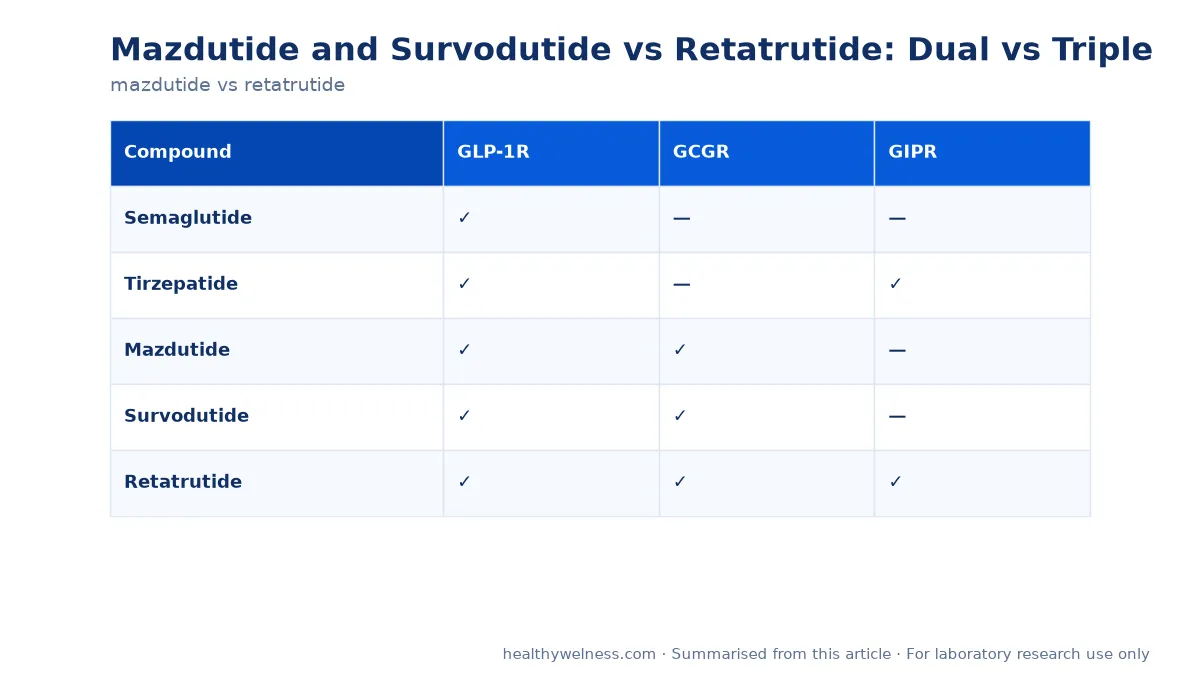
| Compound | GLP-1R | GCGR | GIPR |
|---|---|---|---|
| Semaglutide | ✓ | — | — |
| Tirzepatide | ✓ | — | ✓ |
| Mazdutide | ✓ | ✓ | — |
| Survodutide | ✓ | ✓ | — |
| Retatrutide | ✓ | ✓ | ✓ |
This table is the clearest way to see why “dual agonist” on its own says little. Tirzepatide and mazdutide are both dual agonists, but they share only one of their two targets.
What glucagon receptor agonism contributes
Glucagon raises hepatic glucose output, which is why it was historically avoided in metabolic drug design. It also increases energy expenditure and affects hepatic lipid handling. The strategy in all three compounds is to pair it with GLP-1 receptor agonism, whose glucose-lowering and intake-reducing effects offset the glucose-raising action. In retatrutide’s discovery paper, weight loss in obese mice was attributed to glucagon-receptor-mediated increases in energy expenditure added to GIP- and GLP-1-driven reductions in calorie intake (Coskun et al., 2022). Native GLP-1 itself is cleared within minutes (Müller et al., 2019), so all of these molecules rely on lipidation for weekly exposure.
Trial endpoints, reported separately
| Compound | Trial | Population | Duration | Mean body-weight change | Placebo |
|---|---|---|---|---|---|
| Mazdutide | Phase 3 (Ji et al., 2025) | 610 Chinese adults with obesity or overweight | 48 weeks | −11.00% (4 mg), −14.01% (6 mg) | +0.30% |
| Survodutide | Phase 2 (le Roux et al., 2024) | 387 adults, BMI ≥27, no diabetes, 12 countries | 46 weeks | −6.2% to −14.9% across four doses | −2.8% |
| Retatrutide | Phase 3 (Jastreboff et al., 2026) | 2339 adults with obesity, no diabetes | 80 weeks | −17.6% to −25.0% | −3.9% |
Three caveats before reading anything into the ordering. The trials ran for 46, 48 and 80 weeks. The mazdutide trial enrolled a Chinese population with a lower mean BMI (31.1) than typical Western obesity trials. And the survodutide trial had substantial discontinuation, with 233 of 386 participants completing the 46-week period. Longer trials and higher baseline BMI both tend to produce larger percentage changes.
Why the differences are hard to attribute
If retatrutide’s numbers are larger, three explanations compete: the extra GIP receptor, the longer trial, or the different population. Published data cannot separate them. The only clean comparisons in this field so far are within-trial ones, such as the head-to-head of tirzepatide against semaglutide. A trial comparing a dual GLP-1/glucagon agonist with a triple agonist would settle the question but has not been published.
Handling in the lab
| Property | All three |
|---|---|
| Form | Lyophilized powder |
| Storage | Powder −20 °C; solution 2–8 °C, dark |
| Dissolution | Slow addition, gentle swirling; lipidated peptides self-associate |
| Freeze–thaw | Avoid; aliquot if freezing is necessary |
| Identity | High-resolution MS; all are 4–5 kDa and chromatographically similar |
Research material: mazdutide, survodutide, retatrutide. Reconstitution guidance is in how to reconstitute retatrutide, which applies to all lipidated incretin peptides, and concentrations can be worked out with the peptide reconstitution calculator.
Reading trial percentages carefully
Percentage change in body weight is the headline number in every one of these trials, which makes it tempting to line the figures up. Four things make that unreliable across studies:
| Factor | Why it shifts the number |
|---|---|
| Trial length | These curves have not plateaued by 46 weeks; a longer trial yields a larger change |
| Baseline BMI | Higher starting weight generally allows a larger percentage change |
| Estimand | Treatment-regimen (intention-to-treat) analyses usually give smaller effects than efficacy estimands |
| Completion rate | High discontinuation changes which participants contribute to the final estimate |
For laboratory work none of this matters directly, but it matters a great deal when deciding which compound to use as a reference in an experiment.
Open questions
- How much does GIP receptor agonism add, over and above GLP-1 plus glucagon?
- Do the two dual agonists differ from each other in receptor potency ratios, and does that matter clinically?
- How do hepatic endpoints compare, given that glucagon receptor agonism directly affects the liver?
Related research
Frequently asked questions
What is the difference between mazdutide and retatrutide?
Mazdutide is a GLP-1 and glucagon receptor dual agonist. Retatrutide adds a third target, the GIP receptor. Both are lipidated peptides given once weekly in trials.
What is survodutide?
Survodutide (BI 456906) is another glucagon and GLP-1 receptor dual agonist, developed by a different company and tested in a 46-week phase 2 obesity trial.
Do dual GLP-1/glucagon agonists differ from dual GIP/GLP-1 agonists?
Yes, importantly. Tirzepatide pairs GLP-1 with GIP; mazdutide and survodutide pair GLP-1 with glucagon. The second partner differs, so the pharmacology differs even though both are called dual agonists.
Is retatrutide better than mazdutide or survodutide?
No head-to-head trial has compared them. Their separate trials used different populations, durations and regions, so percentages cannot be ranked across studies.
What is mazdutide's molecular weight?
About 4476 g/mol (C207H317N45O65) according to PubChem.
For laboratory research use only. The research materials supplied by HealthyWelness are not approved medicines, foods or cosmetics and are not for human or veterinary use. This article summarises published research and is not medical advice.
Sources
- Ji L, et al. Once-Weekly Mazdutide in Chinese Adults with Obesity or Overweight. N Engl J Med. 2025. PMID: 40421736
- Ji L, et al. Safety and efficacy of a GLP-1 and glucagon receptor dual agonist mazdutide (IBI362) 9 mg and 10 mg in Chinese adults with overweight or obesity: A randomised, placebo-controlled, multiple-ascending-dose phase 1b trial. EClinicalMedicine. 2022. PMID: 36247927
- le Roux CW, et al. Glucagon and GLP-1 receptor dual agonist survodutide for obesity: a randomised, double-blind, placebo-controlled, dose-finding phase 2 trial. Lancet Diabetes Endocrinol. 2024. PMID: 38330987
- Coskun T, et al. LY3437943, a novel triple glucagon, GIP, and GLP-1 receptor agonist for glycemic control and weight loss: From discovery to clinical proof of concept. Cell Metab. 2022. PMID: 35985340
- Jastreboff AM, et al. Retatrutide, a Triple Hormone Receptor Agonist, for Treatment of Obesity. N Engl J Med. 2026. PMID: 42814954
- Müller TD, et al. Glucagon-like peptide 1 (GLP-1). Mol Metab. 2019. PMID: 31767182
- PubChem Compound Summary for CID 167312357, Mazdutide. National Center for Biotechnology Information.