TB-500 Reconstitution: Method, Concentrations, Storage
How to reconstitute TB-500, concentration and molar tables for 5 and 10 mg vials, why its sequence is forgiving, and what to verify before you start.

Cover illustration: AI-generated editorial artwork. Conceptual only; not an exact molecular structure, actual laboratory result or evidence of clinical effects.
TB-500 is among the easier research peptides to prepare. It is short, strongly basic and not lipidated, so it dissolves quickly and does not self-associate. The one step worth doing before anything else is confirming which molecule is in the vial, because products sold under this name differ.
For laboratory research use only. The research materials supplied by HealthyWelness are not approved medicines, foods or cosmetics and are not for human or veterinary use. This article summarises published research and is not medical advice.
Key points
- Check the mass first: ~889 Da for the heptapeptide, ~4963 Da for full-length Tβ4.
- Highly water-soluble; dissolves with gentle swirling.
- Bacteriostatic water for multi-entry vials, sterile water for single use.
- No Met or Cys, so oxidation risk is low.
- Powder at −20 °C; solution at 2–8 °C, protected from light.
Check the identity first
When an anti-doping laboratory analysed a commercial TB-500 preparation, the key ingredient was N-acetylated LKKTETQ, residues 17–23 of thymosin beta-4 (Ho et al., 2012). That is the usual composition, but “TB-500” is a trade name rather than a chemical one, and some products contain longer fragments or the full protein.
| What the COA shows | Molecule | Handling implication |
|---|---|---|
| ~889 Da | Ac-LKKTETQ heptapeptide | Standard short-peptide handling |
| ~4963 Da | Full-length thymosin beta-4 | Protein-like: more sensitive to agitation and freeze–thaw; contains Met |
| Intermediate mass | Another fragment | Query with the supplier before use |
The distinction matters scientifically as well as practically, because different regions of Tβ4 carry different activities (Sosne et al., 2010). See what is TB-500? and thymosin fragments compared.
Step by step
- Let the sealed vial reach room temperature, 15–30 minutes.
- Swab both stoppers with alcohol; let them dry.
- Draw the planned volume of solvent.
- Run the solvent slowly down the inside wall of the vial.
- Swirl gently until clear. TB-500 usually dissolves within a minute.
- Label with peptide, lot, solvent, volume, concentration and date; refrigerate.
Do not shake. Agitation creates air–water interfaces where peptides can aggregate, and the effect is proportionally worse in dilute solutions (Treuheit et al., 2002). The general method is in how to reconstitute peptides.
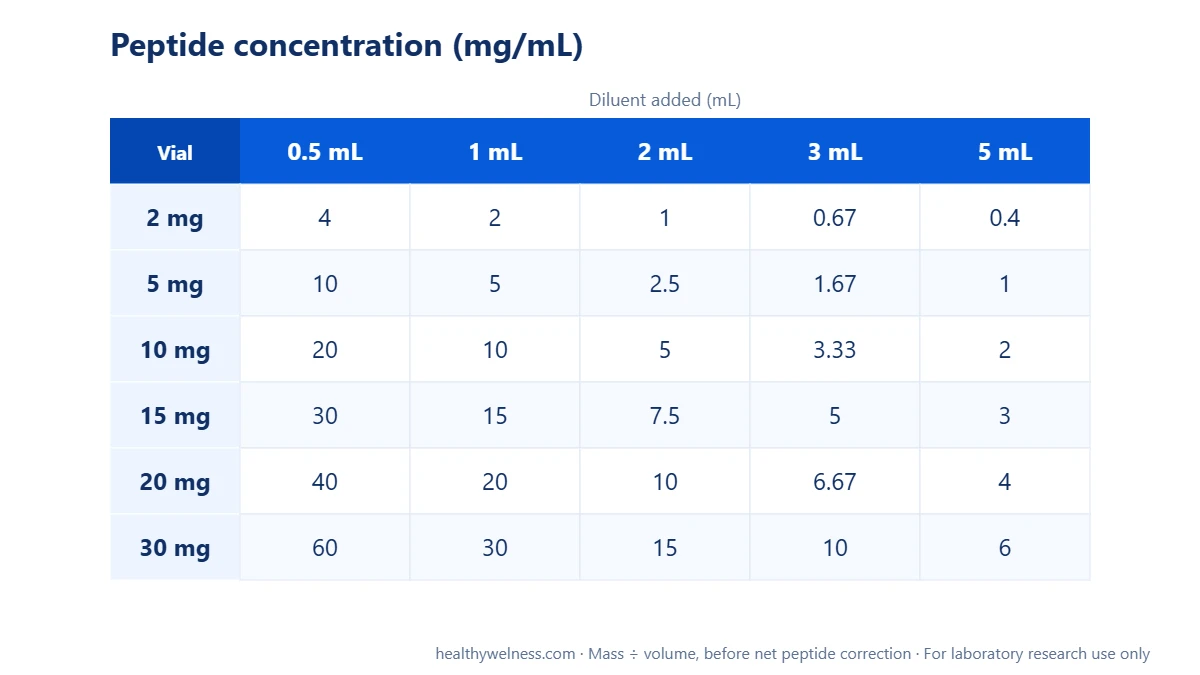
Concentration and molar tables
| Vial | 1 mL | 2 mL | 3 mL |
|---|---|---|---|
| 5 mg | 5 mg/mL | 2.5 mg/mL | 1.67 mg/mL |
| 10 mg | 10 mg/mL | 5 mg/mL | 3.33 mg/mL |
| mg/mL | Approx. molar (at ~889 g/mol) |
|---|---|
| 1 | 1.12 mM |
| 2.5 | 2.81 mM |
| 5 | 5.62 mM |
| 10 | 11.2 mM |
Use the peptide reconstitution calculator for other combinations. If the certificate reports net peptide content, apply that fraction for molar work.
Why TB-500 is forgiving
Reading the sequence Ac-LKKTETQ for weak points explains why it behaves well:
| Feature | Consequence |
|---|---|
| Two lysines, strongly basic | High water solubility |
| No Met, Cys or Trp | Low oxidation risk; less light-sensitive |
| No Asn or Gln followed by Gly | No classical fast-deamidation motif |
| Acetylated N-terminus | Blocks aminopeptidases in biological matrices |
| No lipid chain | No self-association, unlike incretin peptides |
None of this makes it indefinitely stable. Research solutions are unbuffered, and pH control is the main practical stabilisation lever available in formulation (Nugrahadi et al., 2023). Cold storage and a dated label remain the basics.
Which solvent
Bacteriostatic water is supplied in multiple-dose containers for repeated withdrawals and is the default when one vial will be sampled over days (DailyMed prescribing information). Sterile water suits a single preparation or aliquots destined for freezing. The comparison is in bacteriostatic water vs sterile water.
Storage after reconstitution
- 2–8 °C, upright, protected from light.
- Minimise time at room temperature; exposure accumulates.
- Avoid repeated freeze–thaw; aliquot in sterile water if freezing is needed.
- Date every vial. No published in-use stability study covers this peptide.
Our TB-500 research peptide comes in 5 mg and 10 mg vials. Certificates are available for listed products — contact us for the latest report. General guidance: storing reconstituted peptides.
Open questions
- How stable is Ac-LKKTETQ in unbuffered water at 2–8 °C over weeks?
- Does the acetyl cap survive prolonged storage in solution?
- How much variation exists between suppliers in the sequence actually delivered?
Related research
Frequently asked questions
How do you reconstitute TB-500?
Warm the sealed vial to room temperature, add a measured volume of bacteriostatic or sterile water slowly down the vial wall, and swirl gently until the solution is clear. Label and refrigerate.
How much water for a 5 mg TB-500 vial?
1 mL gives 5 mg/mL, 2 mL gives 2.5 mg/mL. In molar terms, at about 889 g/mol, 1 mg/mL is roughly 1.12 mM.
Does TB-500 dissolve easily?
Yes. The two lysines make it basic and highly water-soluble, and it has no fatty acid chain, so it does not self-associate the way lipidated peptides do.
Should TB-500 solutions be refrigerated?
Yes, at 2–8 °C and protected from light. The lyophilized powder should be kept at −20 °C for long-term storage.
What should I check before reconstituting?
The certificate of analysis, specifically the mass. Products sold as TB-500 vary: the heptapeptide is about 889 Da while full-length thymosin beta-4 is about 4963 Da, and the two need different handling.
For laboratory research use only. The research materials supplied by HealthyWelness are not approved medicines, foods or cosmetics and are not for human or veterinary use. This article summarises published research and is not medical advice.
Sources
- Ho EN, et al. Doping control analysis of TB-500, a synthetic version of an active region of thymosin β₄, in equine urine and plasma by liquid chromatography-mass spectrometry. J Chromatogr A. 2012. PMID: 23084823
- Sosne G, et al. Biological activities of thymosin beta4 defined by active sites in short peptide sequences. FASEB J. 2010. PMID: 20179146
- Treuheit MJ, et al. Inverse relationship of protein concentration and aggregation. Pharm Res. 2002. PMID: 12033388
- Nugrahadi PP, et al. Designing Formulation Strategies for Enhanced Stability of Therapeutic Peptides in Aqueous Solutions: A Review. Pharmaceutics. 2023. PMID: 36986796
- DailyMed. Bacteriostatic Water (water) injection, solution — prescribing information. U.S. National Library of Medicine.
- PubChem Compound Summary for CID 45382195, Thymosin beta-4. National Center for Biotechnology Information.