Thymosin Alpha-1 vs Beta-4 and the 17-23 Fragment
Thymosin alpha-1 and beta-4 are unrelated peptides that share only a historical name. How they differ, and how TB-500's 17-23 fragment relates to beta-4.

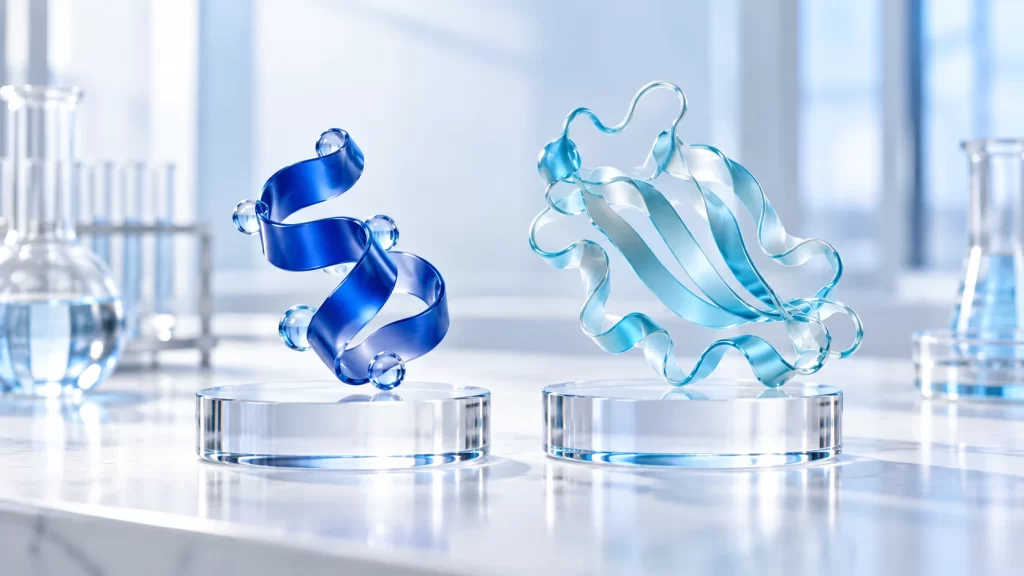
Cover illustration: AI-generated editorial artwork. Conceptual only; not an exact molecular structure, actual laboratory result or evidence of clinical effects.
Thymosin alpha-1 and thymosin beta-4 sound like two members of one family. They are not. They share a name because both were isolated from the same thymus extract in the 1960s and 1970s, before anyone knew what either did. Their sequences, sizes and functions are unrelated, and confusing them is one of the more common errors in peptide catalogues.
For laboratory research use only. The research materials supplied by HealthyWelness are not approved medicines, foods or cosmetics and are not for human or veterinary use. This article summarises published research and is not medical advice.
Key points
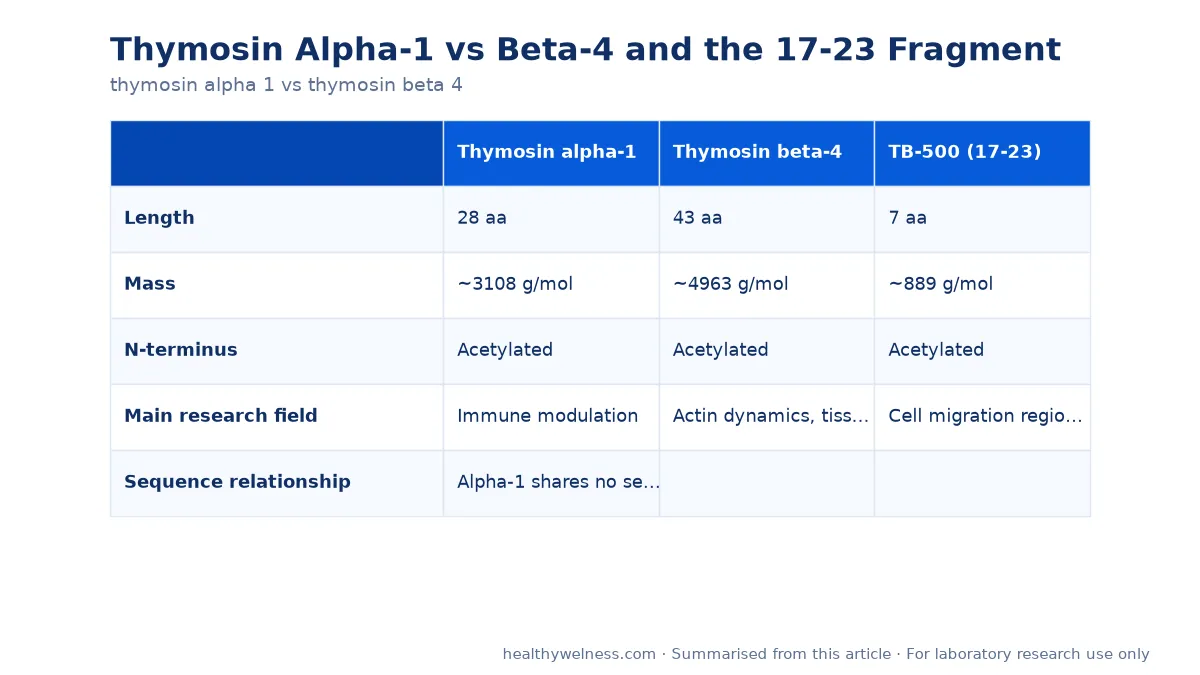
- Thymosin alpha-1: 28 residues, ~3108 g/mol, acetylated N-terminus, immune research.
- Thymosin beta-4: 43 residues, ~4963 g/mol, actin sequestration, tissue repair research.
- TB-500: residues 17–23 of beta-4 (Ac-LKKTETQ), ~889 g/mol.
- The shared name is historical, from “thymosin fraction 5”.
- All three are easily distinguished by mass spectrometry.
Three molecules compared
| Thymosin alpha-1 | Thymosin beta-4 | TB-500 (17-23) | |
|---|---|---|---|
| Length | 28 aa | 43 aa | 7 aa |
| Mass | ~3108 g/mol | ~4963 g/mol | ~889 g/mol |
| N-terminus | Acetylated | Acetylated | Acetylated |
| Main research field | Immune modulation | Actin dynamics, tissue repair | Cell migration region of beta-4 |
| Sequence relationship | Alpha-1 shares no sequence with beta-4; TB-500 is a sub-sequence of beta-4 | ||
Research material: thymosin alpha-1 and TB-500.
Where the shared name came from
Thymosin fraction 5 was a mixture of polypeptides from thymus extract that improved immune responses in early experiments. Several peptides were isolated from it and named by their position on the separation: thymosin alpha-1, polypeptide beta-1, thymosin beta-4. As Hannappel’s review puts it, none of the isolated peptides turned out to be a thymic hormone in the original sense; they were all biologically important peptides with diverse functions. Polypeptide beta-1 was later found to be ubiquitin truncated by two glycines. Thymosin beta-4’s actual function, sequestering G-actin, was only recognised in 1990 (Hannappel, 2007).
So the “thymosin” prefix records where these peptides were found, not what they do or how they relate to each other.
Thymosin alpha-1
Thymosin alpha-1 is a 28-residue acetylated peptide. Reviews describe it as long recognised for modifying, enhancing and restoring immune function, and it has been studied in immunocompromised states, as a vaccine response enhancer, and in sepsis and infections (Dominari et al., 2020). It has been formulated as a pharmaceutical product under the name thymalfasin (Ancell et al., 2001). Its research literature is therefore immunological, with essentially no overlap with the actin and wound-repair literature of the beta-thymosins.
Thymosin beta-4 and its fragments
Thymosin beta-4 is the main intracellular G-actin-sequestering peptide in most vertebrate cells. Different activities map to different short sequences within it (Sosne et al., 2010):
| Region | Sequence | Attributed activity | Present in TB-500? |
|---|---|---|---|
| 1–4 | Ac-SDKP | Anti-inflammatory, anti-fibrotic | No |
| 1–15 | Includes Ac-SDKP | Cell survival, anti-apoptotic | No |
| 17–23 | LKKTETQ | Angiogenesis, migration, wound repair | Yes |
TB-500 therefore represents one third of the mapped activity profile. An analytical study confirmed that a commercial TB-500 preparation contained N-acetylated LKKTETQ (Ho et al., 2012). Full-length Tβ4 has itself been taken into clinical trials in eye, skin, cardiac and neurological injury (Goldstein et al., 2015), but those results belong to the protein, not the fragment. See what is TB-500? and TB-500 half-life and mechanism.
Practical consequences
- Do not cite alpha-1 literature for beta-4 work, or vice versa. They are separate fields.
- Do not transfer full-length Tβ4 findings to TB-500 without noting which region was responsible.
- Verify by mass. 889, 3108 and 4963 Da are far apart; a single MS result settles which molecule a vial holds.
- Handle differently. The heptapeptide is a robust short peptide; the 43-residue and 28-residue peptides are larger and more sensitive to agitation and freeze–thaw. Thymosin alpha-1 and beta-4 both contain residues that can oxidise, so protect them from light and air.
Storage for all three: powder at −20 °C, solutions at 2–8 °C, protected from light. Concentrations: peptide reconstitution calculator; method in reconstituting TB-500.
Open questions
- Does the isolated 17–23 fragment reproduce the actin-related activity of that region within the folded protein?
- Would a fragment containing both Ac-SDKP and LKKTETQ behave differently from either alone?
- Is there any functional connection between the alpha and beta thymosins beyond their shared origin?
Related research
Frequently asked questions
What is the difference between thymosin alpha-1 and thymosin beta-4?
They are different molecules with different sequences, sizes and functions. Thymosin alpha-1 is a 28-residue acetylated peptide studied as an immune modulator. Thymosin beta-4 is a 43-residue actin-sequestering peptide studied in tissue repair. They share only the historical name of the thymus extract both were isolated from.
Why do they share a name?
Both were isolated from ‘thymosin fraction 5’, a mixture of polypeptides from thymus extract. Later work showed that none of the isolated peptides was really a thymic hormone, and that they had diverse, unrelated functions.
Is TB-500 the same as thymosin beta-4?
No. TB-500 is based on residues 17-23 (LKKTETQ), the central actin-binding region, with an acetylated N-terminus. It is about 889 Da against roughly 4963 Da for the full protein.
What is the difference between TB-500 and the 'fragment 17-23'?
They refer to the same region. ‘TB-500’ is the product name and ‘fragment 17-23’ describes which residues it corresponds to.
Can they be told apart analytically?
Easily. Thymosin alpha-1 is about 3108 Da, TB-500 about 889 Da and thymosin beta-4 about 4963 Da, so mass spectrometry distinguishes all three.
For laboratory research use only. The research materials supplied by HealthyWelness are not approved medicines, foods or cosmetics and are not for human or veterinary use. This article summarises published research and is not medical advice.
Sources
- Hannappel E. beta-Thymosins. Ann N Y Acad Sci. 2007. PMID: 17468232
- Sosne G, et al. Biological activities of thymosin beta4 defined by active sites in short peptide sequences. FASEB J. 2010. PMID: 20179146
- Ho EN, et al. Doping control analysis of TB-500, a synthetic version of an active region of thymosin β₄, in equine urine and plasma by liquid chromatography-mass spectrometry. J Chromatogr A. 2012. PMID: 23084823
- Dominari A, et al. Thymosin alpha 1: A comprehensive review of the literature. World J Virol. 2020. PMID: 33362999
- Ancell CD, et al. Thymosin alpha-1. Am J Health Syst Pharm. 2001. PMID: 11381492
- Goldstein AL, et al. Advances in the basic and clinical applications of thymosin β4. Expert Opin Biol Ther. 2015. PMID: 26096726
- PubChem Compound Summary for CID 16130571, Thymalfasin (thymosin alpha-1). National Center for Biotechnology Information.