Myostatin Pathway Research Compounds Compared
GDF-8, Follistatin 344 and ACE-031 all appear in myostatin pathway research but act at different points. A comparison of what each one is.


Cover illustration: AI-generated editorial artwork. Conceptual only; not an exact molecular structure, actual laboratory result or evidence of clinical effects.
Three names appear repeatedly in myostatin pathway research catalogues: GDF-8, Follistatin 344 and ACE-031. They are often listed together as though interchangeable. They are not: one is the ligand itself, one is a ligand-binding protein, and one is an engineered decoy receptor. Knowing which is which determines what an experiment can actually test.
For laboratory research use only. The research materials supplied by HealthyWelness are not approved medicines, foods or cosmetics and are not for human or veterinary use. This article summarises published research and is not medical advice.
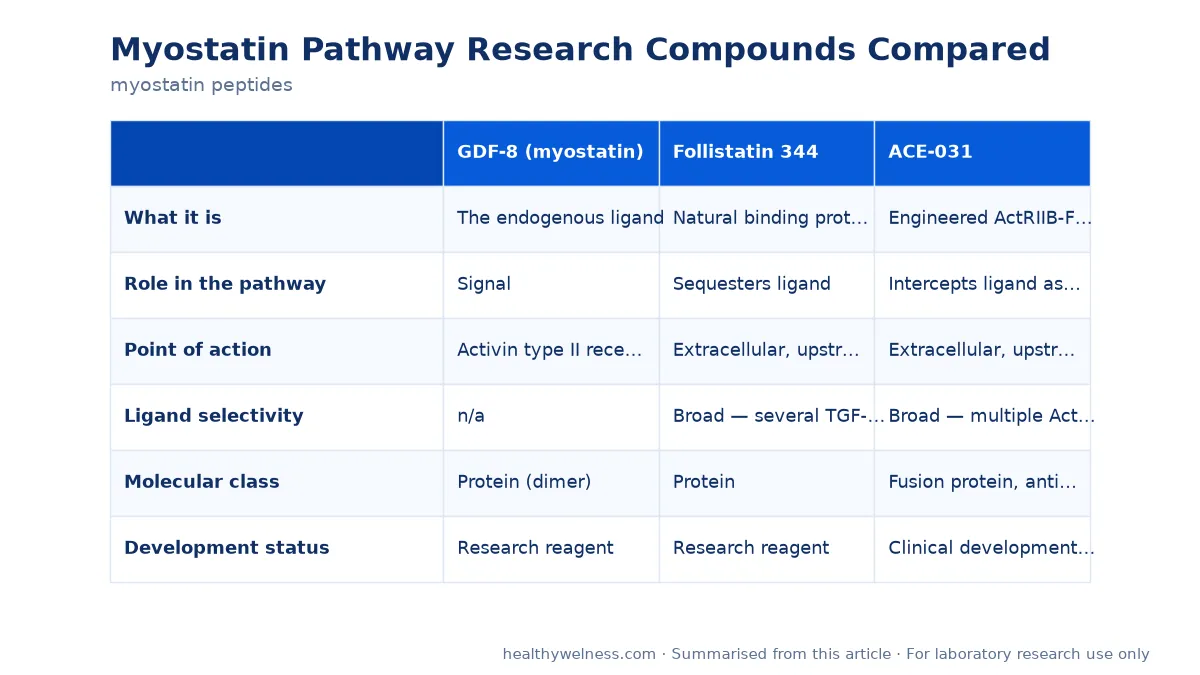
At a glance
| GDF-8 (myostatin) | Follistatin 344 | ACE-031 | |
|---|---|---|---|
| What it is | The endogenous ligand | Natural binding protein isoform | Engineered ActRIIB-Fc fusion |
| Role in the pathway | Signal | Sequesters ligand | Intercepts ligand as decoy |
| Point of action | Activin type II receptors | Extracellular, upstream of receptor | Extracellular, upstream of receptor |
| Ligand selectivity | n/a | Broad — several TGF-beta ligands | Broad — multiple ActRIIB ligands |
| Molecular class | Protein (dimer) | Protein | Fusion protein, antibody-sized |
| Development status | Research reagent | Research reagent | Clinical development discontinued |
GDF-8: the ligand
Myostatin, formally growth/differentiation factor 8, belongs to the TGF-beta superfamily. It is secreted as a latent complex, processed, and signals through activin type II receptors (ActRIIA and ActRIIB) and downstream Smad proteins. Its characterisation as a negative regulator of skeletal muscle mass came from genetic work, and the 2001 PNAS paper by Lee and colleagues is a standard reference for how its activity is regulated extracellularly.
In the laboratory, recombinant GDF-8 is used as the stimulus, not the intervention — for example to establish a baseline Smad response in a reporter cell line before testing an inhibitor against it.
Follistatin: the binding protein
Follistatin binds several TGF-beta superfamily ligands with high affinity, including activins and myostatin, preventing receptor engagement. The “344” in Follistatin 344 is an isoform designation; follistatin occurs naturally in more than one form, differing in length and in whether the molecule associates with cell-surface heparan sulfate.
That breadth of ligand binding is the key interpretive point. Follistatin is not a myostatin-specific tool. An effect observed after adding follistatin cannot be attributed to myostatin blockade alone without controls, because activin signalling is affected in parallel. This limitation is explicit in the literature, and it motivated work such as the 2020 study by Saitoh and colleagues that derived a short peptide from follistatin in the search for narrower selectivity.
ACE-031: the decoy receptor
ACE-031 takes the opposite engineering route. Rather than using a natural binding protein, it fuses the extracellular ligand-binding domain of ActRIIB to an immunoglobulin Fc region. The receptor domain captures circulating ligands; the Fc region confers the long circulating half-life characteristic of antibody-derived therapeutics.
Its clinical development was discontinued. The 2022 Endocrine Reviews article by Rodgers and colleagues is the most useful single source here, because it reviews the development status of the whole class of attenuating agents rather than one molecule. Any catalogue description that presents ACE-031 without this context is incomplete: the discontinuation is part of what is known about it.
Why “upstream of the receptor” matters
Both follistatin and ACE-031 act in the extracellular space, intercepting ligands. Neither targets the receptor itself or anything intracellular. Two consequences follow for study design:
- Selectivity is set by ligand binding, not by receptor targeting. Anything else that binds the same decoy or binding protein is also removed from the system.
- Effects scale with ligand abundance. In a system with little ligand present, a sequestering agent has little to do, which can make results look inconsistent across models.
Handling in the lab
| Consideration | Short peptides | These proteins |
|---|---|---|
| Freeze–thaw tolerance | Moderate | Low — aliquot on first reconstitution |
| Surface adsorption at low concentration | Significant | Significant — carrier protein commonly used |
| Vigorous mixing | Tolerated | Avoid — shear and foaming risk denaturation |
| Identity confirmation | MS of intact mass | SDS-PAGE plus activity assay; intact MS is less informative |
| Diluent | Water or bacteriostatic water | Buffered solution per the data sheet |
The practical rule: do not treat a protein like a short peptide. Loss of a protein’s folded structure destroys binding activity with no visible change in the vial, so an inactive result can be a handling artefact rather than a finding. Concentration maths for the peptide members of a study set is covered by our reconstitution calculator.
Our Follistatin 344 research material is supplied for laboratory research use. Certificates are available for listed products — contact us for the latest report.
Open questions
- Can myostatin-selective inhibition be achieved without affecting activin signalling, and what does that separation cost in potency?
- What accounts for differences in reported effect size between genetic and pharmacological pathway blockade?
- How do short follistatin-derived peptides compare with the full binding protein on selectivity?
Related research
Frequently asked questions
What is myostatin?
Myostatin, also called GDF-8, is a member of the TGF-beta superfamily. It signals through activin type II receptors and acts as a negative regulator of skeletal muscle mass in the organisms where it has been studied.
How does follistatin relate to myostatin?
Follistatin is a binding protein that sequesters several TGF-beta superfamily ligands, including myostatin and activins. Binding the ligand prevents it reaching its receptor, so follistatin is described as acting upstream of the receptor.
What is ACE-031?
ACE-031 is a fusion protein consisting of the extracellular domain of the activin receptor type IIB joined to an antibody Fc region. It acts as a decoy receptor, binding ligands before they reach the cell-surface receptor. Its clinical development was discontinued.
Is Follistatin 344 the same as natural follistatin?
No. Follistatin 344 refers to a specific isoform designation. Natural follistatin exists in multiple isoforms produced by alternative splicing and processing, which differ in length and in tissue distribution.
Are these compounds peptides?
Not in the short-peptide sense. Myostatin, follistatin and ACE-031 are proteins, substantially larger than the 10 to 40 residue peptides most research catalogues list. That difference matters for handling and for stability.
References
- Rodgers BD, et al. Myostatin/Activin Receptor Ligands in Muscle and the Development Status of Attenuating Drugs. Endocr Rev. 2022. PMID: 34520530 https://pubmed.ncbi.nlm.nih.gov/34520530/
- Lee SJ, et al. Regulation of myostatin activity and muscle growth. Proc Natl Acad Sci U S A. 2001. PMID: 11459935 https://pubmed.ncbi.nlm.nih.gov/11459935/
- Saitoh M, et al. Discovery of a follistatin-derived myostatin inhibitory peptide. Bioorg Med Chem Lett. 2020. PMID: 31874826 https://pubmed.ncbi.nlm.nih.gov/31874826/
For laboratory research use only. The research materials supplied by HealthyWelness are not approved medicines, foods or cosmetics and are not for human or veterinary use. This article summarises published research and is not medical advice.
Sources
- Rodgers BD, et al. Myostatin/Activin Receptor Ligands in Muscle and the Development Status of Attenuating Drugs. Endocr Rev. 2022. PMID: 34520530
- Lee SJ, et al. Regulation of myostatin activity and muscle growth. Proc Natl Acad Sci U S A. 2001. PMID: 11459935
- Saitoh M, et al. Discovery of a follistatin-derived myostatin inhibitory peptide. Bioorg Med Chem Lett. 2020. PMID: 31874826