BPC-157 vs GHK-Cu: Peptide Versus Metal Complex
One is a 15-residue peptide, the other a copper-coordinated tripeptide. The metal changes everything about handling, controls and interpretation.

Cover illustration: AI-generated editorial artwork. Conceptual only; not an exact molecular structure, actual laboratory result or evidence of clinical effects.
This comparison is usually framed as two tissue-repair peptides. It is more accurately framed as a peptide versus a metal complex, and once that is clear, most of the practical differences between them follow automatically — what buffer each needs, what controls each requires, and what an experiment with each can actually conclude.
For laboratory research use only. The research materials supplied by HealthyWelness are not approved medicines, foods or cosmetics and are not for human or veterinary use. This article summarises published research and is not medical advice.
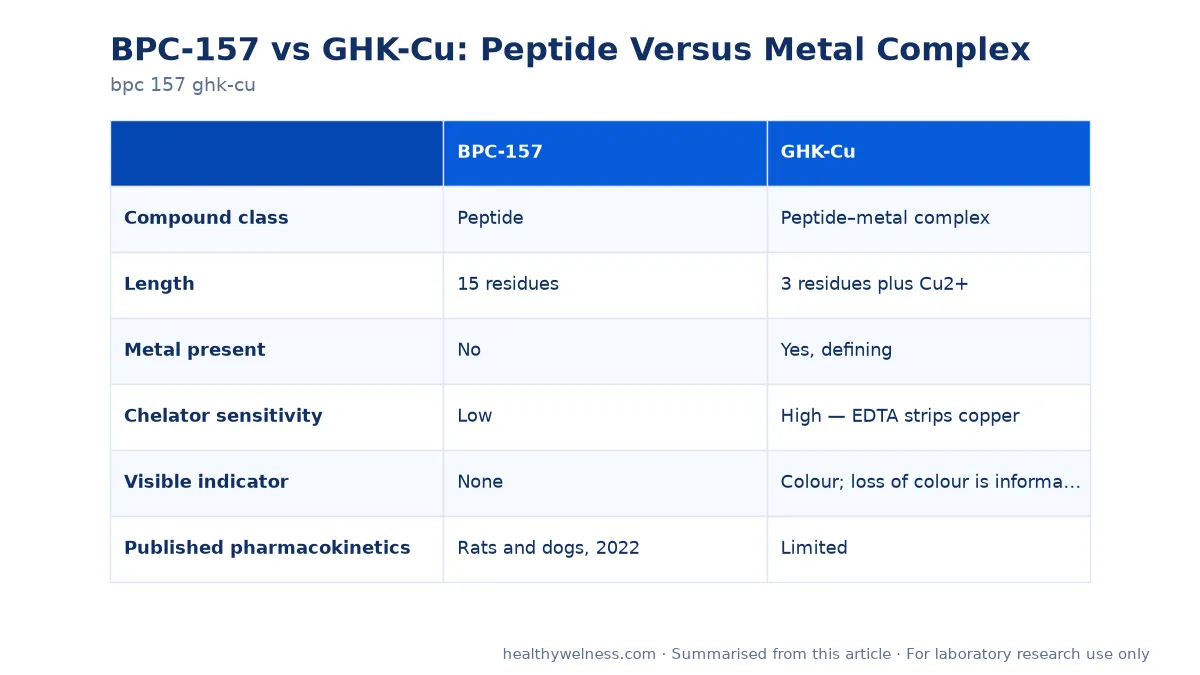
Side by side
| BPC-157 | GHK-Cu | |
|---|---|---|
| Compound class | Peptide | Peptide–metal complex |
| Length | 15 residues | 3 residues plus Cu2+ |
| Metal present | No | Yes, defining |
| Chelator sensitivity | Low | High — EDTA strips copper |
| Visible indicator | None | Colour; loss of colour is informative |
| Published pharmacokinetics | Rats and dogs, 2022 | Limited |
| Flagship primary study | Multiple rodent models | J Clin Invest 1993, rat wounds |
| Extra controls needed | Standard | Copper salt and apo-peptide |
The copper question
This is the single most consequential difference and the one most often passed over. GHK-Cu delivers copper. Copper is not an inert carrier: it participates in redox chemistry and serves as a cofactor for enzymes involved in connective tissue cross-linking.
So when an effect is observed with GHK-Cu, three explanations compete:
- The tripeptide acts as a signalling entity, with copper incidental.
- The complex delivers copper in a bioavailable form, and the copper produces the effect.
- Both contribute, perhaps interdependently.
Distinguishing these needs a control set that is rarely reported: copper salt alone at matched copper concentration, the apo-peptide without copper, and ideally a comparable copper chelate that is not GHK. Without those arms, an experiment characterises the complex as a whole. That may be a perfectly reasonable thing to study — but it should be described as such rather than as a finding about the peptide.
BPC-157 has no equivalent ambiguity. It is a peptide, and an effect observed with it is an effect of a peptide. Its interpretive difficulty is different and lies elsewhere.
Where each one’s evidence is strong
GHK-Cu’s foundation is the 1993 paper by Maquart and colleagues in the Journal of Clinical Investigation, which reported in vivo stimulation of connective tissue accumulation by the tripeptide–copper complex in rat experimental wounds. That is a primary in vivo study in a major journal from an independent group, and its specific claim is well supported. The 2008 review by Pickart and the 2025 tripeptide review by Adnan and colleagues provide the wider framing; the authorship concentration in the GHK review literature is discussed in the GHK-Cu research review.
BPC-157’s distinctive strength is different in kind. The 2022 study by He and colleagues characterised pharmacokinetics, distribution, metabolism and excretion in rats and dogs. Published pharmacokinetic data is uncommon in this product category, and it is what allows exposure expectations in an animal model to be grounded in measurement rather than inference.
So the two are not strong and weak; they are strong on different axes. GHK-Cu has a cleaner flagship efficacy study in a single model; BPC-157 has better-characterised disposition and a larger body of models.
Buffer compatibility, which is a real problem
A shared buffer for both compounds has to satisfy two requirements that pull in opposite directions.
- GHK-Cu requires no competing chelators. EDTA and similar additives remove copper from the complex. A buffer containing EDTA does not contain GHK-Cu for long.
- Peptides generally benefit from low trace metal. Metal-catalysed oxidation at histidine is a documented degradation route, characterised by Khossravi and colleagues in model peptides, and chelators are sometimes added precisely to suppress it.
The resolution is to use a clean, low-metal diluent without added chelator, and to accept that this is a compromise. It is also a reason to prepare the two compounds separately and combine them at the point of use rather than storing a mixed stock.
GHK-Cu’s visible colour is a genuine asset here. A copper complex of this kind is coloured, and a solution that has lost its colour has lost its copper coordination. Few research compounds give such a direct readout of integrity, and it is worth using.
Handling summary
| Step | BPC-157 | GHK-Cu |
|---|---|---|
| Solid storage | −20 °C, dry, dark | −20 °C, dry, dark |
| Diluent | Water or bacteriostatic water | Chelator-free; per certificate |
| Molecular weight for maths | Of the peptide salt | Of the complex, not the free tripeptide |
| Integrity check | Analytical | Colour, plus analytical |
| Aliquot after reconstitution | Yes | Yes |
The molecular weight row is a frequent source of error for GHK-Cu: the complex’s mass includes the copper and the tripeptide, and using the free peptide’s value understates the mass and overstates the molarity. Our reconstitution calculator takes molecular weight as an explicit input so this is a deliberate choice.
Our BPC-157 research material is supplied for laboratory research use. Certificates are available for listed products — contact us for the latest report. See reading a certificate of analysis.
Open questions
- How much of GHK-Cu’s activity survives replacement of the peptide with another copper chelate?
- Does BPC-157 have an identified receptor, or does its mechanism remain inferred from downstream signalling?
- Has either been studied in the presence of the other in any published work?
Related research
Frequently asked questions
What is the fundamental difference between them?
GHK-Cu is a metal complex: a tripeptide coordinating a copper ion, and the copper is part of the defined molecule. BPC-157 is a conventional 15-residue peptide with no metal. That makes them different classes of compound, not two peptides.
Why does the copper complicate interpretation?
Because copper is biologically active in its own right. An effect observed with GHK-Cu could come from the peptide acting as a signal, from the copper delivered in a bioavailable form, or from both. Separating these requires controls that are rarely reported.
Can they be used in the same buffer?
With care. Chelating agents such as EDTA strip copper from GHK-Cu, and trace metal contamination accelerates oxidation of peptides generally. A buffer suitable for one may be unsuitable for the other, so a shared buffer needs checking against both requirements.
Which has the stronger primary evidence?
They are strong in different ways. GHK-Cu has a 1993 Journal of Clinical Investigation paper on connective tissue accumulation in rat wounds. BPC-157 has a larger rodent literature plus published pharmacokinetics in rats and dogs and recent systematic reviews.
What controls does a GHK-Cu experiment need?
At minimum, copper salt alone at matched copper concentration, and the apo-peptide without copper. Without these, the experiment characterises the complex rather than the peptide, which may be the intention but should be stated.
References
- Maquart FX, et al. In vivo stimulation of connective tissue accumulation by the tripeptide-copper complex glycyl-L-histidyl-L-lysine-Cu2+ in rat experimental wounds. J Clin Invest. 1993. PMID: 8227353 https://pubmed.ncbi.nlm.nih.gov/8227353/
- Pickart L. The human tri-peptide GHK and tissue remodeling. J Biomater Sci Polym Ed. 2008. PMID: 18644225 https://pubmed.ncbi.nlm.nih.gov/18644225/
- He L, et al. Pharmacokinetics, distribution, metabolism, and excretion of body-protective compound 157, a potential drug for treating various wounds, in rats and dogs. Front Pharmacol. 2022. PMID: 36588717 https://pubmed.ncbi.nlm.nih.gov/36588717/
- Khossravi M, et al. Chemical pathways of peptide degradation: IX. Metal-catalyzed oxidation of histidine in model peptides. Pharm Res. 1998. PMID: 9688066 https://pubmed.ncbi.nlm.nih.gov/9688066/
- Adnan SB, et al. Exploring the Role of Tripeptides in Wound Healing and Skin Regeneration: A Comprehensive Review. Int J Med Sci. 2025. PMID: 41209547 https://pubmed.ncbi.nlm.nih.gov/41209547/
For laboratory research use only. The research materials supplied by HealthyWelness are not approved medicines, foods or cosmetics and are not for human or veterinary use. This article summarises published research and is not medical advice.
Sources
- Maquart FX, et al. In vivo stimulation of connective tissue accumulation by the tripeptide-copper complex glycyl-L-histidyl-L-lysine-Cu2+ in rat experimental wounds. J Clin Invest. 1993. PMID: 8227353
- Pickart L. The human tri-peptide GHK and tissue remodeling. J Biomater Sci Polym Ed. 2008. PMID: 18644225
- He L, et al. Pharmacokinetics, distribution, metabolism, and excretion of body-protective compound 157, a potential drug for treating various wounds, in rats and dogs. Front Pharmacol. 2022. PMID: 36588717
- Khossravi M, et al. Chemical pathways of peptide degradation: IX. Metal-catalyzed oxidation of histidine in model peptides. Pharm Res. 1998. PMID: 9688066
- Adnan SB, et al. Exploring the Role of Tripeptides in Wound Healing and Skin Regeneration: A Comprehensive Review. Int J Med Sci. 2025. PMID: 41209547