Sermorelin Reconstitution, Half-Life and Storage
Sermorelin is GHRH(1-29), a 29-residue peptide with a short measured half-life. Reconstitution maths, stability chemistry and storage practice.

Cover illustration: AI-generated editorial artwork. Conceptual only; not an exact molecular structure, actual laboratory result or evidence of clinical effects.
Sermorelin is GHRH(1–29) amide: the first twenty-nine residues of growth hormone releasing hormone, with an amidated C-terminus. Everything practical about handling it follows from two facts — it is a native sequence with no stabilising substitution, and it is long enough to have several distinct chemical vulnerabilities rather than one.
For laboratory research use only. The research materials supplied by HealthyWelness are not approved medicines, foods or cosmetics and are not for human or veterinary use. This article summarises published research and is not medical advice.
Why the half-life is short, structurally
The vulnerability is at position 2. Dipeptidyl peptidase-4 cleaves after the second residue of GHRH, removing the first two amino acids and inactivating the peptide. Sermorelin carries the native L-alanine there and has no protection against this.
That the modified analogues exist at all is the clearest evidence of how significant this is. The 1985 study by Barron and colleagues in Peptides compared GHRH(1–29)-NH2 with a D-Ala2 analogue — and the reason to make a D-Ala2 analogue is precisely to block the enzyme that attacks position 2. The 1997 study by Khorram and colleagues used a different modified version, [norleucine27]GHRH(1–29)-NH2, substituting at another position.
Reading the analogue literature backwards tells you where the parent peptide is weak. Every substitution that someone bothered to make marks a liability in the native sequence.
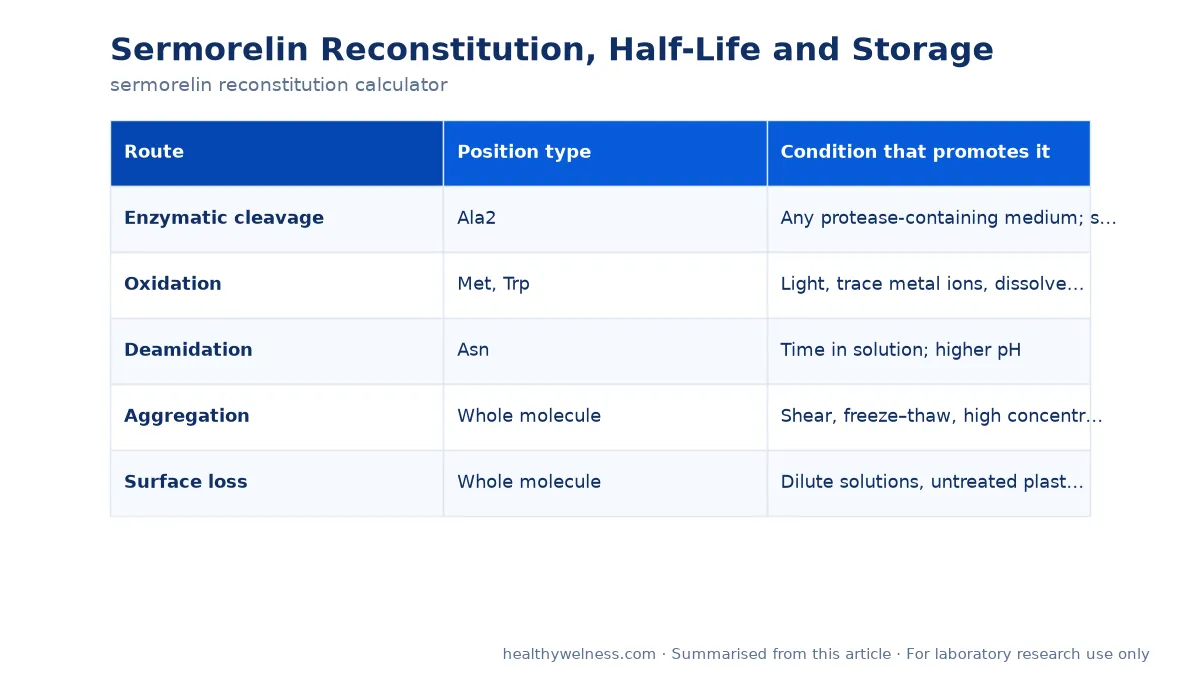
The vulnerable positions in a 29-mer
| Route | Position type | Condition that promotes it |
|---|---|---|
| Enzymatic cleavage | Ala2 | Any protease-containing medium; serum |
| Oxidation | Met, Trp | Light, trace metal ions, dissolved oxygen |
| Deamidation | Asn | Time in solution; higher pH |
| Aggregation | Whole molecule | Shear, freeze–thaw, high concentration |
| Surface loss | Whole molecule | Dilute solutions, untreated plastics |
A short hexapeptide has one or two of these. A 29-residue peptide containing methionine, tryptophan and asparagine has all of them, which is why sermorelin is handled more carefully than the small secretagogues it is often compared with.
Methionine is the most readily oxidised of the common residues, and the resulting sulfoxide adds 16 Da — detectable by mass spectrometry if anyone looks. The 1998 work by Khossravi and colleagues on metal-catalysed oxidation in model peptides establishes why keeping trace metals out of the diluent is a genuine precaution rather than a ritual.
Reconstitution
The arithmetic is straightforward; the inputs are where errors occur.
- Read the net peptide content from the certificate, not the vial label’s nominal weight. Acetate counterion and residual water are real mass. For a peptide with several basic residues this correction can be a double-digit percentage.
- Decide the target concentration from the experiment, not from convenience. Higher concentrations are more prone to aggregation; very dilute ones lose material to surfaces.
- Compute the volume. Our reconstitution calculator takes net mass, molecular weight and target concentration directly.
- Add the diluent slowly down the inside wall of the vial. Do not squirt it onto the lyophilized cake and do not vortex. Swirl until dissolved.
- Aliquot immediately into single-use volumes. Date and label each tube with the concentration.
The order of those steps matters: aliquoting is the last step and it should happen at once, not after the solution has sat on the bench while something else is prepared.
Storage of solid and of solution
| State | Condition | Rationale |
|---|---|---|
| Sealed lyophilized | −20 °C, dry, dark | Residual moisture and oxygen both reduce solid-state stability |
| Opened lyophilized | Reseal with desiccant; return to −20 °C | The powder is hygroscopic once exposed |
| Reconstituted, in use | Refrigerated, short term | Convenience over days; chemical routes still proceed |
| Reconstituted, stored | Aliquoted, frozen | Avoids repeated freeze–thaw of one tube |
| Diluted working solution | Prepare fresh | Dilute peptide is lost to surfaces and degrades faster |
The solid-state point is better documented than people expect. The 1992 study by Pikal and colleagues examined freeze-dried human growth hormone formulations and the effects of moisture and oxygen on their stability. The peptide there is different but the finding generalises: a lyophilized powder is not inert, and its stability depends on how dry and how oxygen-free it is kept. This is the argument for desiccant and for resealing properly rather than relying on the freezer alone.
For solution stability, the 1998 study by Gietz and colleagues on recombinant hirudin degradation kinetics in aqueous solution is a good illustration of how strongly pH governs the rate. The practical upshot is that the buffer is a stability variable, and recording it is part of recording the experiment.
Relating this to the half-life question
People searching for a half-life figure usually want to know how long the peptide persists in a biological system. The honest answer is that this is short for sermorelin, and the more useful answer is that it is governed by an enzyme — so the number depends on the system. In a protease-free buffer, chemical degradation routes dominate and the timescale is quite different from that in serum-containing medium.
For experimental design, that means the relevant stability question is which of the two environments the experiment uses. See storing reconstituted peptides for the general practice.
Our sermorelin acetate research material is supplied for laboratory research use. Certificates are available for listed products — contact us for the latest report.
Open questions
- How much does measured stability differ between protease-free buffer and serum-containing medium?
- What fraction of a dilute working solution is lost to surfaces in common plasticware?
- How quickly does methionine oxidation become detectable under ordinary bench conditions?
Related research
Frequently asked questions
What is sermorelin's half-life?
Short. Sermorelin is the 1-29 fragment of growth hormone releasing hormone, and native GHRH is cleaved rapidly at the Ala2 position by dipeptidyl peptidase-4. Published work on GHRH(1-29) and its D-Ala2 analogue was motivated precisely by that vulnerability, which is why the modified analogues exist.
Why is the Ala2 position so important?
Because dipeptidyl peptidase-4 removes the first two residues, and that cleavage inactivates the peptide. Substituting a D-amino acid at position 2 blocks the enzyme. Sermorelin itself carries the native L-Ala, so it has no such protection.
How is reconstitution volume calculated?
From the net peptide mass and the target concentration. The net mass is not the vial weight: the acetate counterion and residual water both contribute to what the balance reads. Using gross weight gives a solution more dilute than intended.
Should reconstituted sermorelin be refrigerated or frozen?
Aliquoted and frozen is the standard practice for a peptide intended for use over more than a few days, with refrigeration for material in active use over a short period. The point of aliquoting is to avoid repeatedly warming and refreezing a single tube.
What degrades sermorelin in solution?
Enzymatic cleavage in any protease-containing medium, and chemical routes in buffer: oxidation at its methionine and tryptophan residues, and deamidation at asparagine. A 29-residue peptide has more vulnerable positions than a short one.
References
- Barron JL, et al. Growth hormone responses to growth hormone-releasing hormone (1-29)-NH2 and a D-Ala2 analog in normal men. Peptides. 1985. PMID: 2866496 https://pubmed.ncbi.nlm.nih.gov/2866496/
- Khorram O, et al. Effects of [norleucine27]growth hormone-releasing hormone (GHRH) (1-29)-NH2 administration on the immune system of aging men and women. J Clin Endocrinol Metab. 1997. PMID: 9360512 https://pubmed.ncbi.nlm.nih.gov/9360512/
- Khossravi M, et al. Chemical pathways of peptide degradation: IX. Metal-catalyzed oxidation of histidine in model peptides. Pharm Res. 1998. PMID: 9688066 https://pubmed.ncbi.nlm.nih.gov/9688066/
- Pikal MJ, et al. Formulation and stability of freeze-dried proteins: effects of moisture and oxygen on the stability of freeze-dried formulations of human growth hormone. Dev Biol Stand. 1992. PMID: 1592171 https://pubmed.ncbi.nlm.nih.gov/1592171/
- Gietz U, et al. Chemical degradation kinetics of recombinant hirudin (HV1) in aqueous solution: effect of pH. Pharm Res. 1998. PMID: 9755900 https://pubmed.ncbi.nlm.nih.gov/9755900/
For laboratory research use only. The research materials supplied by HealthyWelness are not approved medicines, foods or cosmetics and are not for human or veterinary use. This article summarises published research and is not medical advice.
Sources
- Barron JL, et al. Growth hormone responses to growth hormone-releasing hormone (1-29)-NH2 and a D-Ala2 analog in normal men. Peptides. 1985. PMID: 2866496
- Khorram O, et al. Effects of [norleucine27]growth hormone-releasing hormone (GHRH) (1-29)-NH2 administration on the immune system of aging men and women. J Clin Endocrinol Metab. 1997. PMID: 9360512
- Khossravi M, et al. Chemical pathways of peptide degradation: IX. Metal-catalyzed oxidation of histidine in model peptides. Pharm Res. 1998. PMID: 9688066
- Pikal MJ, et al. Formulation and stability of freeze-dried proteins: effects of moisture and oxygen on the stability of freeze-dried formulations of human growth hormone. Dev Biol Stand. 1992. PMID: 1592171
- Gietz U, et al. Chemical degradation kinetics of recombinant hirudin (HV1) in aqueous solution: effect of pH. Pharm Res. 1998. PMID: 9755900