Dihexa vs Semax: Lipophilic Analogue or Short Peptide
Semax is a water-soluble ACTH fragment analogue; Dihexa is a lipophilic angiotensin IV derivative with a retracted key paper. A careful comparison.


Cover illustration: AI-generated editorial artwork. Conceptual only; not an exact molecular structure, actual laboratory result or evidence of clinical effects.
These two compounds get compared because both are marketed within the same research niche. Chemically and evidentially they are quite different, and one of those differences deserves stating up front: Dihexa’s most-cited mechanistic paper was retracted in 2025, which changes how its literature should be read. Semax has no comparable problem.
For laboratory research use only. The research materials supplied by HealthyWelness are not approved medicines, foods or cosmetics and are not for human or veterinary use. This article summarises published research and is not medical advice.
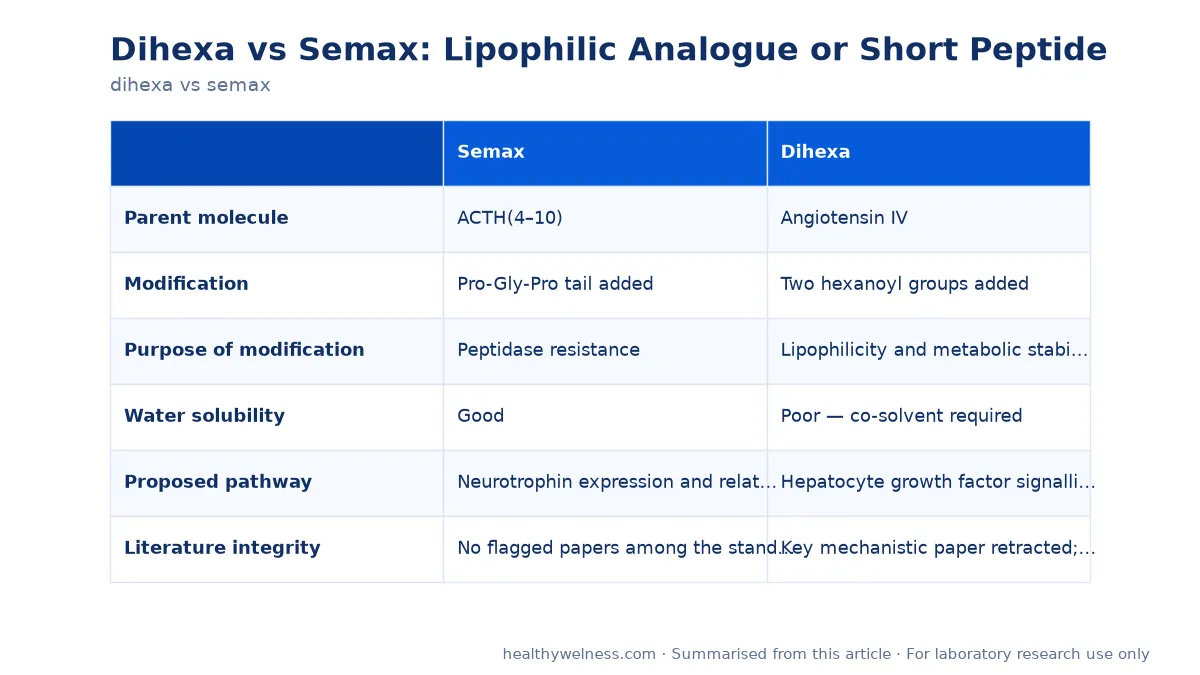
Side by side
| Semax | Dihexa | |
|---|---|---|
| Parent molecule | ACTH(4–10) | Angiotensin IV |
| Modification | Pro-Gly-Pro tail added | Two hexanoyl groups added |
| Purpose of modification | Peptidase resistance | Lipophilicity and metabolic stability |
| Water solubility | Good | Poor — co-solvent required |
| Proposed pathway | Neurotrophin expression and related | Hepatocyte growth factor signalling |
| Literature integrity | No flagged papers among the standard references | Key mechanistic paper retracted; a second flagged |
| Handling difficulty | Low | Moderate — precipitation risk |
Two different answers to the same design problem
Both compounds exist because a short native fragment was not usable as a reagent. The responses diverged.
Semax added a proline-rich tail. Pro-Gly-Pro appended to the ACTH(4–10) sequence resists many peptidases while keeping the molecule polar and water-soluble. The same tail appears on Selank, derived from an unrelated parent, which shows it is a general-purpose stabilising device — see Selank storage and stability.
Dihexa added lipid chains. Two hexanoyl groups on a short angiotensin IV-derived core raise lipophilicity substantially. That achieves stability and membrane permeability at the cost of aqueous solubility, which becomes the first practical obstacle at the bench.
Neither approach is better in the abstract. They produce reagents with opposite handling profiles, and the choice between them in an experiment is partly a choice about which inconvenience to accept.
Reading Dihexa’s literature with the retraction in view
The specifics matter, because the frequently repeated claim that Dihexa is dramatically more potent than comparable compounds traces to the affected papers. A 2014 study in the Journal of Pharmacology and Experimental Therapeutics on the hepatocyte growth factor mechanism was retracted in 2025 and had carried an expression of concern since 2021; a 2013 paper from the same laboratory also carries an expression of concern. The detail is in what Dihexa is.
What remains is independent and unflagged:
- The 2021 study by Sun and colleagues in Brain Sciences, in APP/PS1 mice, from an unrelated group.
- The 2018 systematic review by Ho and colleagues, which surveys angiotensin IV-related experimental work as a body rather than relying on any single study.
That is a usable evidence base, and it is thinner than the citation counts suggest. Semax’s literature, by contrast, spans multiple independent groups: the 2010 study by Dmitrieva and colleagues on neurotrophin transcription, and the 2016 study by Magrì and colleagues on how N-terminal acetylation affects copper and zinc coordination — a chemistry paper that also explains why the acetylated variant is a distinct compound. See Semax variants compared.
The identity question in this category
The 2020 study by Vanhee and colleagues in Drug Testing and Analysis examined putative cognitive-enhancing research peptides found in seized pharmaceutical preparations. Its subject is precisely this product category, and it is a reason to verify rather than assume.
The checks differ by compound:
| Check | Semax | Dihexa |
|---|---|---|
| Stated sequence or structure | Seven residues; note whether acetylated | Core plus both acyl groups; note the salt |
| Observed mass | Close to definitive at this length | Must match the stated salt form |
| Counterion named | Relevant for mass | Relevant for mass and for cell work |
| Chromatogram | Shows co-present species | Retention informative for a lipophilic compound |
For Semax the acetylation question is a real one: N-acetyl Semax amidate is a different molecule with different coordination chemistry, as the 2016 paper demonstrates. For Dihexa the salt form governs the molecular weight, and the arithmetic is covered in Dihexa acetate: structure and salt form.
Practical handling
- Semax: aqueous diluent; store sealed, dry and dark at −20 °C; aliquot on first reconstitution. Concentration from net peptide content via our reconstitution calculator.
- Dihexa: organic co-solvent for the stock, dilute into aqueous medium last, match the co-solvent in the vehicle control, and inspect the diluted solution. Partial precipitation leaves an unknown concentration and preferentially affects the highest points in a series.
Our Dihexa research material is supplied for laboratory research use. Certificates are available for listed products — contact us for the latest report.
Open questions
- How much of Dihexa’s reputation survives removal of the retracted and flagged work?
- Does the lipophilic modification deliver the permeability advantage it was designed for, in independent hands?
- How do the two compounds compare on a single functional readout with matched exposure?
Related research
Frequently asked questions
What is the main difference between Dihexa and Semax?
Chemical character. Semax is a short water-soluble peptide derived from an ACTH fragment with a Pro-Gly-Pro stabilising tail. Dihexa is a short angiotensin IV-derived core carrying two hexanoyl groups, which makes it lipophilic and poorly water-soluble.
Do they act on the same system?
No. Semax derives from ACTH(4-10) and its published work involves neurotrophin expression and related pathways. Dihexa derives from angiotensin IV and its proposed mechanism concerns hepatocyte growth factor signalling. The parent systems are unrelated.
Which has the more reliable literature?
Semax, on balance. Its literature is spread across independent groups. Dihexa’s most-cited mechanistic paper was retracted in 2025 and a second from the same laboratory carries an expression of concern, so its evidence base requires filtering before use.
Which is easier to handle?
Semax. It dissolves in aqueous diluent and its proline-rich tail resists peptidases. Dihexa requires an organic co-solvent for a stock solution and can precipitate on dilution into aqueous medium, which is a silent failure mode.
Have either been found in seized preparations?
A 2020 study in Drug Testing and Analysis examined putative cognitive-enhancing research peptides in seized pharmaceutical preparations. Its existence is a reason to verify material identity in this category rather than assume it from a label.
References
- Dmitrieva VG, et al. Semax and Pro-Gly-Pro activate the transcription of neurotrophins and their receptor genes after cerebral ischemia. Cell Mol Neurobiol. 2010. PMID: 19633950 https://pubmed.ncbi.nlm.nih.gov/19633950/
- Sun X, et al. AngIV-Analog Dihexa Rescues Cognitive Impairment and Recovers Memory in the APP/PS1 Mouse via the PI3K/AKT Signaling Pathway. Brain Sci. 2021. PMID: 34827486 https://pubmed.ncbi.nlm.nih.gov/34827486/
- Ho JK, et al. Cognitive benefits of angiotensin IV and angiotensin-(1-7): A systematic review of experimental studies. Neurosci Biobehav Rev. 2018. PMID: 29733881 https://pubmed.ncbi.nlm.nih.gov/29733881/
- Magrì A, et al. Influence of the N-terminus acetylation of Semax, a synthetic analog of ACTH(4-10), on copper(II) and zinc(II) coordination and biological properties. J Inorg Biochem. 2016. PMID: 27586814 https://pubmed.ncbi.nlm.nih.gov/27586814/
- Vanhee C, et al. The occurrence of putative cognitive enhancing research peptides in seized pharmaceutical preparations: An incentive for controlling agencies to prepare for future encounters of the kind. Drug Test Anal. 2020. PMID: 31667971 https://pubmed.ncbi.nlm.nih.gov/31667971/
For laboratory research use only. The research materials supplied by HealthyWelness are not approved medicines, foods or cosmetics and are not for human or veterinary use. This article summarises published research and is not medical advice.
Sources
- Dmitrieva VG, et al. Semax and Pro-Gly-Pro activate the transcription of neurotrophins and their receptor genes after cerebral ischemia. Cell Mol Neurobiol. 2010. PMID: 19633950
- Sun X, et al. AngIV-Analog Dihexa Rescues Cognitive Impairment and Recovers Memory in the APP/PS1 Mouse via the PI3K/AKT Signaling Pathway. Brain Sci. 2021. PMID: 34827486
- Ho JK, et al. Cognitive benefits of angiotensin IV and angiotensin-(1-7): A systematic review of experimental studies. Neurosci Biobehav Rev. 2018. PMID: 29733881
- Magrì A, et al. Influence of the N-terminus acetylation of Semax, a synthetic analog of ACTH(4-10), on copper(II) and zinc(II) coordination and biological properties. J Inorg Biochem. 2016. PMID: 27586814
- Vanhee C, et al. The occurrence of putative cognitive enhancing research peptides in seized pharmaceutical preparations: An incentive for controlling agencies to prepare for future encounters of the kind. Drug Test Anal. 2020. PMID: 31667971