IGF-1 LR3 vs Sermorelin: Downstream Versus Upstream
Sermorelin acts at the top of the GH-IGF axis; IGF-1 LR3 is a modified version of the axis output. A comparison of upstream and downstream tools.


Cover illustration: AI-generated editorial artwork. Conceptual only; not an exact molecular structure, actual laboratory result or evidence of clinical effects.
These two compounds are the clearest example in a research catalogue of the same axis approached from both ends. Sermorelin acts at the top: a GHRH fragment engaging the GHRH receptor. IGF-1 LR3 is a modified version of what the axis produces, applied directly. The choice between them is a choice about how much of the system to keep in the experiment.
For laboratory research use only. The research materials supplied by HealthyWelness are not approved medicines, foods or cosmetics and are not for human or veterinary use. This article summarises published research and is not medical advice.
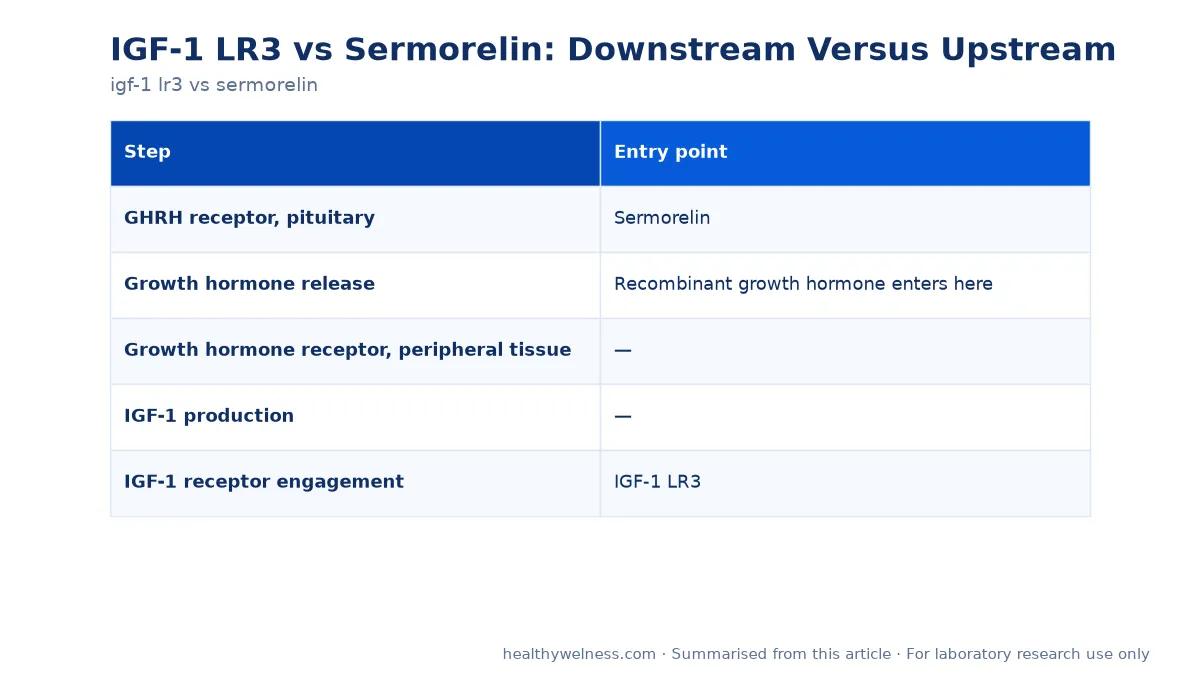
The axis, and where each compound enters it
| Step | Entry point |
|---|---|
| GHRH receptor, pituitary | Sermorelin |
| Growth hormone release | Recombinant growth hormone enters here |
| Growth hormone receptor, peripheral tissue | — |
| IGF-1 production | — |
| IGF-1 receptor engagement | IGF-1 LR3 |
Three rows separate the two entry points, and each of those rows is a regulated step. That is the substance of the comparison: an upstream intervention passes through regulation that a downstream one does not encounter.
What acting upstream preserves
Sermorelin is GHRH(1–29) amide, identical in sequence to the native hormone’s active region. An experiment using it keeps the whole downstream cascade intact, including the feedback that normally constrains it.
The 1985 study by Barron and colleagues compared GHRH(1–29)-NH2 with a D-Ala2 analogue, and the 1997 study by Khorram and colleagues used a norleucine-substituted version in older adults. Both work at the top of the axis and measure consequences further down — which is only informative because the intervening steps were left in place.
The cost is specificity of a different kind: an upstream intervention produces a diffuse readout. Many things change, and attributing a particular downstream observation to a particular intermediate step requires additional measurements.
What acting downstream isolates
IGF-1 LR3 carries a 13-residue N-terminal extension and an arginine at position 3, modifications whose purpose is to reduce capture by IGF binding proteins. The 1997 study by Tomas and colleagues established the principle across two species: variants binding poorly to IGF binding proteins show more prolonged action than native IGF-1.
Applying it directly isolates the final step of the axis. Everything upstream is removed from the experiment, which is exactly right when the question concerns the IGF-1 receptor and exactly wrong when the question concerns regulation.
There is a second consequence that is easy to overlook. The LR3 modifications remove part of the regulation deliberately. Binding proteins are not merely a clearance mechanism; they are a control layer. A variant engineered to evade them is a tool for bypassing that layer, and an experiment using it is not studying physiological IGF-1 signalling. The 1991 clearance study by Ballard and colleagues on a sibling variant is the measurement that makes this concrete.
The growth hormone comparison
Searches often pair IGF-1 LR3 with recombinant growth hormone instead. The same framework applies: growth hormone acts at its own receptor, one step above IGF-1 production, so the comparison is again between positions in a pathway rather than between two agents at one target.
The 2008 study by Hadsell and colleagues is a good illustration because it used both — mouse growth hormone and long-R3-IGF-I — in one mouse model, examining mammary signalling and gene expression. That design acknowledges the two are not interchangeable: it treats them as separate interventions whose signatures can be compared.
| If the question is | Use | Why |
|---|---|---|
| Does the IGF-1 receptor mediate this effect? | IGF-1 LR3 | Direct engagement; upstream removed |
| Does axis stimulation produce this effect? | Sermorelin | Regulation and feedback preserved |
| Is the effect growth-hormone-receptor-dependent? | Neither alone | Needs growth hormone and a receptor control |
| Do upstream and downstream entry differ? | Both | The contrast is the experiment |
| Comparison with published IGF variant data | IGF-1 LR3 or DES | That literature concerns the variants |
They are handled differently, and it matters
This is not a minor practical note but a difference in category. Sermorelin is a 29-residue peptide. IGF-1 LR3 is an 83-residue folded protein with three disulfide bridges whose activity depends on its conformation.
- Sermorelin: aqueous diluent, swirl to dissolve, aliquot and freeze. Vulnerable to oxidation at methionine and tryptophan and to deamidation at asparagine. See sermorelin reconstitution and storage.
- IGF-1 LR3: diluent per the certificate, never vortex, carrier protein when dilute, minimal freeze–thaw. Denaturation destroys activity without changing the mass, so the failure is silent. See reconstituting IGF-1 LR3.
In a side-by-side experiment this asymmetry is a live risk: the protein arm can fail invisibly while the peptide arm fails visibly. If the LR3 arm underperforms, material integrity is the first hypothesis to test, ahead of any conclusion about pathway position.
Concentration maths uses net peptide content for both, with the correct molecular weight for each — 29 residues and 83 residues are far apart. Our reconstitution calculator takes molecular weight as an explicit input. Our IGF-1 LR3 research material is supplied for laboratory research use. Certificates are available for listed products — contact us for the latest report.
Open questions
- How different are the transcriptional signatures of upstream and downstream axis stimulation?
- How much regulation is lost by using a binding-protein-evading variant rather than native IGF-1?
- Can feedback effects be detected in a short in vitro experiment at all?
Related research
Frequently asked questions
How do these two relate to each other?
They sit at opposite ends of one axis. Sermorelin is a GHRH fragment acting at the top of the growth hormone to IGF-1 axis. IGF-1 LR3 is a modified form of the axis output, applied directly. One works through the system; the other bypasses it.
Does bypassing the axis matter experimentally?
It changes what the experiment can conclude. Acting upstream preserves the regulation between the steps, including feedback. Applying the downstream molecule directly removes that regulation, which is useful for isolating the final step and misleading if the question concerns the system.
How does IGF-1 LR3 compare with recombinant growth hormone?
They act at different points too: growth hormone acts at the growth hormone receptor and IGF-1 is one of its downstream outputs. Comparing them conflates a receptor-level difference with a position-in-the-pathway difference.
Is one a peptide and the other a protein?
Effectively yes. Sermorelin is a 29-residue peptide handled with peptide practice. IGF-1 LR3 is an 83-residue folded protein with three disulfide bridges, and it requires protein handling: no vortexing, carrier protein when dilute, and minimal freeze-thaw.
Can they be used in the same experiment?
They can be compared on a shared downstream readout. What they cannot do is substitute for one another, because an upstream intervention and a downstream one produce different patterns even when the endpoint is the same.
References
- Barron JL, et al. Growth hormone responses to growth hormone-releasing hormone (1-29)-NH2 and a D-Ala2 analog in normal men. Peptides. 1985. PMID: 2866496 https://pubmed.ncbi.nlm.nih.gov/2866496/
- Hadsell DL, et al. Enhancement of maternal lactation performance during prolonged lactation in the mouse by mouse GH and long-R3-IGF-I is linked to changes in mammary signaling and gene expression. J Endocrinol. 2008. PMID: 18577570 https://pubmed.ncbi.nlm.nih.gov/18577570/
- Tomas FM, et al. IGF-I variants which bind poorly to IGF-binding proteins show more potent and prolonged hypoglycaemic action than native IGF-I in pigs and marmoset monkeys. J Endocrinol. 1997. PMID: 9415072 https://pubmed.ncbi.nlm.nih.gov/9415072/
- Ballard FJ, et al. Plasma clearance and tissue distribution of labelled insulin-like growth factor-I (IGF-I), IGF-II and des(1-3)IGF-I in rats. J Endocrinol. 1991. PMID: 2005410 https://pubmed.ncbi.nlm.nih.gov/2005410/
- Khorram O, et al. Effects of [norleucine27]growth hormone-releasing hormone (GHRH) (1-29)-NH2 administration on the immune system of aging men and women. J Clin Endocrinol Metab. 1997. PMID: 9360512 https://pubmed.ncbi.nlm.nih.gov/9360512/
For laboratory research use only. The research materials supplied by HealthyWelness are not approved medicines, foods or cosmetics and are not for human or veterinary use. This article summarises published research and is not medical advice.
Sources
- Barron JL, et al. Growth hormone responses to growth hormone-releasing hormone (1-29)-NH2 and a D-Ala2 analog in normal men. Peptides. 1985. PMID: 2866496
- Hadsell DL, et al. Enhancement of maternal lactation performance during prolonged lactation in the mouse by mouse GH and long-R3-IGF-I is linked to changes in mammary signaling and gene expression. J Endocrinol. 2008. PMID: 18577570
- Tomas FM, et al. IGF-I variants which bind poorly to IGF-binding proteins show more potent and prolonged hypoglycaemic action than native IGF-I in pigs and marmoset monkeys. J Endocrinol. 1997. PMID: 9415072
- Ballard FJ, et al. Plasma clearance and tissue distribution of labelled insulin-like growth factor-I (IGF-I), IGF-II and des(1-3)IGF-I in rats. J Endocrinol. 1991. PMID: 2005410
- Khorram O, et al. Effects of [norleucine27]growth hormone-releasing hormone (GHRH) (1-29)-NH2 administration on the immune system of aging men and women. J Clin Endocrinol Metab. 1997. PMID: 9360512