MOTS-c vs Retatrutide: Mitochondrial vs Receptor
MOTS-c is a mitochondrially encoded peptide with no established receptor; retatrutide is a triple incretin receptor agonist. Two different sciences.


Cover illustration: AI-generated editorial artwork. Conceptual only; not an exact molecular structure, actual laboratory result or evidence of clinical effects.
This comparison is asked because both compounds appear under a metabolic heading. Scientifically it is a comparison between two different kinds of object: an endogenous peptide whose receptor is unknown, and an engineered molecule designed against three named receptors. The gap in what is known about each is larger than any difference between them.
For laboratory research use only. The research materials supplied by HealthyWelness are not approved medicines, foods or cosmetics and are not for human or veterinary use. This article summarises published research and is not medical advice.
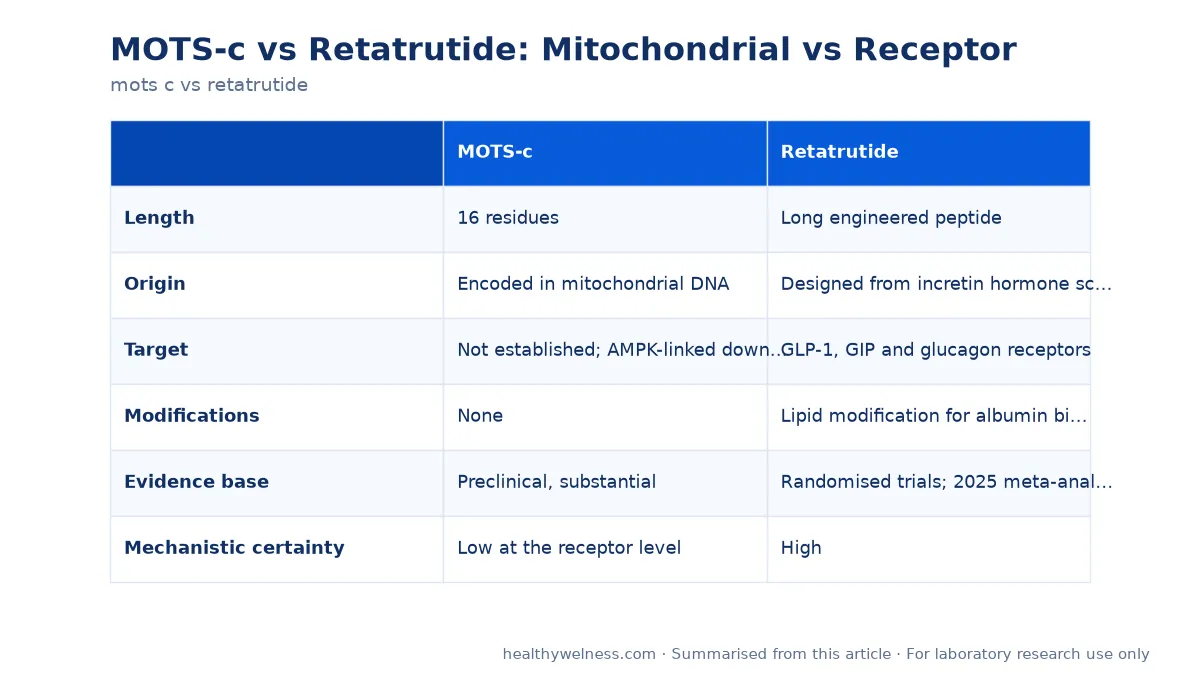
Side by side
| MOTS-c | Retatrutide | |
|---|---|---|
| Length | 16 residues | Long engineered peptide |
| Origin | Encoded in mitochondrial DNA | Designed from incretin hormone scaffolds |
| Target | Not established; AMPK-linked downstream | GLP-1, GIP and glucagon receptors |
| Modifications | None | Lipid modification for albumin binding |
| Evidence base | Preclinical, substantial | Randomised trials; 2025 meta-analysis |
| Mechanistic certainty | Low at the receptor level | High |
| Handling complexity | Low | Moderate |
MOTS-c: an unusual provenance
MOTS-c is encoded within the mitochondrial genome, which sets it apart from essentially every other signalling peptide in a research catalogue. The overwhelming majority are products of nuclear genes; this one comes from the organelle’s own small genome.
The 2016 review by Lee and colleagues in Free Radical Biology and Medicine is the standard orientation, and the 2023 review by Zheng and colleagues in Frontiers in Endocrinology is the more recent synthesis. The 2019 study by Kim and colleagues in Physiological Reports is representative of the primary work, examining plasma metabolites and insulin sensitivity.
What the literature has not produced is a receptor. Downstream effects are well documented and AMPK-linked signalling is repeatedly implicated, but the proximal binding partner is unidentified. The experimental consequence is specific and limiting: there is no antagonist, no knockout of the receptor, and no competitive ligand, so an observed effect cannot be attributed to a pathway by the usual means. Negative controls, including scrambled-sequence peptides, carry more of the argument than they would otherwise.
Retatrutide: the opposite situation
Retatrutide was designed against three receptors simultaneously — GLP-1, GIP and glucagon — and that triple agonism is its defining property. The receptors are characterised, the agonism is measurable, and the compound has progressed through randomised controlled trials.
The 2025 systematic review and meta-analysis by Abdrabou Abouelmagd and colleagues aggregates that trial evidence, and the 2025 review by Katsi and colleagues in Biomolecules places the compound in its pharmacological class. For a research catalogue item, this is an unusually mature evidence base.
The design also introduces a specific complication. A molecule engineered to engage three receptors cannot be used to isolate the contribution of any one of them. An effect observed with retatrutide is an effect of triple agonism, and separating the three requires selective comparator agonists — a point that applies to the whole multi-agonist class and is developed in retatrutide compared with tirzepatide.
Comparing across that gap
Because the mechanisms do not overlap, only a shared functional readout permits any comparison, and even then the interpretation is constrained.
| What a comparison can show | What it cannot show |
|---|---|
| Whether both affect a chosen endpoint | Relative potency — the targets differ |
| Whether their effects on that endpoint differ in size | Why they differ, without mechanistic measures |
| Whether distinct interventions converge functionally | Anything about combination, with no literature |
| Differences in time course | Receptor-level efficacy for MOTS-c |
The middle row of the right-hand column is worth stating plainly: there is no published co-administration work for these two compounds. An experiment combining them is exploratory, and presenting it otherwise would overstate what exists.
Handling differences
- MOTS-c: a short unmodified peptide, aqueous diluent, straightforward. Store sealed, dry and dark at −20 °C; aliquot on first reconstitution. Among the more forgiving reagents in this category.
- Retatrutide: a long engineered peptide carrying a lipid modification intended to bind albumin. That modification raises the hydrophobic character of the molecule, which affects dissolution behaviour and makes gentle reconstitution more important. See reconstituting retatrutide.
- Both: compute molarity from net peptide content rather than vial weight — the correction is proportionally larger for the short peptide. Our reconstitution calculator takes those figures from the certificate.
- Both: for a long engineered peptide the chromatogram matters most, since deletion impurities are a real synthesis outcome at that length. See how to read a certificate of analysis.
Our MOTS-c research material is supplied for laboratory research use. Certificates are available for listed products — contact us for the latest report.
Scope note
This material is supplied for laboratory research use only. It is not a medicine, not a supplement, and not for human or veterinary use. The clinical literature cited above is referenced as published evidence about a molecule, not as a statement about any use of research material.
Open questions
- What is MOTS-c’s proximal receptor or binding partner?
- Can the three receptor contributions to retatrutide’s profile be separated experimentally?
- Do the two converge on overlapping transcriptional signatures at a functional endpoint?
Related research
Frequently asked questions
Are MOTS-c and retatrutide comparable compounds?
Only in that both appear in metabolic research. MOTS-c is a 16-residue peptide encoded in mitochondrial DNA with no established receptor. Retatrutide is an engineered agonist at three defined incretin and glucagon receptors. The mechanisms share nothing.
Which has a defined molecular target?
Retatrutide. Its receptors are named and characterised: GLP-1, GIP and glucagon receptors. MOTS-c has well-documented downstream effects, including AMPK-linked signalling, but no identified primary receptor.
Which has stronger clinical evidence?
Retatrutide, by a wide margin. It has randomised controlled trials and a 2025 systematic review and meta-analysis. MOTS-c has a substantial preclinical literature and no comparable clinical body of work.
Do they need different handling?
Yes. Retatrutide is a long engineered peptide with a lipid modification designed for albumin binding, so it is handled with attention to that chemistry. MOTS-c is a short unmodified peptide and is the more straightforward reagent.
Is there any reason to study them together?
Only if the experiment asks whether interventions at different levels converge on a shared functional endpoint. There is no published co-administration literature and no mechanistic rationale for expecting an interaction.
References
- Lee C, et al. MOTS-c: A novel mitochondrial-derived peptide regulating muscle and fat metabolism. Free Radic Biol Med. 2016. PMID: 27216708 https://pubmed.ncbi.nlm.nih.gov/27216708/
- Zheng Y, et al. MOTS-c: A promising mitochondrial-derived peptide for therapeutic exploitation. Front Endocrinol (Lausanne). 2023. PMID: 36761202 https://pubmed.ncbi.nlm.nih.gov/36761202/
- Kim SJ, et al. The mitochondrial-derived peptide MOTS-c is a regulator of plasma metabolites and enhances insulin sensitivity. Physiol Rep. 2019. PMID: 31293078 https://pubmed.ncbi.nlm.nih.gov/31293078/
- Abdrabou Abouelmagd A, et al. Efficacy and safety of retatrutide, a novel GLP-1, GIP, and glucagon receptor agonist for obesity treatment: a systematic review and meta-analysis of randomized controlled trials. Proc (Bayl Univ Med Cent). 2025. PMID: 40291085 https://pubmed.ncbi.nlm.nih.gov/40291085/
- Katsi V, et al. Retatrutide-A Game Changer in Obesity Pharmacotherapy. Biomolecules. 2025. PMID: 40563436 https://pubmed.ncbi.nlm.nih.gov/40563436/
For laboratory research use only. The research materials supplied by HealthyWelness are not approved medicines, foods or cosmetics and are not for human or veterinary use. This article summarises published research and is not medical advice.
Sources
- Lee C, et al. MOTS-c: A novel mitochondrial-derived peptide regulating muscle and fat metabolism. Free Radic Biol Med. 2016. PMID: 27216708
- Zheng Y, et al. MOTS-c: A promising mitochondrial-derived peptide for therapeutic exploitation. Front Endocrinol (Lausanne). 2023. PMID: 36761202
- Kim SJ, et al. The mitochondrial-derived peptide MOTS-c is a regulator of plasma metabolites and enhances insulin sensitivity. Physiol Rep. 2019. PMID: 31293078
- Abdrabou Abouelmagd A, et al. Efficacy and safety of retatrutide, a novel GLP-1, GIP, and glucagon receptor agonist for obesity treatment: a systematic review and meta-analysis of randomized controlled trials. Proc (Bayl Univ Med Cent). 2025. PMID: 40291085
- Katsi V, et al. Retatrutide-A Game Changer in Obesity Pharmacotherapy. Biomolecules. 2025. PMID: 40563436