SLU-PP-332 vs MOTS-c vs 5-Amino-1MQ Compared
Three metabolic research compounds with three different mechanisms: a nuclear receptor agonist, a mitochondrial peptide and an enzyme inhibitor.


Cover illustration: AI-generated editorial artwork. Conceptual only; not an exact molecular structure, actual laboratory result or evidence of clinical effects.
These three compounds are routinely grouped in research catalogues under a metabolic heading, which is the only thing they have in common. Mechanistically they could hardly be further apart: one activates a family of nuclear receptors, one is a peptide encoded by mitochondrial DNA, and one inhibits a methyltransferase. Two of the three are not peptides at all. Getting this straight determines how each is handled and what an experiment comparing them can conclude.
For laboratory research use only. The research materials supplied by HealthyWelness are not approved medicines, foods or cosmetics and are not for human or veterinary use. This article summarises published research and is not medical advice.
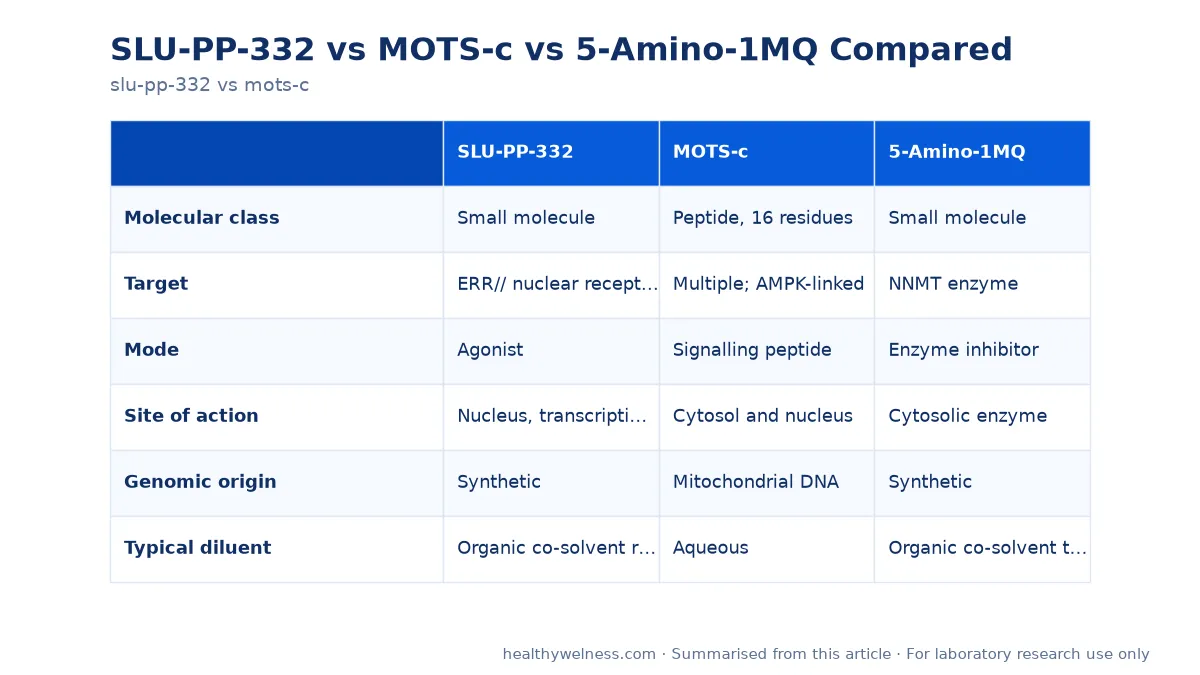
At a glance
| SLU-PP-332 | MOTS-c | 5-Amino-1MQ | |
|---|---|---|---|
| Molecular class | Small molecule | Peptide, 16 residues | Small molecule |
| Target | ERRα/β/γ nuclear receptors | Multiple; AMPK-linked | NNMT enzyme |
| Mode | Agonist | Signalling peptide | Enzyme inhibitor |
| Site of action | Nucleus, transcriptional | Cytosol and nucleus | Cytosolic enzyme |
| Genomic origin | Synthetic | Mitochondrial DNA | Synthetic |
| Typical diluent | Organic co-solvent required | Aqueous | Organic co-solvent typically required |
| Literature volume | Focused, growing | Large | Moderate, within NNMT field |
SLU-PP-332: a transcriptional agonist
SLU-PP-332 is a pan-agonist at the estrogen-related receptors ERRα, ERRβ and ERRγ. These are nuclear receptors, which means the compound’s primary action is on gene transcription rather than on an acute signalling event.
The 2023 paper by Billon and colleagues in ACS Chemical Biology is the original characterisation, reporting an ERRα-dependent response and enhanced exercise capacity in mice. The 2024 follow-up in the Journal of Pharmacology and Experimental Therapeutics extended this to a metabolic syndrome model.
The experimental consequence of a transcriptional mechanism is timescale. Transcriptional changes take hours, and the functional consequences longer. An assay designed around an acute readout will see nothing, and that nothing is a design error rather than a result. The term “exercise mimetic”, which appears in this literature, should be read as a description of a transcriptional signature observed in animal models, not as a claim about outcomes.
MOTS-c: the only peptide here
MOTS-c is a 16-residue peptide encoded within the mitochondrial genome — an unusual provenance, since the overwhelming majority of signalling peptides are encoded in nuclear DNA. The 2016 review by Lee and colleagues in Free Radical Biology and Medicine is the primary orientation, and the 2023 review by Zheng and colleagues in Frontiers in Endocrinology is the more recent synthesis.
Its literature is by far the largest of the three and spans mitochondrial biology, metabolic regulation and exercise physiology. That breadth is an advantage for anyone designing an experiment, because comparable published conditions exist to anchor against.
Being a short peptide, MOTS-c is also the most straightforward of the three to handle in aqueous systems — no organic co-solvent, no solubility negotiation. See what MOTS-c is for the detail.
5-Amino-1MQ: an enzyme inhibitor
5-Amino-1MQ inhibits nicotinamide N-methyltransferase. The 2018 study by Neelakantan and colleagues in Biochemical Pharmacology describes selective, membrane-permeable small-molecule NNMT inhibitors in a mouse model.
An enzyme inhibitor requires a different experimental logic from either of the others:
- Enzyme expression has to be confirmed. In a system with little NNMT, there is nothing to inhibit, and a null result carries no information.
- Substrate and product levels are the proximal readout. Measuring a downstream metabolic outcome without confirming target engagement leaves the mechanism unaddressed.
- Selectivity needs checking against related methyltransferases, which share cofactor chemistry.
Why the diluent is the first practical problem
This is where the peptide-versus-small-molecule split becomes concrete. A short hydrophilic peptide dissolves in water or bacteriostatic water. A planar heteroaromatic small molecule generally does not, and typically requires an organic co-solvent at a concentration that must then be matched in the vehicle control.
In a three-way comparison, that means:
| Requirement | SLU-PP-332 | MOTS-c | 5-Amino-1MQ |
|---|---|---|---|
| Aqueous diluent sufficient | No | Yes | Usually no |
| Vehicle control needed | Yes, co-solvent-matched | Aqueous | Yes, co-solvent-matched |
| Precipitation risk on dilution | Real | Low | Real |
| Identity confirmed by | NMR, LC-MS | HPLC plus peptide MS | NMR, LC-MS |
Precipitation on dilution into aqueous medium is the most common silent failure with the two small molecules. A compound that has come out of solution is not at the nominal concentration, and nothing in the plate reading announces that. Visual inspection after dilution is a cheap and worthwhile check.
Concentration maths differs too: for the peptide, net content and counterion matter, which our reconstitution calculator handles; for the small molecules, molecular weight and solubility limit are what govern.
Our SLU-PP-332 research material is supplied for laboratory research use. Certificates are available for listed products — contact us for the latest report.
What a three-way comparison can and cannot show
Because the mechanisms do not overlap, a comparison is only meaningful on a shared functional readout — a metabolic rate measurement, a transcriptional panel, a mitochondrial function assay. On any such readout, a difference between the three says nothing about relative potency at their respective targets, because the targets are different. What it can show is whether distinct interventions converge on a common functional endpoint, which is a legitimate and interesting question in its own right.
Open questions
- Do these three converge on overlapping transcriptional signatures, or distinct ones?
- What is MOTS-c’s proximal receptor or binding partner?
- How much of each compound remains in solution at working concentrations in culture medium?
Related research
- What is SLU-PP-332?
- What is 5-Amino-1MQ?
- What is MOTS-c?
- NAD+ compared with MOTS-c
Frequently asked questions
Are these three compounds comparable?
Only in the sense that all three appear in metabolic research. Mechanistically they are entirely different: SLU-PP-332 is a small-molecule nuclear receptor agonist, MOTS-c is a mitochondrially encoded peptide, and 5-Amino-1MQ is a small-molecule enzyme inhibitor.
Which of them is actually a peptide?
Only MOTS-c. It is a 16-residue peptide encoded in mitochondrial DNA. SLU-PP-332 and 5-Amino-1MQ are small molecules and are not peptides at all, despite often appearing in peptide catalogues.
Does that distinction matter in the laboratory?
Considerably. Small molecules and peptides differ in solubility behaviour, in the diluents they need, in stability, and in how identity is confirmed. A small molecule usually needs an organic co-solvent, whereas a short peptide typically dissolves in aqueous media.
Which has the most published research?
MOTS-c, by a wide margin, with reviews and primary work spanning mitochondrial biology, metabolism and exercise physiology. SLU-PP-332 has a focused and growing literature from the group that developed it. 5-Amino-1MQ sits in the NNMT inhibitor literature.
Can they be used in the same experiment?
They can be compared in one, provided each is handled appropriately and the diluents are controlled for. Because they act at different points, a shared readout such as a metabolic rate measurement is the only basis on which they are comparable at all.
References
- Billon C, et al. Synthetic ERRα/β/γ Agonist Induces an ERRα-Dependent Acute Aerobic Exercise Response and Enhances Exercise Capacity. ACS Chem Biol. 2023. PMID: 36988910 https://pubmed.ncbi.nlm.nih.gov/36988910/
- Billon C, et al. A Synthetic ERR Agonist Alleviates Metabolic Syndrome. J Pharmacol Exp Ther. 2024. PMID: 37739806 https://pubmed.ncbi.nlm.nih.gov/37739806/
- Lee C, et al. MOTS-c: A novel mitochondrial-derived peptide regulating muscle and fat metabolism. Free Radic Biol Med. 2016. PMID: 27216708 https://pubmed.ncbi.nlm.nih.gov/27216708/
- Zheng Y, et al. MOTS-c: A promising mitochondrial-derived peptide for therapeutic exploitation. Front Endocrinol (Lausanne). 2023. PMID: 36761202 https://pubmed.ncbi.nlm.nih.gov/36761202/
- Neelakantan H, et al. Selective and membrane-permeable small molecule inhibitors of nicotinamide N-methyltransferase reverse high fat diet-induced obesity in mice. Biochem Pharmacol. 2018. PMID: 29155147 https://pubmed.ncbi.nlm.nih.gov/29155147/
For laboratory research use only. The research materials supplied by HealthyWelness are not approved medicines, foods or cosmetics and are not for human or veterinary use. This article summarises published research and is not medical advice.
Sources
- Billon C, et al. Synthetic ERRα/β/γ Agonist Induces an ERRα-Dependent Acute Aerobic Exercise Response and Enhances Exercise Capacity. ACS Chem Biol. 2023. PMID: 36988910
- Billon C, et al. A Synthetic ERR Agonist Alleviates Metabolic Syndrome. J Pharmacol Exp Ther. 2024. PMID: 37739806
- Lee C, et al. MOTS-c: A novel mitochondrial-derived peptide regulating muscle and fat metabolism. Free Radic Biol Med. 2016. PMID: 27216708
- Zheng Y, et al. MOTS-c: A promising mitochondrial-derived peptide for therapeutic exploitation. Front Endocrinol (Lausanne). 2023. PMID: 36761202
- Neelakantan H, et al. Selective and membrane-permeable small molecule inhibitors of nicotinamide N-methyltransferase reverse high fat diet-induced obesity in mice. Biochem Pharmacol. 2018. PMID: 29155147