SLU-PP-915 vs SLU-PP-332: What Changed, and Why
SLU-PP-915 came out of a chemistry programme to improve on SLU-PP-332. A 2026 paper characterises both analytically, including metabolism.


Cover illustration: AI-generated editorial artwork. Conceptual only; not an exact molecular structure, actual laboratory result or evidence of clinical effects.
SLU-PP-915 is what a medicinal chemistry programme produced after SLU-PP-332, and the fact that a successor exists is itself informative: somebody with access to both decided the first one needed improving. A 2026 analytical paper characterises the pair side by side, which makes this one of the better-documented comparisons in a research catalogue.
For laboratory research use only. The research materials supplied by HealthyWelness are not approved medicines, foods or cosmetics and are not for human or veterinary use. This article summarises published research and is not medical advice.
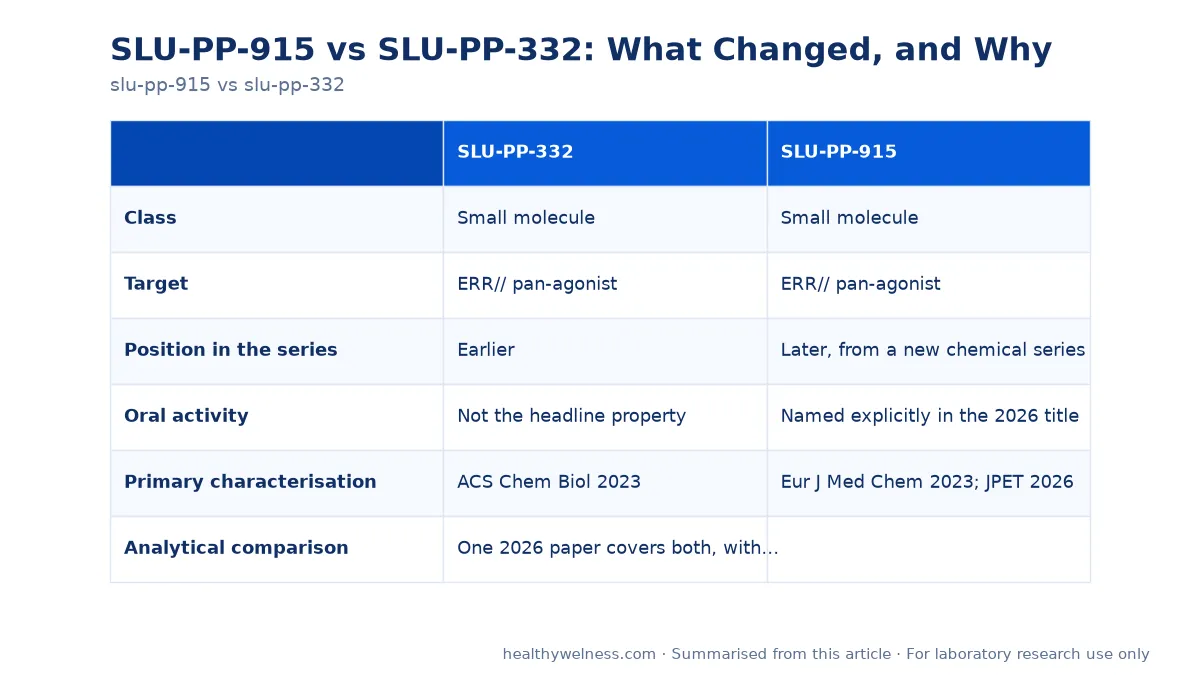
Side by side
| SLU-PP-332 | SLU-PP-915 | |
|---|---|---|
| Class | Small molecule | Small molecule |
| Target | ERRα/β/γ pan-agonist | ERRα/β/γ pan-agonist |
| Position in the series | Earlier | Later, from a new chemical series |
| Oral activity | Not the headline property | Named explicitly in the 2026 title |
| Primary characterisation | ACS Chem Biol 2023 | Eur J Med Chem 2023; JPET 2026 |
| Analytical comparison | One 2026 paper covers both, with in vitro metabolism | |
What the chemistry programme was for
The 2023 paper by Hampton and colleagues in the European Journal of Medicinal Chemistry describes the development and pharmacological evaluation of a new chemical series of potent pan-ERR agonists, and names SLU-PP-915 as the compound identified from it.
Reading that title carefully tells you the shape of the work. A new chemical series is not a tweak to one molecule; it is a different scaffold explored systematically. Groups do that when the existing scaffold has a limit they cannot engineer around.
The 2026 paper by Billon and colleagues in the Journal of Pharmacology and Experimental Therapeutics then reports SLU-PP-915 as orally active and examines aerobic exercise capacity in its model. Oral activity is a property the earlier compound’s literature does not foreground, so that is the most likely answer to what the series was optimising.
For anyone comparing published results across the two, this matters: a difference in observed effect between them may reflect how much compound reached the target rather than a difference at the receptor.
The analytical paper is the useful one
The 2026 study by Möller and colleagues in Rapid Communications in Mass Spectrometry covers in vitro metabolism and analytical characterisation of both compounds, framed around doping detection.
We would put this paper first for laboratory work, ahead of the pharmacology, for three reasons:
- It is a direct comparison. Two compounds, one laboratory, one method — which is rare and removes between-study variability.
- Metabolism data answers the duration question better than a half-life figure would. Knowing which transformations occur in vitro is more actionable than a single number with no system attached.
- Detection work is the most structurally rigorous literature available for compounds of this type, because unambiguous identification is its entire purpose. If you need to confirm what is in a vial, this is the paper that tells you what to look for.
It also answers, indirectly, the common search for an SLU-PP-332 half-life. There is no clean published figure. What exists is metabolism characterised in vitro, and that is a more honest basis for planning an exposure window than a number borrowed from an unrelated system.
What the pharmacology does and does not establish
The 2023 paper by Billon and colleagues in ACS Chemical Biology is the original characterisation of SLU-PP-332: an ERRα-dependent acute response and enhanced exercise capacity in mice.
Two points of interpretation carry across to both compounds. First, the mechanism is transcriptional: these are nuclear receptor agonists, so the timescale is hours and the readouts are gene-expression-dependent. An acute assay sees nothing, and that nothing is a design error rather than a result. Second, the term “exercise mimetic” that appears around this class describes a transcriptional signature observed in animal models, not an outcome claim.
The wider class context is in what SLU-PP-332 is and the comparison of metabolic research compounds.
Handling both
Neither compound is a peptide, and that governs everything practical:
- Organic co-solvent for the stock, then dilution into the assay medium last, with the co-solvent fraction matched in the vehicle control.
- Inspect the diluted solution. Precipitation on dilution is the characteristic silent failure, it can be partial, and it affects the highest concentrations in a series preferentially — which flattens a response curve in a way that mimics saturation.
- Expect small-molecule analytical data, not peptide data: purity with a method, a mass matching the molecular formula, NMR where available, and residual solvent. A peptide-content figure does not apply.
- Store the solid sealed, dry and dark at −20 °C; aliquot organic stocks and record the solvent.
The full handling detail is in handling SLU-PP-332. Concentration here is set by the formula weight and the solubility limit in the chosen solvent rather than by the net-content arithmetic our reconstitution calculator performs for peptides.
Our SLU-PP-332 research material is supplied for laboratory research use. Certificates are available for listed products — contact us for the latest report.
Scope note
This material is supplied for laboratory research use only. It is not a medicine, not a supplement, and not for human or veterinary use. The published work is in vitro and in animal models.
Open questions
- What exactly did the new chemical series improve, beyond oral activity?
- Do the two compounds differ at the receptor, or only in exposure?
- Which metabolites are the most reliable markers of each compound?
Related research
Frequently asked questions
What is SLU-PP-915?
A later compound from the same pan-ERR agonist programme that produced SLU-PP-332. A 2023 paper in the European Journal of Medicinal Chemistry describes the chemical series and the identification of SLU-PP-915; a 2026 paper reports that it is orally active.
Why was a successor developed?
Because the first compound’s properties limited what could be done with it. A medicinal chemistry series exists to improve something measurable, and oral activity is named explicitly in the title of the 2026 work, which indicates what the programme was optimising.
Is there a half-life figure for SLU-PP-332?
Not a clean published one. The most relevant work is a 2026 study of in vitro metabolism and analytical characterisation of both compounds, which addresses how they are broken down and detected rather than reporting a single half-life number.
Why does anti-doping analytical work appear in this literature?
Because compounds described as exercise mimetics attract detection interest. That literature is useful for laboratory purposes: it is the most structurally rigorous source on identity, metabolites and measurement for compounds of this kind.
Are these peptides?
No. Both are small molecules, not peptides, despite being sold alongside them. They need an organic co-solvent for a stock solution and are characterised by NMR and LC-MS rather than by peptide methods.
References
- Hampton CS, et al. Development and pharmacological evaluation of a new chemical series of potent pan-ERR agonists, identification of SLU-PP-915. Eur J Med Chem. 2023. PMID: 37421886 https://pubmed.ncbi.nlm.nih.gov/37421886/
- Billon C, et al. An orally active estrogen receptor-related receptor agonist, SLU-PP-915, enhances aerobic exercise capacity. J Pharmacol Exp Ther. 2026. PMID: 41421047 https://pubmed.ncbi.nlm.nih.gov/41421047/
- Möller T, et al. In Vitro Metabolism and Analytical Characterization of SLU-PP-332 and SLU-PP-915: Novel Pan-ERR Agonists With Doping Potential. Rapid Commun Mass Spectrom. 2026. PMID: 41588687 https://pubmed.ncbi.nlm.nih.gov/41588687/
- Billon C, et al. Synthetic ERRα/β/γ Agonist Induces an ERRα-Dependent Acute Aerobic Exercise Response and Enhances Exercise Capacity. ACS Chem Biol. 2023. PMID: 36988910 https://pubmed.ncbi.nlm.nih.gov/36988910/
For laboratory research use only. The research materials supplied by HealthyWelness are not approved medicines, foods or cosmetics and are not for human or veterinary use. This article summarises published research and is not medical advice.
Sources
- Hampton CS, et al. Development and pharmacological evaluation of a new chemical series of potent pan-ERR agonists, identification of SLU-PP-915. Eur J Med Chem. 2023. PMID: 37421886
- Billon C, et al. An orally active estrogen receptor-related receptor agonist, SLU-PP-915, enhances aerobic exercise capacity. J Pharmacol Exp Ther. 2026. PMID: 41421047
- Möller T, et al. In Vitro Metabolism and Analytical Characterization of SLU-PP-332 and SLU-PP-915: Novel Pan-ERR Agonists With Doping Potential. Rapid Commun Mass Spectrom. 2026. PMID: 41588687
- Billon C, et al. Synthetic ERRα/β/γ Agonist Induces an ERRα-Dependent Acute Aerobic Exercise Response and Enhances Exercise Capacity. ACS Chem Biol. 2023. PMID: 36988910