Gonadorelin vs Kisspeptin: Two Steps on One Axis
Kisspeptin acts on the neurons that generate the pulse; gonadorelin is the pulse itself. Where each enters the axis and what that changes.


Cover illustration: AI-generated editorial artwork. Conceptual only; not an exact molecular structure, actual laboratory result or evidence of clinical effects.
These two peptides are often presented as alternatives for studying the same axis. They are better understood as two consecutive steps on it: kisspeptin acts on the neurons that generate the pulse, and gonadorelin is the pulse. Choosing between them is choosing how much of the system to keep in the experiment.
For laboratory research use only. The research materials supplied by HealthyWelness are not approved medicines, foods or cosmetics and are not for human or veterinary use. This article summarises published research and is not medical advice.
- Gonadorelin is synthetic gonadotropin-releasing hormone, identical in sequence to the native decapeptide.
- Kisspeptin-10 is the C-terminal decapeptide of the longer native kisspeptin forms and signals through the KISS1 receptor.
- KNDy neurons co-expressing kisspeptin, neurokinin B and dynorphin A are described as the GnRH pulse generator (Uenoyama et al., 2021, PMID 34566891).
- The GnRH receptor responds in opposite directions to intermittent and continuous stimulation: intermittent sustains signalling, continuous desensitises it.
- Neither peptide carries a stabilising substitution, so both are short-lived relative to their engineered analogues.
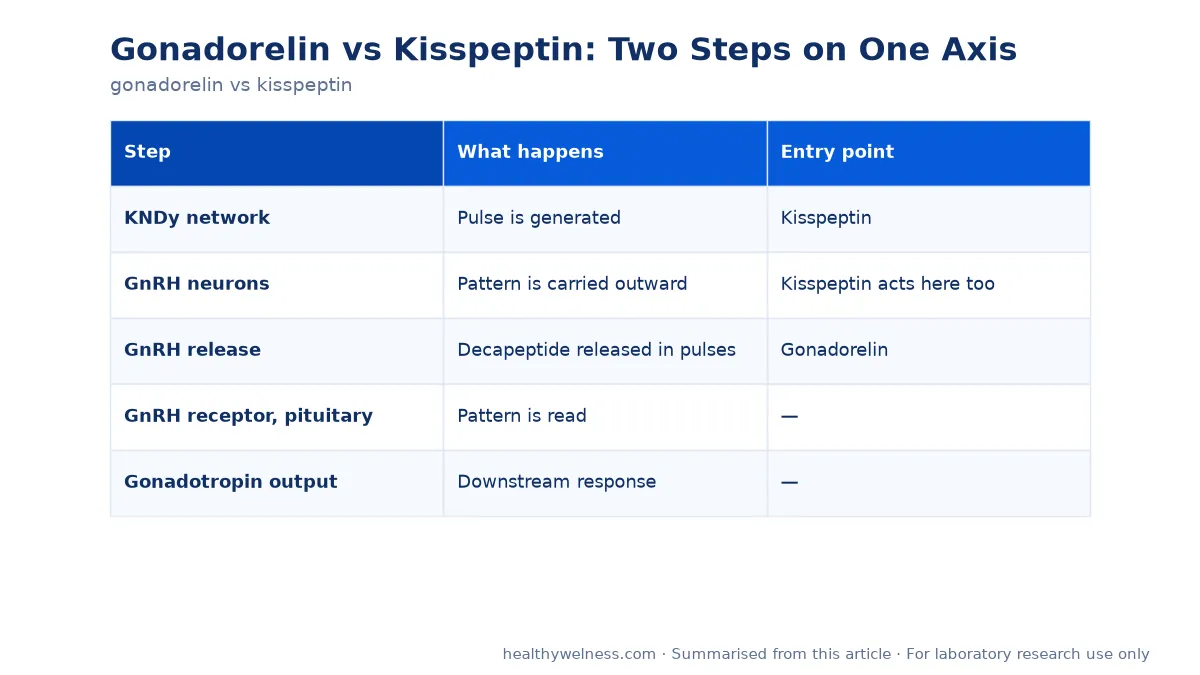
Where does each one enter the axis?
| Step | What happens | Entry point |
|---|---|---|
| KNDy network | Pulse is generated | Kisspeptin |
| GnRH neurons | Pattern is carried outward | Kisspeptin acts here too |
| GnRH release | Decapeptide released in pulses | Gonadorelin |
| GnRH receptor, pituitary | Pattern is read | — |
| Gonadotropin output | Downstream response | — |
Two rows separate the entry points, and both are regulated. That is the substance of the comparison: an upstream intervention passes through regulation that a downstream one does not encounter.
What does acting upstream preserve?
The pulse generator. The 2021 review by Uenoyama and colleagues sets out the KNDy model: neurokinin B initiates activity within the network, dynorphin A terminates it, and kisspeptin carries the resulting signal to GnRH neurons. A network with its own start and stop signals does not need an external clock — it is one.
So an experiment that intervenes at the kisspeptin level still has the system producing its own pattern. The 2016 review by Herbison in Nature Reviews Endocrinology is the authoritative account of what that pattern controls, and the 2011 review by Hameed and colleagues covers the kisspeptin system specifically.
The cost of acting upstream is the usual one: the readout is diffuse. Many things change at once, and attributing a particular downstream observation to a particular intervening step takes additional measurements.
What does acting at the receptor isolate?
The pituitary response. Gonadorelin engages the GnRH receptor directly, and everything above that receptor is removed from the experiment.
That is exactly right when the question concerns the receptor or the pituitary, and exactly wrong when the question concerns regulation. It also makes the exposure pattern an experimental variable rather than a system property: whatever schedule the administration follows is the pattern the receptor sees.
Because the GnRH receptor distinguishes intermittent from continuous engagement, that choice is consequential rather than procedural. The 2001 Lancet review by Huirne and colleagues on receptor antagonists is useful alongside the agonist literature, because it makes the receptor’s behaviour legible from the opposite direction: an antagonist suppresses without the initial stimulatory phase an agonist produces.
Which should an experiment use?
| If the question is | Use | Why |
|---|---|---|
| How is the pulse generated? | Kisspeptin | The generator stays in the experiment |
| How does the pituitary read a pattern? | Gonadorelin | Pattern becomes an input you control |
| Is an effect upstream or downstream of GnRH? | Both, in parallel | The contrast localises the step |
| Does the system compensate? | Kisspeptin | Feedback is intact |
| A defined, repeatable stimulus | Gonadorelin | No upstream variability |
The third row is the comparison worth running. If an effect appears with gonadorelin but not with kisspeptin, the intervening steps are implicated; if it appears with both, the pituitary end is sufficient. That is a localisation experiment, and it is the one thing this pair can do that neither peptide can do alone.
Why are both fragile, and does it matter equally?
Both are native sequences without stabilising substitutions, which is why both are selective and why both are short-lived.
- Gonadorelin has both termini already protected in the native structure — pyroglutamate at the N-terminus, glycinamide at the C-terminus — so its vulnerable region is the Arg-Pro-Gly stretch. It also contains tryptophan, histidine and tyrosine, making oxidation the main chemical route. Detail in what gonadorelin is.
- Kisspeptin-10 has a characterised decomposition product, identified in the same 2013 study that measured its rat pharmacokinetics, so degradation produces a defined second species rather than debris. Detail in reconstituting kisspeptin-10.
In a side-by-side experiment this asymmetry matters: the two arms degrade by different routes at different rates, so a difference in outcome can be a difference in survival. Prepare both working solutions at the bench, immediately before use, and treat an unexpected null in either arm as a material question before a biological one.
Both need molarity computed from net peptide content rather than nominal vial weight — the correction is proportionally large for decapeptides — which our reconstitution calculator applies. Our gonadorelin acetate research material is supplied for laboratory research use. Certificates are available for listed products — contact us for the latest report.
What a two-point intervention reveals that one cannot
The real value of holding both peptides in a laboratory is not that either is better. It is that two entry points on one pathway make a localisation experiment possible, and localisation is usually the question worth asking.
Consider an observation that some manipulation — a genetic change, a metabolic state, a second compound — alters the downstream gonadotropin response. On its own that tells you the axis changed somewhere. Adding both peptides narrows it:
- Response to gonadorelin preserved, response to kisspeptin lost: the pituitary is intact and the change sits upstream, in the generator or in the GnRH neurons.
- Both responses lost: the change is at or below the GnRH receptor.
- Both preserved: the manipulation acted somewhere the two peptides do not probe, or not on this axis at all.
That design costs one extra arm and converts a vague finding into a located one. It works only because the two peptides are native sequences entering at known, separate points — an engineered long-acting analogue would blur the comparison by changing exposure at the same time as position.
Why neither is a long-acting analogue, and why that is useful
Both compounds have engineered relatives built to last longer in circulation, and in most contexts those relatives are the more practical agents. For a localisation experiment they are the wrong tool, and the reason is worth making explicit.
A long-acting analogue changes two things at once: it extends exposure, and in doing so it converts a pulsatile signal into a sustained one. Since the GnRH receptor reads pattern rather than only magnitude, that is not a neutral change — it alters the very property the experiment is trying to observe. The native sequences, for all their fragility, deliver a short defined pulse, which is what makes them informative about a system built on pulses.
The practical trade is therefore clear rather than regrettable: native sequences buy interpretability at the cost of handling discipline. Prepare them fresh, keep the exposure window in view when choosing a readout, and accept that an unexpected null is a material question first and a biological one second.
Scope note
This material is supplied for laboratory research use only. It is not a medicine, not a supplement, and not for human or veterinary use. The content above concerns receptor pharmacology and neural circuitry in published research. The 2019 Endocrine Reviews article by Young and colleagues is cited as background on what is known when this axis fails developmentally.
Open questions
- Can upstream and downstream stimulation be distinguished by downstream signature alone?
- How closely can an administered schedule reproduce a physiological pulse pattern?
- How much do the two peptides differ in measured stability under identical conditions?
Related research
Frequently asked questions
What is the difference between gonadorelin and kisspeptin?
Where each one enters the axis. Kisspeptin acts on KNDy neurons and GnRH neurons, upstream of GnRH release. Gonadorelin is synthetic GnRH itself, acting directly at the GnRH receptor on the pituitary. One works on the generator, the other is the signal.
Are both native sequences?
Yes. Gonadorelin is identical in sequence to native GnRH, a decapeptide. Kisspeptin-10 is the C-terminal decapeptide of the longer native kisspeptin forms. Neither carries stabilising substitutions, which is why both are short-lived and selective.
Which preserves more of the system's own regulation?
Kisspeptin, because it leaves the GnRH pulse generator in the experiment. Gonadorelin replaces the system’s pattern with whatever the administration schedule produces, which is useful when the pituitary is the subject and misleading when the regulation is.
Does pulsatility matter for both?
It matters for both but for different reasons. The GnRH receptor responds in opposite directions to intermittent and continuous stimulation. Kisspeptin feeds the network that creates the pattern; gonadorelin bypasses that network and imposes one.
Can they be compared in one experiment?
Yes, and the comparison is genuinely informative because the two act at different points on one pathway. A difference in downstream outcome is evidence about the intervening steps rather than about relative potency.
For laboratory research use only. The research materials supplied by HealthyWelness are not approved medicines, foods or cosmetics and are not for human or veterinary use. This article summarises published research and is not medical advice.
Sources
- Herbison AE. Control of puberty onset and fertility by gonadotropin-releasing hormone neurons. Nat Rev Endocrinol. 2016. PMID: 27199290
- Uenoyama Y, et al. Role of KNDy Neurons Expressing Kisspeptin, Neurokinin B, and Dynorphin A as a GnRH Pulse Generator Controlling Mammalian Reproduction. Front Endocrinol (Lausanne). 2021. PMID: 34566891
- Hameed S, et al. Kisspeptin and fertility. J Endocrinol. 2011. PMID: 21084385
- Young J, et al. Clinical Management of Congenital Hypogonadotropic Hypogonadism. Endocr Rev. 2019. PMID: 30698671
- Huirne JA, et al. Gonadotropin-releasing-hormone-receptor antagonists. Lancet. 2001. PMID: 11734258