How Does Kisspeptin Work? The KNDy Pulse Generator
Kisspeptin acts on KNDy neurons upstream of GnRH, where it helps generate the pulses that drive the axis. The receptor, the circuit, the evidence.

Cover illustration: AI-generated editorial artwork. Conceptual only; not an exact molecular structure, actual laboratory result or evidence of clinical effects.
Kisspeptin binds the KISS1 receptor on gonadotropin-releasing hormone neurons and acts within the KNDy neuron network, which generates the pulsatile pattern driving the reproductive axis. It works upstream of GnRH, on the generator rather than on the output, which is why the timing of its signal matters as much as its size.
For laboratory research use only. The research materials supplied by HealthyWelness are not approved medicines, foods or cosmetics and are not for human or veterinary use. This article summarises published research and is not medical advice.
- Kisspeptin signals through the KISS1 receptor, a G protein-coupled receptor expressed on GnRH neurons.
- KNDy neurons co-express kisspeptin, neurokinin B and dynorphin A, and are described in the literature as the GnRH pulse generator.
- Neurokinin B is associated with starting a pulse and dynorphin A with ending it, giving the network its rhythm.
- Kisspeptin-10 is the C-terminal decapeptide of the longer kisspeptin forms and retains the receptor-engaging region.
- A 2017 PLoS One study examined why kisspeptin-54 is more potent than kisspeptin-10 in vivo (d’Anglemont de Tassigny et al., PMID 28464043).
What does KNDy stand for, and why does it matter?
KNDy is an acronym for the three signalling molecules a single population of hypothalamic neurons co-expresses: Kisspeptin, Neurokinin B, and Dynorphin A. One cell type, three transmitters.
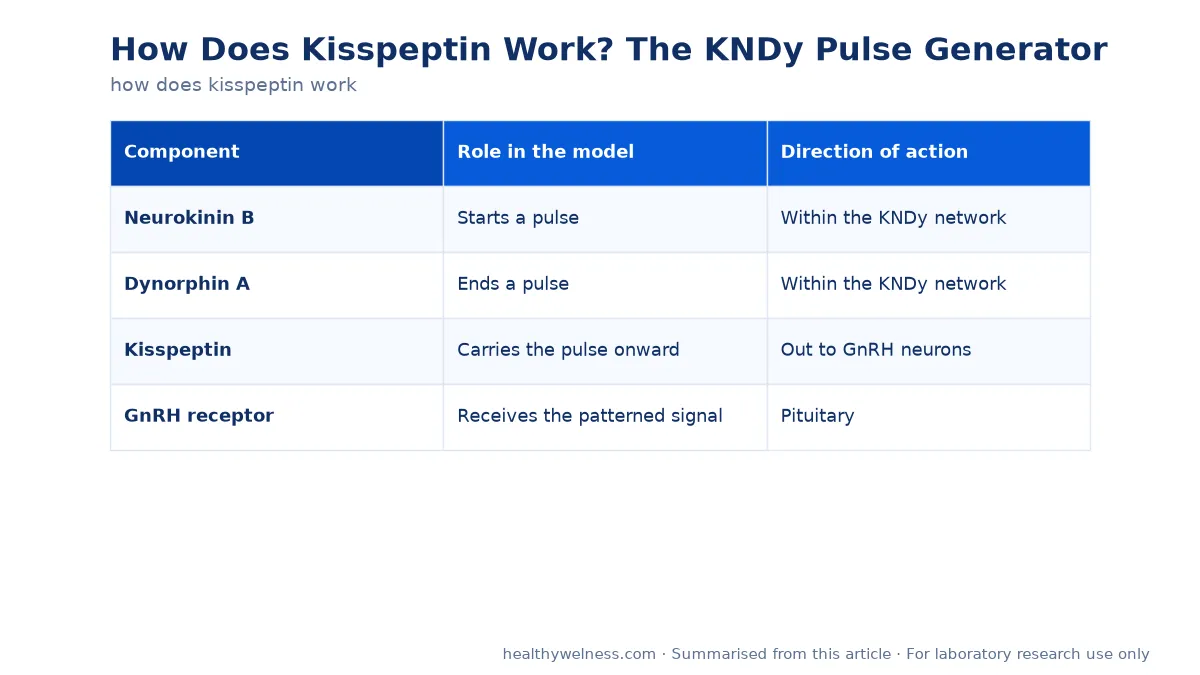
That co-expression is the mechanism, not a coincidence of staining. The 2021 review by Uenoyama and colleagues in Frontiers in Endocrinology sets out the model: neurokinin B acts within the network to initiate activity, dynorphin A acts to terminate it, and kisspeptin carries the resulting signal outward to GnRH neurons.
| Component | Role in the model | Direction of action |
|---|---|---|
| Neurokinin B | Starts a pulse | Within the KNDy network |
| Dynorphin A | Ends a pulse | Within the KNDy network |
| Kisspeptin | Carries the pulse onward | Out to GnRH neurons |
| GnRH receptor | Receives the patterned signal | Pituitary |
A network with its own start and stop signals does not need an external clock. It is the clock. That is what “pulse generator” means, and it is the single most useful idea for reading this literature.
Why does the pattern matter more than the amount?
Because the receptor downstream does not integrate; it discriminates.
The GnRH receptor responds in opposite directions to intermittent and continuous ligand presence. Intermittent engagement sustains downstream gonadotropin signalling. Continuous engagement desensitises the receptor and suppresses it. The 2016 review by Herbison in Nature Reviews Endocrinology is the authoritative account of how the GnRH neuron population produces this pattern and what depends on it.
For an experiment this has a hard consequence: the temporal structure of a stimulus is a variable that has to be designed, not assumed. Two protocols delivering identical total exposure in different patterns are two different experiments, and they can produce opposite results without either being wrong.
The same principle governs gonadorelin, the native GnRH decapeptide, which is covered in what gonadorelin is.
Where does kisspeptin sit relative to GnRH?
One step above it. The axis runs: KNDy neurons generate the pattern, kisspeptin carries it to GnRH neurons, GnRH is released in pulses, and the pituitary responds.
Intervening at the kisspeptin level and at the GnRH level are therefore different interventions even when the downstream readout is the same:
- Acting at the kisspeptin level keeps the pulse generator in the experiment, so the pattern is still produced by the system.
- Acting at the GnRH receptor directly replaces the system’s pattern with whatever the administration produces.
- Which you want depends on the question. Studying regulation argues for the upstream intervention; studying the pituitary response argues for the downstream one.
The 2011 review by Hameed and colleagues in the Journal of Endocrinology covers the kisspeptin system and fertility and is the right orientation to what the axis controls.
Does the species matter?
Yes, more than in most fields, and this is worth knowing before transferring a protocol. The 2023 review by Nestor and colleagues in Peptides is specifically about KNDy neurons as the GnRH pulse generator in ruminants.
A review devoted to one animal group signals that the findings are not assumed to be uniform across species. Pulse frequency, the relative contributions of neurokinin B and dynorphin, and the seasonal structure of the axis all differ between model organisms. A result obtained in one is a hypothesis in another.
Which form should an experiment use?
Kisspeptin-10 is the C-terminal decapeptide of the longer forms, and the longer forms share that same C-terminal region. So all of them retain the part the receptor engages. Why, then, do they behave differently?
The 2017 study by d’Anglemont de Tassigny and colleagues addressed exactly that, examining why kisspeptin-54 has a more potent effect in vivo than kisspeptin-10. The answer is not purely receptor affinity — duration of exposure contributes, because a longer peptide presents a different substrate to the peptidases that clear it.
- Choosing between the forms is choosing an exposure profile, not simply a molecule.
- A result with one form does not transfer to the other without justification, even though both engage the same receptor.
- Comparing them is a legitimate experiment, provided molar equivalence is used and any difference is attributed to duration rather than to receptor pharmacology by default.
The measured behaviour of the decapeptide, including a characterised decomposition product, is covered in kisspeptin-10 half-life, and the handling practice in reconstituting kisspeptin-10.
Our kisspeptin-10 research material is supplied for laboratory research use. Certificates are available for listed products — contact us for the latest report. Concentration maths for a decapeptide runs through net peptide content, which our reconstitution calculator takes as an input.
Three things this mechanism does not explain
A model that accounts for pulse generation still leaves real gaps, and naming them is more useful than implying the circuit is solved.
- What sets the interval. The KNDy network starts and stops its own pulses, but what determines how long the gap between them is, and how that interval shifts with physiological state, is not settled by the start-stop model alone.
- How the signal is read downstream. The GnRH receptor distinguishes intermittent from continuous input, but the molecular machinery that performs that discrimination — the part that makes a pulse legible as a pulse — is a separate question from how pulses are made.
- How much transfers between species. A review devoted to ruminants exists because the answers are not assumed to be uniform, and a result in one model organism is a hypothesis in another rather than a finding.
For laboratory work the practical reading is that kisspeptin is a well-characterised tool for engaging a defined receptor on a defined neuron population, and a less certain tool for reproducing a physiological pattern. Those are different claims, and an experiment should be explicit about which one it rests on.
Scope note
This material is supplied for laboratory research use only. It is not a medicine, not a supplement, and not for human or veterinary use. The content above describes receptor pharmacology and neural circuitry in published animal and human research.
Open questions
- What sets the frequency of KNDy network activity, and can it be reproduced experimentally?
- How much do pulse characteristics differ between common model species?
- Can kisspeptin-driven and directly GnRH-driven stimulation be distinguished by downstream signature alone?
Related research
Frequently asked questions
How does kisspeptin work?
It binds the KISS1 receptor on gonadotropin-releasing hormone neurons and acts within the KNDy neuron network, which generates the pulsatile pattern that drives the reproductive axis. Kisspeptin sits upstream of GnRH, so its action is on the generator rather than on the output.
What are KNDy neurons?
A population of hypothalamic neurons that co-express kisspeptin, neurokinin B and dynorphin A. The acronym comes from those three. Published work describes them as the GnRH pulse generator, with neurokinin B acting to start a pulse and dynorphin to stop it.
Why is pulsatility the key idea?
Because the GnRH receptor responds differently to intermittent and continuous stimulation. Intermittent engagement sustains downstream signalling; continuous engagement desensitises it. A system that generates pulses is therefore generating the signal itself, not just its magnitude.
What is the difference between kisspeptin-10 and kisspeptin-54?
Length. Kisspeptin-10 is the C-terminal decapeptide of the longer forms and retains the region needed for receptor engagement. A 2017 study examined why kisspeptin-54 produces a more potent effect in vivo, and duration of exposure is part of the explanation.
Is kisspeptin's mechanism established or proposed?
Established at the level of the receptor and the neuron population, with reviews in Endocrinology, Frontiers in Endocrinology and the Journal of Neuroendocrinology describing KNDy neurons as the pulse generator. The fine detail of how pulses are timed is still an active question.
For laboratory research use only. The research materials supplied by HealthyWelness are not approved medicines, foods or cosmetics and are not for human or veterinary use. This article summarises published research and is not medical advice.
Sources
- Uenoyama Y, et al. Role of KNDy Neurons Expressing Kisspeptin, Neurokinin B, and Dynorphin A as a GnRH Pulse Generator Controlling Mammalian Reproduction. Front Endocrinol (Lausanne). 2021. PMID: 34566891
- Nestor CC, et al. KNDy neurons as the GnRH pulse generator: Recent studies in ruminants. Peptides. 2023. PMID: 36990389
- Hameed S, et al. Kisspeptin and fertility. J Endocrinol. 2011. PMID: 21084385
- d'Anglemont de Tassigny X, et al. Mechanistic insights into the more potent effect of KP-54 compared to KP-10 in vivo. PLoS One. 2017. PMID: 28464043
- Herbison AE. Control of puberty onset and fertility by gonadotropin-releasing hormone neurons. Nat Rev Endocrinol. 2016. PMID: 27199290