Kisspeptin-10 Reconstitution and Working Solutions
Kisspeptin-10 has a characterised decomposition product and short measured exposure. How to reconstitute it so the concentration is what you think.


Cover illustration: AI-generated editorial artwork. Conceptual only; not an exact molecular structure, actual laboratory result or evidence of clinical effects.
Kisspeptin-10 is a ten-residue peptide, which makes it straightforward to dissolve and easy to get wrong in one specific way: the counterion and residual water are a large share of the vial weight at this length, so a concentration calculated from the label is systematically too dilute. Everything else about handling it follows from its short measured exposure and its characterised decomposition product.
For laboratory research use only. The research materials supplied by HealthyWelness are not approved medicines, foods or cosmetics and are not for human or veterinary use. This article summarises published research and is not medical advice.
- Kisspeptin-10 is the C-terminal decapeptide of the longer kisspeptin forms and retains the receptor-engaging region.
- A 2013 study in the Journal of Chromatography B characterised a decomposition product of kisspeptin-10 and reported its pharmacokinetics in rats (Liu et al., PMID 23524040).
- For a ten-residue peptide, counterion and residual water can account for a double-digit percentage of the gross vial weight.
- Reverse-phase purification leaves peptides as the trifluoroacetate salt unless an exchange step is performed (Roux et al., 2008, PMID 18035848).
- Freeze-dried peptide stability is governed by moisture and oxygen content, not by storage temperature alone (Pikal et al., 1992, PMID 1592171).
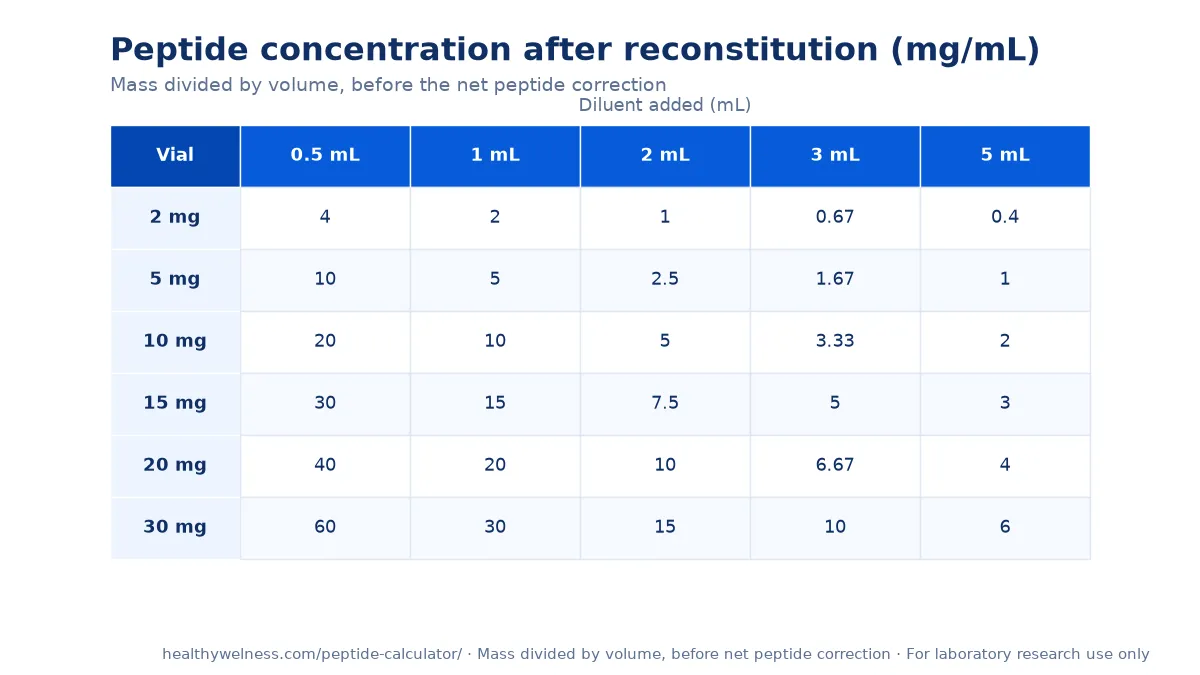
How should kisspeptin-10 be reconstituted?
- Let the sealed vial reach room temperature before opening. Cold glass and cold powder condense atmospheric moisture, and a hygroscopic peptide takes it up immediately. Every subsequent problem starts here.
- Centrifuge briefly if material may have moved in transit. Powder in the cap is powder not in the solution, and for a small quantity the fraction lost is not negligible.
- Use the diluent named on the certificate. Solubility depends on the exact salt form, and the lot’s own document is the authority rather than a general rule.
- Add the diluent down the inside wall, slowly. Let it run over the cake rather than directing a stream onto it.
- Swirl until fully dissolved. Do not vortex and do not pipette up and down vigorously.
- Inspect against a dark background. Haze or particulates mean the concentration is no longer what the arithmetic says.
- Aliquot immediately into single-use volumes, then freeze. Date and label each tube with concentration and diluent.
The chart above gives the gross arithmetic — mass divided by volume for common vial sizes. The correction that makes it accurate is the net peptide content, which our reconstitution calculator applies.
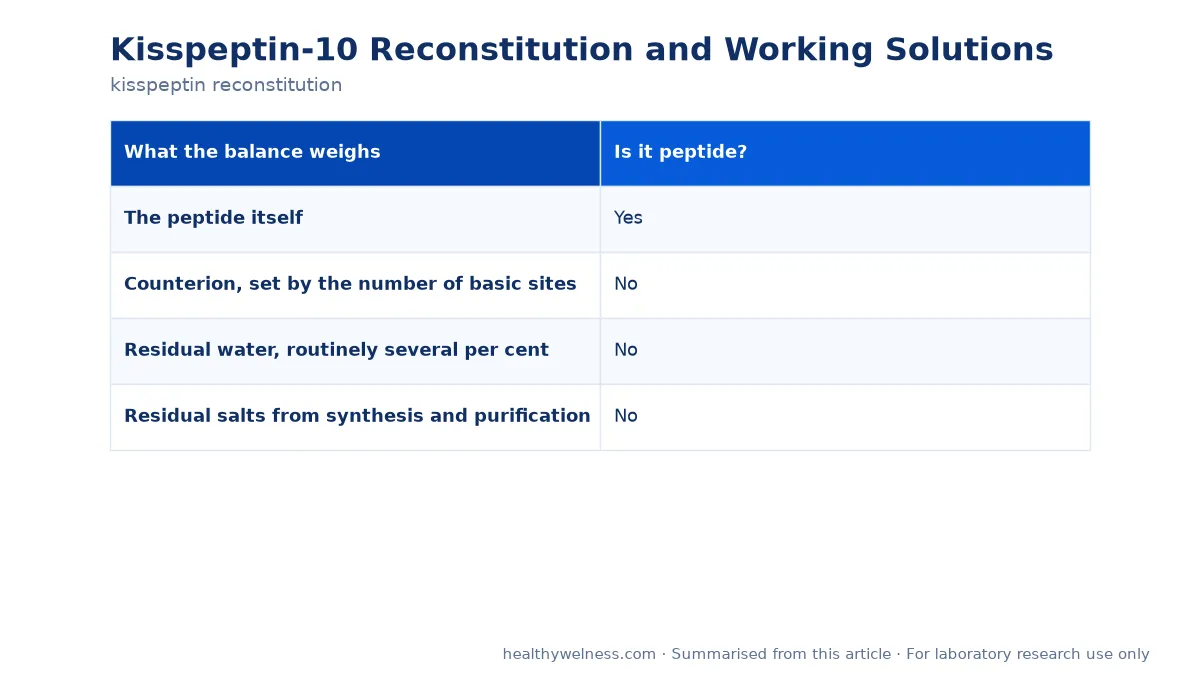
Why is the net content correction larger for short peptides?
Because the counterion mass is a fixed cost per charged residue, and a short peptide has fewer residues to spread it over.
A peptide with basic residues is isolated as a salt — there is no neutral form to supply. Reverse-phase purification is normally run with trifluoroacetic acid in the mobile phase, so the peptide comes off the column paired with trifluoroacetate and is lyophilized that way unless an exchange step is added. The 2008 critical evaluation by Roux and colleagues compared approaches to that exchange and found them to differ in completeness, which means “acetate salt” tells you an exchange was performed, not that no trifluoroacetate remains.
| What the balance weighs | Is it peptide? |
|---|---|
| The peptide itself | Yes |
| Counterion, set by the number of basic sites | No |
| Residual water, routinely several per cent | No |
| Residual salts from synthesis and purification | No |
For cell work the counterion identity also matters in its own right, because trifluoroacetate is not biologically inert at the levels that can accompany a peptide. The full arithmetic is in peptide counterions: TFA versus acetate.
What does the decomposition product change?
This is the detail that makes kisspeptin-10 more interesting to handle than a generic decapeptide. The 2013 study by Liu and colleagues did three things in one paper: it developed an LC-MS/MS method for kisspeptin-10, it characterised the peptide’s decomposition product, and it reported pharmacokinetics in rats.
Two consequences follow:
- Degradation produces a defined second species, not debris. A partly degraded preparation is a mixture of two identified molecules.
- A less selective assay can count the decomposition product as parent peptide. That is how an apparently clean measurement overstates the concentration of the intended species, and it is why method selectivity is a precondition for interpreting any concentration figure.
The same principle appears in the wider analytical literature: the 2018 study by Li and colleagues on structurally related impurities in synthetic human C-peptide showed what distinguishing close relatives actually requires — high-resolution LC-MS rather than a summary figure.
How should it be stored?
| State | Condition | Why |
|---|---|---|
| Sealed lyophilized | −20 °C, desiccated, dark | Moisture and oxygen govern solid-state stability |
| Before each opening | Warm the sealed vial to room temperature | Prevents condensation into a hygroscopic powder |
| Opened lyophilized | Reseal with desiccant; return to −20 °C | Hygroscopic once exposed |
| Reconstituted, in use | Refrigerated, short period | For days of working use, not months |
| Reconstituted, stored | Aliquoted, frozen, dated | One warming round per aliquot |
| Dilute working solution | Prepare fresh | Surface loss and faster degradation |
The solid-state row rests on measurement rather than convention. The 1992 study by Pikal and colleagues examined freeze-dried formulations and found stability governed by moisture and oxygen content, not temperature alone. In practice that means desiccant in the storage container and a properly reseated cap, not just a freezer.
Why does short exposure change the experiment?
The rat pharmacokinetics in the 2013 study are the measured basis for treating this as a short-exposure reagent, and the 2017 study by d’Anglemont de Tassigny and colleagues found that duration contributes to why the longer kisspeptin-54 is more potent in vivo.
- Readout timing is a design variable, not a convenience. A measurement taken outside the exposure window returns a null result carrying no information about the peptide.
- Comparisons with longer-lived analogues conflate potency and duration unless exposure is matched or modelled.
- Dilute solutions should be made at the bench, immediately before use. Degradation and surface adsorption both proceed while a tube waits.
Our kisspeptin-10 research material is supplied for laboratory research use. Certificates are available for listed products — contact us for the latest report. For a decapeptide the observed mass is close to definitive for identity, while the chromatogram is what shows whether the characterised decomposition product is already present — see how to read a certificate of analysis.
A short checklist before each experiment
- Is the concentration derived from net peptide content rather than the vial label?
- Is the counterion named on the report, and does it suit the assay?
- Was the working dilution made today, at the bench?
- Is the solution clear against a dark background?
- Does the readout fall inside the exposure window the pharmacokinetics imply?
- Would the assay distinguish the parent peptide from its known decomposition product?
The last item is the one that separates a careful kisspeptin-10 experiment from an ordinary one, and it is answerable in advance rather than after an anomalous result.
Scope note
This material is supplied for laboratory research use only. It is not a medicine, not a supplement, and not for human or veterinary use. The pharmacokinetic work cited was conducted in rats.
Open questions
- Does the characterised decomposition product retain any receptor activity?
- How quickly does it form in a stored aqueous solution at refrigerator temperature?
- How much material is lost to surfaces at nanomolar working concentrations?
Related research
Frequently asked questions
How is kisspeptin-10 reconstituted?
Warm the sealed vial to room temperature, add the diluent named on the certificate down the inside wall, swirl until dissolved rather than vortexing, inspect for haze, then aliquot into single-use tubes and freeze. Concentration is computed from net peptide content, not from the nominal vial weight.
Why does the net peptide content matter so much for a decapeptide?
Because the counterion and residual water are a proportionally larger share of the vial weight for a short peptide than for a long one. Calculating molarity from gross weight gives a solution more dilute than intended, systematically and always in the same direction.
How long do kisspeptin-10 solutions last?
Prepare working dilutions close to use. A 2013 bioanalytical study characterised a decomposition product of kisspeptin-10 alongside its rat pharmacokinetics, so degradation produces a defined second species rather than inert debris.
Does the decomposition product interfere with measurement?
It can. A degradation product that is itself detectable may be counted as parent peptide by a less selective assay, which is why the 2013 study developed an LC-MS/MS method able to distinguish them.
What diluent should be used?
The one named on the certificate for that lot. Kisspeptin-10 is a short, charged peptide and aqueous diluents are usual, but solubility depends on the exact salt form supplied and the certificate is the authority.
For laboratory research use only. The research materials supplied by HealthyWelness are not approved medicines, foods or cosmetics and are not for human or veterinary use. This article summarises published research and is not medical advice.
Sources
- Liu Z, et al. LC-MS/MS quantification of a neuropeptide fragment kisspeptin-10 (NSC 741805) and characterization of its decomposition product and pharmacokinetics in rats. J Chromatogr B Analyt Technol Biomed Life Sci. 2013. PMID: 23524040
- d'Anglemont de Tassigny X, et al. Mechanistic insights into the more potent effect of KP-54 compared to KP-10 in vivo. PLoS One. 2017. PMID: 28464043
- Roux S, et al. Elimination and exchange of trifluoroacetate counter-ion from cationic peptides: a critical evaluation of different approaches. J Pept Sci. 2008. PMID: 18035848
- Li M, et al. Identification and accurate quantification of structurally related peptide impurities in synthetic human C-peptide by liquid chromatography-high resolution mass spectrometry. Anal Bioanal Chem. 2018. PMID: 29862433
- Pikal MJ, et al. Formulation and stability of freeze-dried proteins: effects of moisture and oxygen on the stability of freeze-dried formulations of human growth hormone. Dev Biol Stand. 1992. PMID: 1592171