Orforglipron vs Tirzepatide: Pill Versus Peptide
Orforglipron is a non-peptide taken by mouth; tirzepatide is an injected dual-receptor peptide with a measured 5-day half-life. A full comparison.


Cover illustration: AI-generated editorial artwork. Conceptual only; not an exact molecular structure, actual laboratory result or evidence of clinical effects.
Orforglipron is a non-peptide small molecule that activates one receptor and can be taken by mouth; tirzepatide is an injected peptide that activates two. They differ on the axis that matters least in a product catalogue and most in a laboratory: one is a peptide and the other is not.
For laboratory research use only. The research materials supplied by HealthyWelness are not approved medicines, foods or cosmetics and are not for human or veterinary use. This article summarises published research and is not medical advice.
- Orforglipron (LY3502970) is a non-peptide small molecule agonist at the GLP-1 receptor only.
- Tirzepatide is a peptide agonist at both the GLP-1 receptor and the GIP receptor.
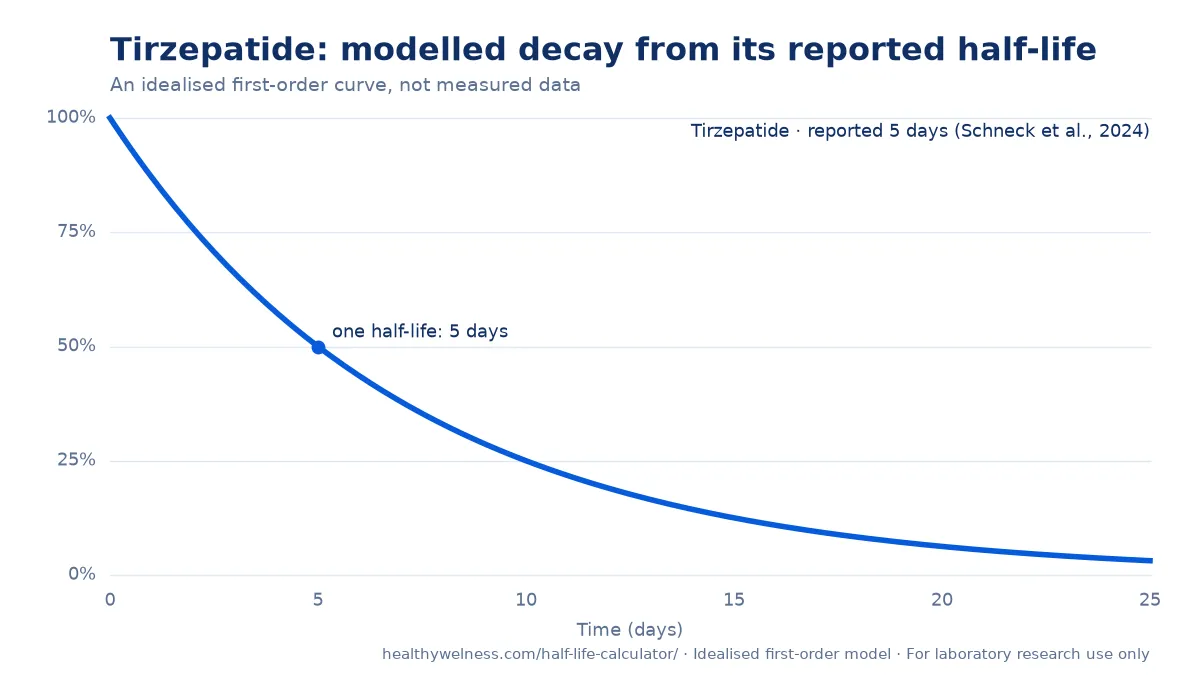
- Tirzepatide’s half-life was reported as approximately 5 days (Schneck et al., 2024, PMID 38356317).
- Orforglipron shares no amino acid sequence with GLP-1 and is not an analogue of it.
- The structural basis for non-peptide agonism of the GLP-1 receptor was described by Sloop and colleagues in Science Translational Medicine in 2024.
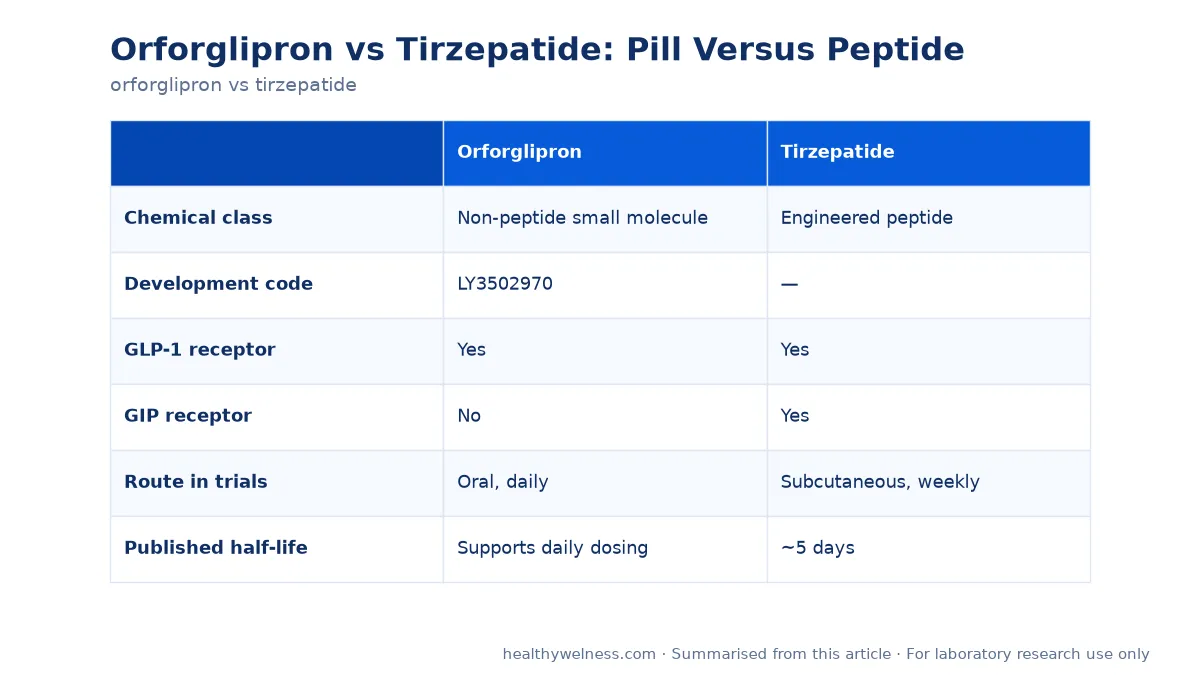
Side by side
| Orforglipron | Tirzepatide | |
|---|---|---|
| Chemical class | Non-peptide small molecule | Engineered peptide |
| Development code | LY3502970 | — |
| GLP-1 receptor | Yes | Yes |
| GIP receptor | No | Yes |
| Route in trials | Oral, daily | Subcutaneous, weekly |
| Published half-life | Supports daily dosing | ~5 days |
| Laboratory handling | Small-molecule practice | Peptide practice |
| Identity confirmed by | NMR, LC-MS, residual solvent | HPLC plus peptide MS, net content |
Why can one be swallowed and the other not?
Peptides are poor oral agents for two structural reasons, neither of which is incidental. Peptidases in the gut cleave peptide bonds, and a large, charged, flexible molecule crosses the intestinal wall inefficiently even when it survives. Both problems are properties of being a peptide.
A non-peptide can be designed around both. That is the whole purpose of the orforglipron programme, and it is harder than it sounds — which is what makes the chemistry interesting rather than merely commercial.
The difficulty is structural. Class B G protein-coupled receptors like the GLP-1 receptor normally bind a long peptide in two parts: the extracellular domain grips the ligand’s C-terminal region, while the N-terminal region reaches down into the receptor core to activate it. A small molecule cannot occupy both sites at once. Finding a chemical series that activates such a receptor anyway was a long-standing unsolved problem, and the 2024 paper by Sloop and colleagues sets out how this one does it.
The experimental consequence matters more than the pharmaceutical one: a small molecule and a peptide may engage the same receptor differently enough to produce different downstream signalling. Matching receptor occupancy does not guarantee matching output. A divergence between them is a finding, not an inconsistency to be explained away.
What does the 5-day half-life mean for an experiment?
The chart above plots first-order decay from the reported figure. It is an idealised model, not measured data, and the value behind it comes from the 2024 population pharmacokinetic analysis by Schneck and colleagues.
Three practical readings:
- After five half-lives, roughly 3 per cent remains. For a 5-day half-life that is about 25 days — the timescale on which an in vivo exposure effectively ends.
- Weekly dosing with a 5-day half-life accumulates. The interval is shorter than the time needed for near-complete clearance, which is how a steady state is reached rather than a series of isolated peaks.
- None of this transfers to a dish. In vitro, the half-life that matters is set by proteolysis in the medium, by adsorption to surfaces and by aggregation — not by renal clearance and albumin binding.
That last point is the one most often missed in comparisons. You can plot your own values, for either compound or any other, in our half-life calculator.
One receptor or two: which is the better probe?
For isolating a mechanism, the single-receptor agent wins.
| If the question is | Use | Why |
|---|---|---|
| Is this effect GLP-1 receptor-mediated? | Orforglipron | One receptor; attribution is clean |
| Does adding GIP change the outcome? | Both, in parallel | The contrast is the experiment |
| Comparison with published trial data | Whichever the trial used | They are not interchangeable |
| Does chemical class change signalling? | Both at the GLP-1 receptor | Peptide versus non-peptide at one target |
| A control unrelated to peptide chemistry | Orforglipron | Shares no scaffold with any peptide agonist |
The last row is an underused idea. Because orforglipron is chemically unrelated to the peptides, it makes an unusually good negative control for artefacts that come from peptide handling — aggregation, adsorption, proteolysis. If an effect survives in both, peptide-specific artefacts are unlikely to explain it.
How does handling differ?
Completely, and treating them alike is the commonest error when both appear in one study.
- Tirzepatide: aqueous diluent per the certificate, added down the vial wall and swirled, never vortexed. Aliquot on first reconstitution. Concentration from net peptide content, since counterion and residual water are real mass — our reconstitution calculator applies that correction. Detail in reconstituting tirzepatide.
- Orforglipron: a concentrated stock in an organic co-solvent, diluted into the assay medium last, with the co-solvent fraction matched in the vehicle control. Inspect the diluted solution: precipitation on dilution is the characteristic silent failure, it can be partial, and it affects the highest concentrations in a series preferentially — which flattens a response curve in a way that looks exactly like receptor saturation.
- Both: store the solid sealed, dry and dark at −20 °C, and warm the container to room temperature before opening.
Our tirzepatide research material is supplied for laboratory research use. Certificates are available for listed products — contact us for the latest report. What a certificate should contain for each class is set out in how to read a certificate of analysis.
What the chemical difference means for reproducibility
There is a practical argument for keeping both compound classes in a laboratory that works on this receptor, and it has nothing to do with which performs better.
Peptides fail in characteristic ways: they aggregate under shear, adsorb to plastic at low concentrations, and are cleaved by peptidases in serum-containing medium. Each of those produces a lower effective concentration than the protocol records, and none announces itself in the data. A result that depends on a peptide alone inherits every one of those risks.
A non-peptide at the same receptor fails differently — its characteristic problem is precipitation on dilution, which is at least visible. So running both is a way of separating pharmacology from handling:
- Effect present with both: peptide-specific artefacts are unlikely to be the explanation.
- Effect present only with the peptide: either GIP receptor engagement matters, or the peptide arm is behaving differently for a handling reason worth checking.
- Effect present only with the small molecule: check the vehicle control, because co-solvent effects are the usual culprit.
That is a cheap experimental control that the two compounds make available precisely because they are chemically unrelated.
Scope note
This material is supplied for laboratory research use only. It is not a medicine, not a supplement, and not for human or veterinary use. The clinical trials cited are referenced as published literature about these molecules.
Open questions
- Do peptide and non-peptide agonists at the GLP-1 receptor produce the same downstream signalling profile?
- What does the non-peptide scaffold cost in receptor affinity relative to the native ligand?
- Can the GIP contribution to tirzepatide’s profile be isolated with a selective comparator?
Related research
- Orforglipron compared with retatrutide
- What is tirzepatide?
- Tirzepatide half-life
Frequently asked questions
What is the difference between orforglipron and tirzepatide?
Chemical class and receptor count. Orforglipron is a non-peptide small molecule that activates only the GLP-1 receptor and is taken by mouth. Tirzepatide is a peptide that activates both the GLP-1 and GIP receptors and is given by subcutaneous injection.
What is tirzepatide's half-life?
Approximately 5 days, reported in a 2024 population pharmacokinetic analysis by Schneck and colleagues in CPT: Pharmacometrics & Systems Pharmacology. That figure supports sustained exposure with once-weekly dosing.
Why can orforglipron be taken orally when peptides cannot?
Because it is not a peptide. Peptidases in the gut cleave peptide bonds, and large charged flexible molecules are absorbed poorly. A small molecule designed around both problems can survive the gut and cross the intestinal wall.
Is orforglipron a GLP-1 analogue?
No. It shares no sequence with GLP-1 and is not derived from it. It activates the same receptor by a different chemical route, which a 2024 Science Translational Medicine paper describes in structural terms.
Which is the cleaner experimental probe?
Orforglipron, because it engages one receptor. An effect seen with tirzepatide is an effect of combined GLP-1 and GIP agonism and cannot be assigned to either receptor without selective comparators.
References
- Schneck K, et al. Population pharmacokinetics of the GIP/GLP receptor agonist tirzepatide. CPT Pharmacometrics Syst Pharmacol. 2024. PMID: 38356317 https://pubmed.ncbi.nlm.nih.gov/38356317/
- Sloop KW, et al. The pharmacological basis for nonpeptide agonism of the GLP-1 receptor by orforglipron. Sci Transl Med. 2024. PMID: 39693407 https://pubmed.ncbi.nlm.nih.gov/39693407/
- Rosenstock J, et al. Orforglipron, an Oral Small-Molecule GLP-1 Receptor Agonist, in Early Type 2 Diabetes. N Engl J Med. 2025. PMID: 40544435 https://pubmed.ncbi.nlm.nih.gov/40544435/
- Wharton S, et al. Orforglipron, an Oral Small-Molecule GLP-1 Receptor Agonist for Obesity Treatment. N Engl J Med. 2025. PMID: 40960239 https://pubmed.ncbi.nlm.nih.gov/40960239/
- Pratt E, et al. Orforglipron (LY3502970), a novel, oral non-peptide glucagon-like peptide-1 receptor agonist: A Phase 1b, multicentre, blinded, placebo-controlled, randomized, multiple-ascending-dose study in people with type 2 diabetes. Diabetes Obes Metab. 2023. PMID: 37264711 https://pubmed.ncbi.nlm.nih.gov/37264711/
For laboratory research use only. The research materials supplied by HealthyWelness are not approved medicines, foods or cosmetics and are not for human or veterinary use. This article summarises published research and is not medical advice.
Sources
- Schneck K, et al. Population pharmacokinetics of the GIP/GLP receptor agonist tirzepatide. CPT Pharmacometrics Syst Pharmacol. 2024. PMID: 38356317
- Sloop KW, et al. The pharmacological basis for nonpeptide agonism of the GLP-1 receptor by orforglipron. Sci Transl Med. 2024. PMID: 39693407
- Rosenstock J, et al. Orforglipron, an Oral Small-Molecule GLP-1 Receptor Agonist, in Early Type 2 Diabetes. N Engl J Med. 2025. PMID: 40544435
- Wharton S, et al. Orforglipron, an Oral Small-Molecule GLP-1 Receptor Agonist for Obesity Treatment. N Engl J Med. 2025. PMID: 40960239
- Pratt E, et al. Orforglipron (LY3502970), a novel, oral non-peptide glucagon-like peptide-1 receptor agonist: A Phase 1b, multicentre, blinded, placebo-controlled, randomized, multiple-ascending-dose study in people with type 2 diabetes. Diabetes Obes Metab. 2023. PMID: 37264711