Dihexa Mechanism of Action: What Survives the Retraction
The HGF/c-Met mechanism for Dihexa comes from a paper retracted in 2025. What independent work still supports, and how to read the rest.


Cover illustration: AI-generated editorial artwork. Conceptual only; not an exact molecular structure, actual laboratory result or evidence of clinical effects.
Dihexa’s mechanism of action is not established. The hepatocyte growth factor and c-Met account that appears in almost every description of this compound traces to a 2014 paper that was retracted in 2025, and which had carried an expression of concern since 2021. This article sets out what that leaves standing.
For laboratory research use only. The research materials supplied by HealthyWelness are not approved medicines, foods or cosmetics and are not for human or veterinary use. This article summarises published research and is not medical advice.
- A 2014 Journal of Pharmacology and Experimental Therapeutics paper on the HGF/c-Met mechanism for angiotensin IV-derived peptides was retracted in 2025 (PMID 25187433).
- A 2013 paper from the same laboratory in the same journal carries an expression of concern dated 2021 (PMID 23055539).
- The frequently repeated claim that Dihexa is several orders of magnitude more potent than comparable compounds traces to that flagged work.
- A 2021 study in Brain Sciences reported effects in APP/PS1 mice via PI3K/AKT signalling and carries no flag (Sun et al., PMID 34827486).
- A 2020 study in Drug Testing and Analysis examined putative cognitive-enhancing research peptides found in seized pharmaceutical preparations.
What exactly was retracted, and why does it matter?
The 2014 study by Benoist and colleagues reported that the procognitive and synaptogenic effects of angiotensin IV-derived peptides depend on activation of the hepatocyte growth factor and c-Met system. That is the mechanistic foundation on which most descriptions of Dihexa rest.
It was retracted in 2025. A second paper from the same laboratory, published in the same journal in 2013, carries an expression of concern from 2021.
Two points of interpretation, both important and both easy to get wrong:
- A retraction removes evidence for a claim. It does not establish the opposite. Nothing about the retraction shows that Dihexa is inactive. It shows that the published basis for one specific mechanistic account no longer stands.
- Claims derived from the retracted work inherit the problem. The potency comparison that circulates widely — that Dihexa is dramatically more potent than related compounds — traces to this body of work, so it should not be repeated as established.
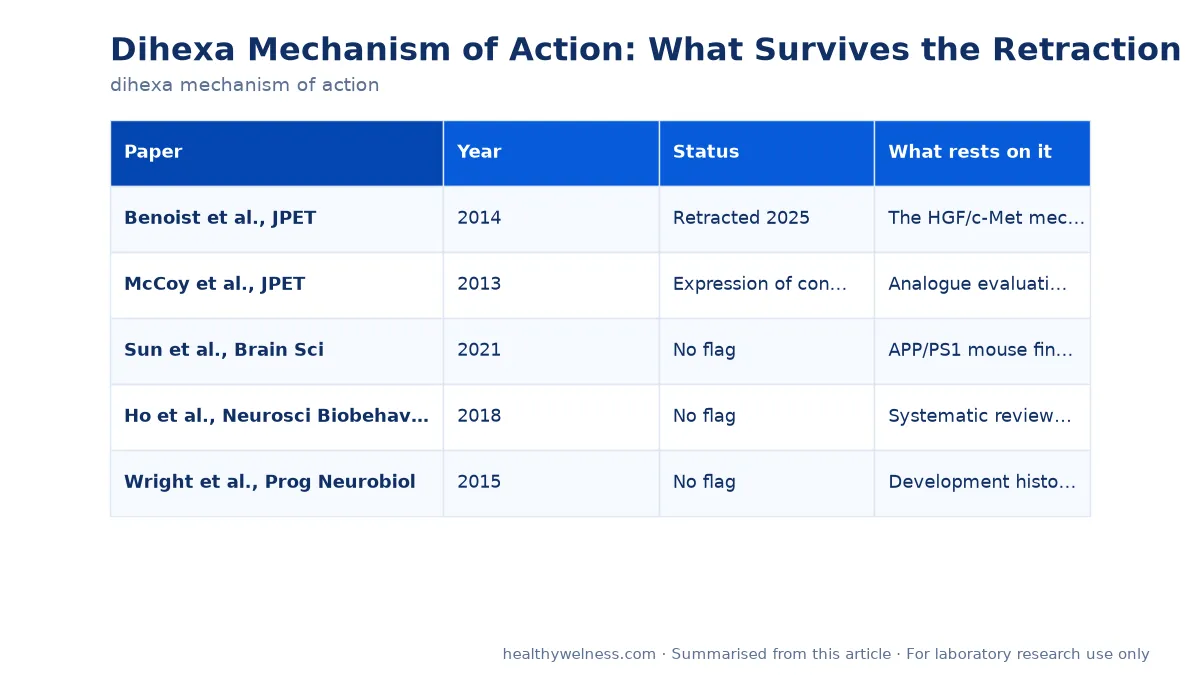
| Paper | Year | Status | What rests on it |
|---|---|---|---|
| Benoist et al., JPET | 2014 | Retracted 2025 | The HGF/c-Met mechanism |
| McCoy et al., JPET | 2013 | Expression of concern 2021 | Analogue evaluation |
| Sun et al., Brain Sci | 2021 | No flag | APP/PS1 mouse findings |
| Ho et al., Neurosci Biobehav Rev | 2018 | No flag | Systematic review of the class |
| Wright et al., Prog Neurobiol | 2015 | No flag | Development history of the analogues |
What independent evidence remains?
Three unflagged sources, and they support a narrower set of claims than the flagged work did.
The 2021 study by Sun and colleagues in Brain Sciences is the most directly useful. It is from an unrelated group, it used APP/PS1 mice, and it reported effects via PI3K/AKT signalling. Note that this is a different proposed pathway from HGF/c-Met — it does not restore the retracted mechanism, it proposes another one.
The 2018 systematic review by Ho and colleagues surveys cognitive findings for angiotensin IV and angiotensin-(1-7) across experimental studies. A systematic review is more robust than any single study because it aggregates, and it places Dihexa in a class rather than treating it as unique.
The 2015 review by Wright and colleagues in Progress in Neurobiology covers how the angiotensin IV analogue programme developed, which is the right context for understanding why a short native fragment was modified into a lipophilic molecule at all.
What none of them provides is a confirmed receptor or binding partner. The honest position is that Dihexa’s proximal target is unidentified, and that a PI3K/AKT association is a downstream observation rather than a mechanism.
What does this mean for an experiment?
A compound without an established proximal target constrains what a result can claim, in ways worth planning around rather than discovering afterwards.
- Mechanistic controls are limited. There is no validated receptor antagonist to block, so attribution has to come from pathway-level measurements such as the PI3K/AKT readouts the 2021 study used.
- Negative controls carry more weight. Without receptor-level controls, a vehicle-matched arm and, where feasible, an inactive structural analogue are what the argument rests on.
- Published effect sizes should be treated cautiously, particularly any inherited from the flagged literature.
- Replication is the most valuable thing a new experiment can contribute. A field whose central mechanistic paper has been retracted needs independent confirmation more than it needs new claims.
What should be verified about the material itself?
More than usual, because the compound-level literature is thin and because this product category has a documented identity problem.
The 2020 study by Vanhee and colleagues examined putative cognitive-enhancing research peptides found in seized pharmaceutical preparations. Its existence is the reason to verify rather than assume.
Dihexa is a short angiotensin IV-derived core carrying two hexanoyl groups, supplied as a salt. The checks that follow:
- Is the exact structure stated, including both acyl groups and the salt form? A name alone does not identify it.
- Is an observed mass given as a number? Compute the expected value for the stated salt form and compare it yourself.
- Is the counterion named? Required for the molecular weight and relevant in cell work.
- Is there a chromatogram? For a lipophilic compound retention is informative, and a single clean peak is meaningful evidence.
The salt-form arithmetic is in Dihexa acetate: structure and salt form, and the framework in how to read a certificate of analysis.
Why does solubility complicate the picture further?
Because the two hexanoyl chains that make the molecule lipophilic also make it precipitate when a concentrated organic stock meets aqueous medium.
That failure is partial, often slow, and affects the highest concentrations in a series preferentially — which flattens the top of a response curve in a way indistinguishable from target saturation on the numbers alone. In a field where the mechanism is unsettled, adding an invisible concentration artefact makes results harder to interpret still. Inspecting the diluted wells is the cheap control, and the compound profile is in what Dihexa is.
Our Dihexa research material is supplied for laboratory research use. Certificates are available for listed products — contact us for the latest report. For peptides in a comparison set, concentration runs through net peptide content via our reconstitution calculator; for this compound the inputs are the formula weight of the supplied salt and the solubility limit in the chosen solvent.
Scope note
This material is supplied for laboratory research use only. It is not a medicine, not a supplement, and not for human or veterinary use. The retracted paper is cited above so that readers can see exactly which claim is affected.
Open questions
- Which of the originally reported effects replicate in independent laboratories?
- Is there a proximal binding partner, or is the activity receptor-independent?
- Does the PI3K/AKT association reflect a direct mechanism or a downstream consequence?
Related research
Frequently asked questions
What is Dihexa's mechanism of action?
Not established. The widely repeated hepatocyte growth factor and c-Met account comes from a 2014 paper that was retracted in 2025 and had carried an expression of concern since 2021. Independent work has not replaced it with a confirmed mechanism.
Which Dihexa papers are flagged?
Two from the same laboratory. A 2014 study in the Journal of Pharmacology and Experimental Therapeutics on the HGF and c-Met mechanism was retracted in 2025; a 2013 paper in the same journal carries an expression of concern dated 2021.
What independent evidence remains?
A 2021 study in Brain Sciences reporting effects in APP/PS1 mice via PI3K/AKT signalling, a 2018 systematic review of angiotensin IV-related cognitive studies, and a 2015 review of angiotensin IV analogue development. None of these carries a flag.
Does the retraction mean Dihexa does not work?
No. A retraction removes the evidence for a specific claim; it does not establish the opposite. What it means is that the mechanism most often quoted has no sound published basis, and the potency claims derived from it should not be repeated.
What should be checked on the material?
The exact structure including both acyl groups and the salt form, the observed mass against the expected value for that form, and the chromatogram. Compounds in this family circulate under several names and stated salt forms.
For laboratory research use only. The research materials supplied by HealthyWelness are not approved medicines, foods or cosmetics and are not for human or veterinary use. This article summarises published research and is not medical advice.
Sources
- Sun X, et al. AngIV-Analog Dihexa Rescues Cognitive Impairment and Recovers Memory in the APP/PS1 Mouse via the PI3K/AKT Signaling Pathway. Brain Sci. 2021. PMID: 34827486
- Ho JK, et al. Cognitive benefits of angiotensin IV and angiotensin-(1-7): A systematic review of experimental studies. Neurosci Biobehav Rev. 2018. PMID: 29733881
- Wright JW, et al. The development of small molecule angiotensin IV analogs to treat Alzheimer's and Parkinson's diseases. Prog Neurobiol. 2015. PMID: 25455861
- Benoist CC, et al. The procognitive and synaptogenic effects of angiotensin IV-derived peptides are dependent on activation of the hepatocyte growth factor/c-met system. J Pharmacol Exp Ther. 2014. RETRACTED 2025. PMID: 25187433
- Vanhee C, et al. The occurrence of putative cognitive enhancing research peptides in seized pharmaceutical preparations: An incentive for controlling agencies to prepare for future encounters of the kind. Drug Test Anal. 2020. PMID: 31667971