Gonadorelin Reconstitution, Mixing and Shelf Life
Gonadorelin is native GnRH with both termini already protected. The one vulnerable region, the oxidation-prone residues and how to store it.

Cover illustration: AI-generated editorial artwork. Conceptual only; not an exact molecular structure, actual laboratory result or evidence of clinical effects.
Gonadorelin is the native GnRH decapeptide, and it comes with an unusual advantage and an unusual constraint. Both of its termini are already protected by the natural structure, so the usual proteolytic entry points are blocked — but the experiment it is normally used for depends on a defined exposure pattern, which makes a partly degraded stock worse than it would be for most peptides.
For laboratory research use only. The research materials supplied by HealthyWelness are not approved medicines, foods or cosmetics and are not for human or veterinary use. This article summarises published research and is not medical advice.
- Gonadorelin is pyroGlu-His-Trp-Ser-Tyr-Gly-Leu-Arg-Pro-Gly-NH2, identical in sequence to native GnRH.
- The N-terminal pyroglutamate blocks aminopeptidase attack and the C-terminal glycinamide blocks carboxypeptidases.
- The vulnerable proteolytic region is the Arg-Pro-Gly stretch near the C-terminus, which is where long-acting analogues are substituted.
- Gonadorelin contains tryptophan, histidine and tyrosine, all oxidation-prone residues.
- Metal-catalysed oxidation at histidine is a documented route in model peptides (Khossravi et al., 1998, PMID 9688066).
How should gonadorelin be reconstituted?
- Warm the sealed vial to room temperature first. Opening a cold vial condenses atmospheric moisture into a hygroscopic powder, and that water stays.
- Centrifuge briefly if the cake may have shifted in transit.
- Use the diluent named on the certificate, and use a clean one. Old buffer stocks of unknown composition are the usual unnoticed source of trace metal.
- Add the diluent down the inside wall, slowly, letting it run over the cake.
- Swirl until dissolved. Avoid vigorous mixing: the peptide is not fragile mechanically, but tryptophan and tyrosine make it worth minimising both agitation and light exposure.
- Keep it out of direct light and return it to an amber or foil-wrapped tube.
- Aliquot immediately, date each tube, and freeze what is not in use that day.
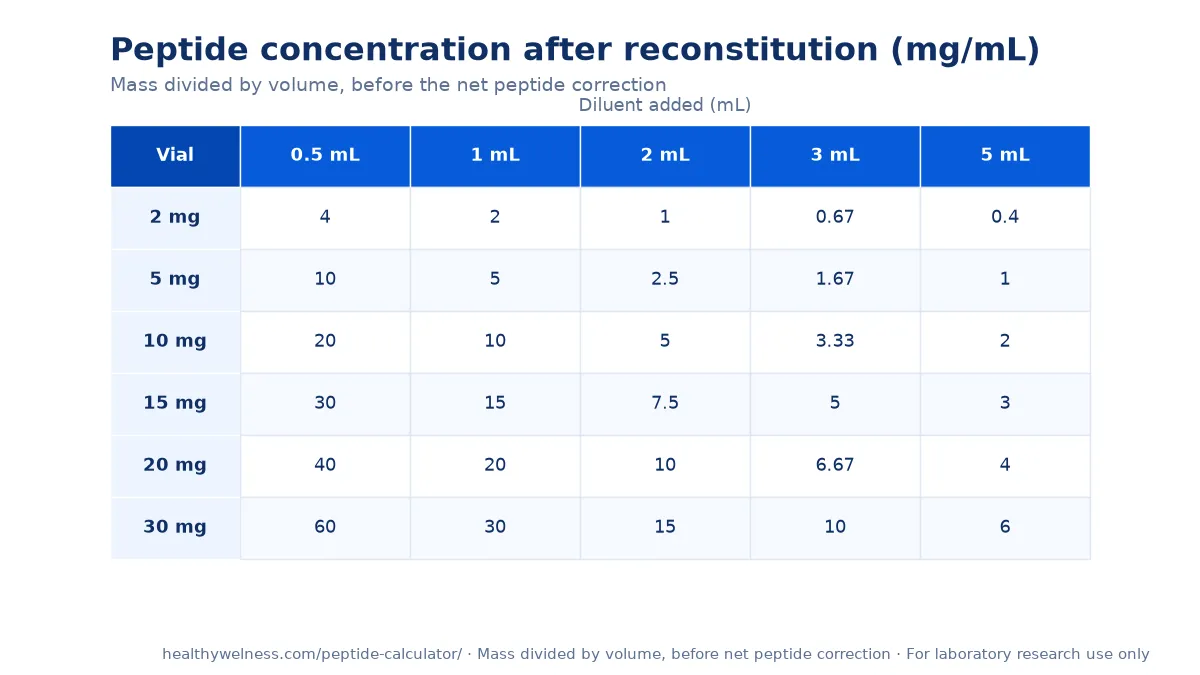
The chart above shows gross concentration for common vial sizes; the net content correction is applied by our reconstitution calculator.
Why are both termini already protected?
This is a genuinely elegant feature of the native molecule and it has a practical pay-off.
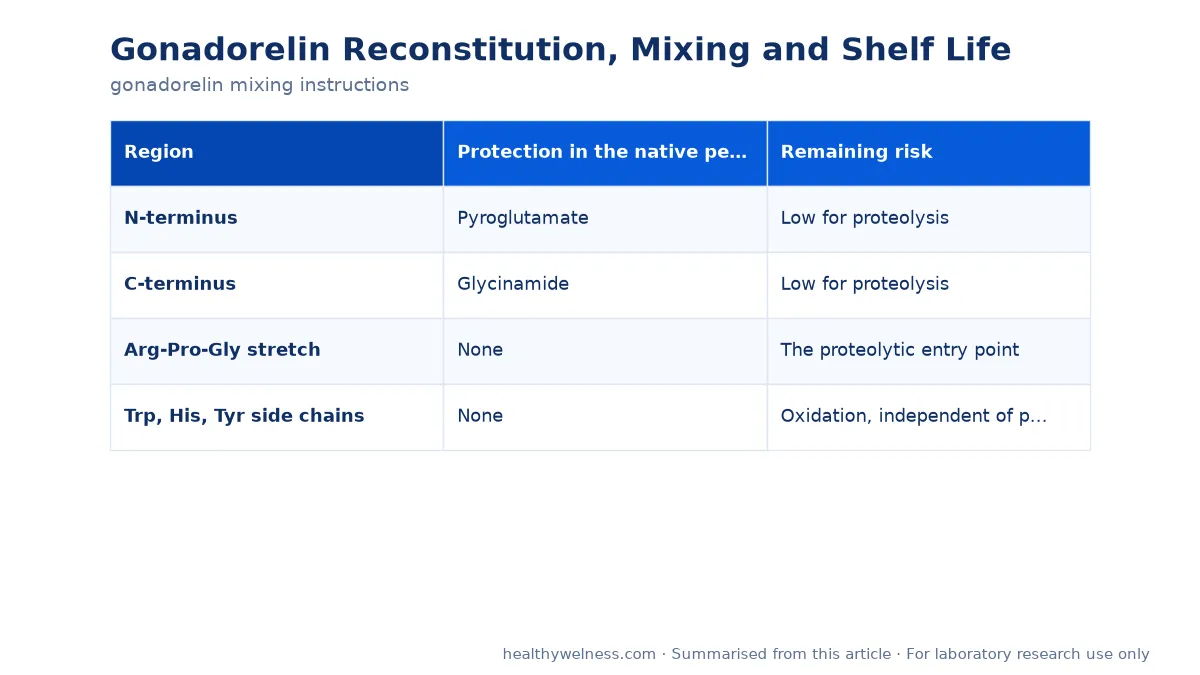
Most short peptides are attacked from the ends. Aminopeptidases remove residues from the N-terminus; carboxypeptidases work from the C-terminus. Gonadorelin blocks both: the N-terminal glutamate is cyclised to pyroglutamate, removing the free alpha-amino group, and the C-terminus is an amide rather than a free acid.
So the vulnerable point is internal: the Arg-Pro-Gly region near the C-terminus. That is not a guess — it is where the long-acting GnRH analogues carry their substitutions, and reading the analogue literature backwards tells you where the parent is weak. Every modification someone bothered to make marks a liability.
| Region | Protection in the native peptide | Remaining risk |
|---|---|---|
| N-terminus | Pyroglutamate | Low for proteolysis |
| C-terminus | Glycinamide | Low for proteolysis |
| Arg-Pro-Gly stretch | None | The proteolytic entry point |
| Trp, His, Tyr side chains | None | Oxidation, independent of proteolysis |
Does gonadorelin go bad, and how would you know?
It degrades without looking different, which is the honest answer to a question people usually ask hoping for a visual cue.
Three routes operate independently:
- Moisture uptake in the solid. The 1992 study by Pikal and colleagues found freeze-dried stability governed by moisture and oxygen content rather than temperature alone. A powder that has taken up a few per cent water is less stable even in a freezer.
- Oxidation in solution. Tryptophan, histidine and tyrosine are all present. Metal-catalysed oxidation at histidine is documented, and tryptophan and tyrosine both absorb in the ultraviolet and photo-oxidise.
- Hydrolysis, governed by pH. The 1998 study by Gietz and colleagues on degradation kinetics shows how strongly pH sets the rate, which is why the buffer belongs in the method rather than in the background.
None of these produces a colour change or a precipitate at the levels that matter. The practical response is preventive: dry, dark, cold, aliquoted, and prepared fresh when dilute.
Why does degradation matter more for this peptide than most?
Because of what gonadorelin is normally used to study.
The GnRH receptor responds in opposite directions to intermittent and continuous ligand presence: intermittent engagement sustains downstream signalling, continuous engagement desensitises it. The 2016 review by Herbison is the authoritative account of how the GnRH neuron population generates that pattern, and the 2001 Lancet review by Huirne and colleagues makes the receptor’s behaviour legible from the antagonist side.
So an experiment with gonadorelin is usually an experiment about pattern. If the stock has partly degraded, the amount delivered in each pulse is not the amount recorded, and a design whose entire logic rests on a defined exposure profile is undermined at its foundation. That is a sharper consequence than a simple loss of potency.
The mechanism and its comparison with the upstream entry point are covered in gonadorelin compared with kisspeptin and what gonadorelin is.
What storage practice follows?
| State | Condition |
|---|---|
| Sealed lyophilized | −20 °C, desiccated, dark |
| Before each opening | Warm the sealed vial to room temperature |
| Opened lyophilized | Reseal with desiccant; return to −20 °C |
| Reconstituted, in use | Refrigerated, dark, short period |
| Reconstituted, stored | Aliquoted, frozen, dated with diluent recorded |
| Dilute working solution | Prepare at the bench, immediately before use |
Aliquoting is the step with the best return. A single tube thawed twenty times has had twenty opportunities to warm, concentrate at an ice interface and take up moisture when opened; twenty aliquots thawed once each have had one. The general practice is in storing reconstituted peptides.
Concentration should be computed from net peptide content rather than vial weight — for a decapeptide supplied as an acetate salt, the non-peptide share of the gross weight is substantial. Our gonadorelin acetate research material is supplied for laboratory research use. Certificates are available for listed products — contact us for the latest report.
A short checklist before each experiment
- Is the concentration derived from net peptide content rather than the vial label?
- Was the working dilution made today, at the bench, rather than retrieved from the refrigerator?
- Has the solution been kept out of direct light since reconstitution?
- Is the diluent clean, and free of trace metal from old buffer stocks?
- Is the buffer recorded in the method, given that pH governs the degradation rate?
- Does the readout fall inside the exposure window the design assumes?
The last two are what distinguish a careful gonadorelin experiment from an ordinary one. Because the biology under study is a pattern rather than a level, both the buffer and the timing are part of the independent variable rather than background conditions — and an experiment that records neither cannot be repeated by anyone else.
Taken together, these precautions cost a few minutes per vial and remove most of the ways a gonadorelin experiment fails for reasons that have nothing to do with the biology under study.
Scope note
This material is supplied for laboratory research use only. It is not a medicine, not a supplement, and not for human or veterinary use.
Open questions
- How quickly does oxidation at tryptophan become detectable under ordinary bench conditions?
- What is the measured half-life of gonadorelin in common laboratory buffers?
- How much does partial degradation distort a pulsatile stimulation protocol?
Related research
Frequently asked questions
How is gonadorelin reconstituted?
Warm the sealed vial to room temperature, add the diluent named on the certificate down the inside wall, swirl until dissolved, inspect for haze, then aliquot into single-use tubes and freeze. Concentration is computed from net peptide content rather than the nominal vial weight.
Does gonadorelin go bad?
It degrades rather than spoiling visibly. The solid takes up moisture once opened, and in solution the peptide is exposed to oxidation at tryptophan, histidine and tyrosine, plus enzymatic cleavage in any protease-containing medium. None of this produces a visible change.
Why is gonadorelin more stable at its ends than in the middle?
Because the native structure already protects both termini: a pyroglutamate at the N-terminus blocks aminopeptidases and a glycinamide at the C-terminus blocks carboxypeptidases. The vulnerable region is the Arg-Pro-Gly stretch near the C-terminus.
How long does a reconstituted solution keep?
Aliquot on first reconstitution and freeze what is not in immediate use, keeping the working aliquot refrigerated over a short period. The useful measure is how many warming and cooling rounds a tube has been through, not a fixed number of days.
Does the buffer matter?
Yes. pH governs the rate of chemical degradation in solution, and trace metal content governs oxidation at histidine. Recording the diluent is part of recording the method for this peptide.
For laboratory research use only. The research materials supplied by HealthyWelness are not approved medicines, foods or cosmetics and are not for human or veterinary use. This article summarises published research and is not medical advice.
Sources
- Herbison AE. Control of puberty onset and fertility by gonadotropin-releasing hormone neurons. Nat Rev Endocrinol. 2016. PMID: 27199290
- Khossravi M, et al. Chemical pathways of peptide degradation: IX. Metal-catalyzed oxidation of histidine in model peptides. Pharm Res. 1998. PMID: 9688066
- Gietz U, et al. Chemical degradation kinetics of recombinant hirudin (HV1) in aqueous solution: effect of pH. Pharm Res. 1998. PMID: 9755900
- Pikal MJ, et al. Formulation and stability of freeze-dried proteins: effects of moisture and oxygen on the stability of freeze-dried formulations of human growth hormone. Dev Biol Stand. 1992. PMID: 1592171
- Huirne JA, et al. Gonadotropin-releasing-hormone-receptor antagonists. Lancet. 2001. PMID: 11734258