LL-37 Peptide Sequence: Why It Is Called LL-37
LL-37 is named for two leucines and 37 residues. The cathelicidin origin, the helical amphipathic structure and what that means for handling.

Cover illustration: AI-generated editorial artwork. Conceptual only; not an exact molecular structure, actual laboratory result or evidence of clinical effects.
LL-37 is named for its own sequence: it begins with two leucine residues and is 37 amino acids long. That is unusually informative for a peptide name, and the rest of what matters about the molecule — where it comes from, how it folds, and why it is awkward to handle — follows from its being a long, cationic, amphipathic helix.
For laboratory research use only. The research materials supplied by HealthyWelness are not approved medicines, foods or cosmetics and are not for human or veterinary use. This article summarises published research and is not medical advice.
- LL-37 takes its name from two N-terminal leucine residues and a length of 37 amino acids.
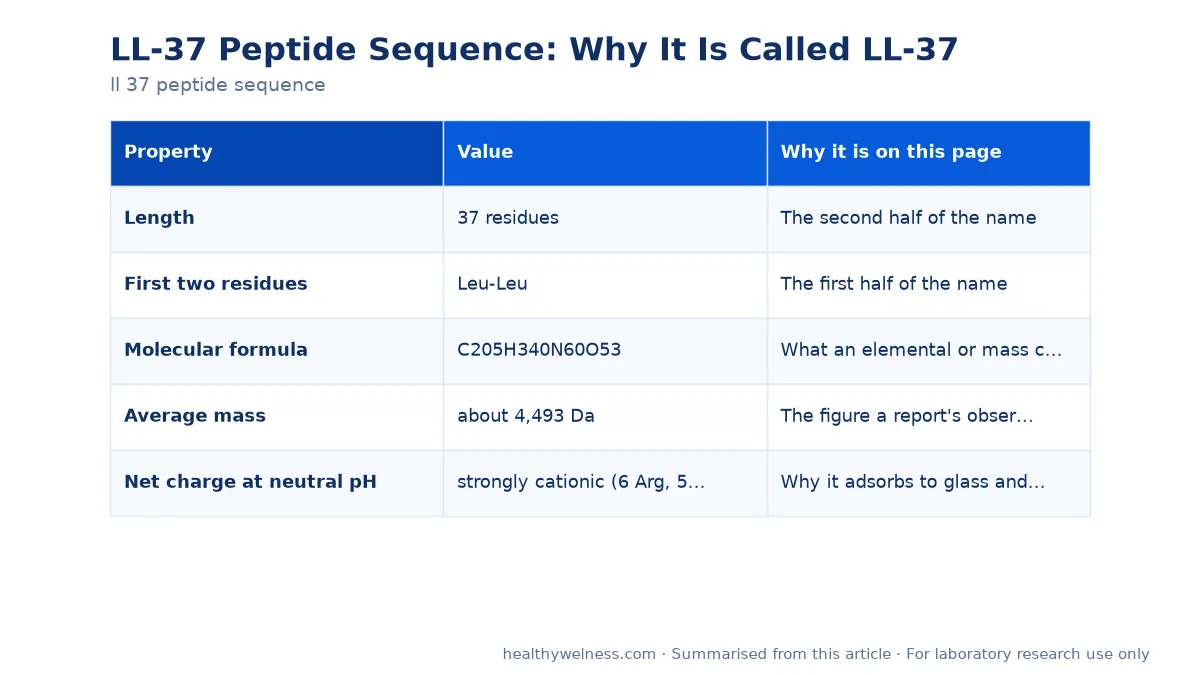
- The sequence is LLGDFFRKSKEKIGKEFKRIVQRIKDFLRNLVPRTES — 37 residues beginning Leu-Leu, with a molecular formula of C205H340N60O53 and an average mass of about 4,493 Da (PubChem CID 16198951).
- It is the mature peptide released from human cathelicidin, the precursor protein hCAP18.
- Its folded form is an amphipathic alpha helix, with hydrophobic and cationic residues on opposite faces.
- Published reviews describe it as pleiotropic, with activity beyond direct antimicrobial action (Fabisiak et al., Pharmacol Rep 2016, PMID 27117377).
- A 2024 review in Pharmacological Research covers LL-37’s involvement in heart disease (Miao et al., PMID 39615616).
What is the LL-37 sequence?
In one-letter code, reading from the N-terminus:
LLGDFFRKSKEKIGKEFKRIVQRIKDFLRNLVPRTES
And in three-letter code, which is how a certificate of analysis will usually state it:
Leu-Leu-Gly-Asp-Phe-Phe-Arg-Lys-Ser-Lys-Glu-Lys-Ile-Gly-Lys-Glu-Phe-Lys-Arg-Ile-Val-Gln-Arg-Ile-Lys-Asp-Phe-Leu-Arg-Asn-Leu-Val-Pro-Arg-Thr-Glu-Ser
| Property | Value | Why it is on this page |
|---|---|---|
| Length | 37 residues | The second half of the name |
| First two residues | Leu-Leu | The first half of the name |
| Molecular formula | C205H340N60O53 | What an elemental or mass check is compared against |
| Average mass | about 4,493 Da | The figure a report’s observed mass should sit near |
| Net charge at neutral pH | strongly cationic (6 Arg, 5 Lys, 5 acidic residues) | Why it adsorbs to glass and standard plastics |
Counting the basic residues in that sequence is also the quickest explanation of the handling problems further down this page: eleven arginines and lysines against five acidic residues is where the net positive charge comes from. Values in this table are taken from the PubChem record for LL-37 (CID 16198951); a certificate for a particular lot should state its own observed mass.
What does the cathelicidin origin mean?
LL-37 is not synthesised as LL-37. It is released from a precursor protein, human cathelicidin hCAP18, by proteolytic cleavage. The precursor carries a conserved cathelin domain plus the antimicrobial peptide at its C-terminus; cleavage frees the active peptide.
Two practical consequences follow from that provenance:
- The literature uses two names closely together. Searching only for “LL-37” misses work indexed under cathelicidin or hCAP18, and vice versa. The 2016 review by Fabisiak and colleagues is titled with both terms for exactly this reason.
- Fragments and variants circulate. Because the active peptide is itself a cleavage product, shorter derived fragments appear in the literature as distinct entities. A report naming a residue range rather than “LL-37” is describing something else.
What is an amphipathic helix, and why does it matter?
When LL-37 folds into an alpha helix, the residues do not distribute randomly around the cylinder. Hydrophobic residues gather on one face and cationic residues on the opposite face, giving the helix two chemically distinct sides.
That arrangement is the structural basis of the antimicrobial peptide class, and it explains the molecule’s behaviour in three separate contexts:
| Context | What the two faces do |
|---|---|
| At a membrane | Cationic face meets the anionic surface; hydrophobic face inserts |
| At an air–water interface | The same partitioning drives aggregation when solutions are shaken |
| At a plastic or glass surface | The cationic face binds negatively charged surfaces, removing peptide from solution |
The important reading is that the property that makes LL-37 biologically interesting is the same property that makes it difficult to keep in solution. They cannot be separated, so the handling discipline is part of working with the molecule rather than an optional refinement.
Is LL-37 only an antimicrobial peptide?
No, and the word used in the literature is pleiotropic. The 2016 review by Fabisiak and colleagues carries it in the title; the 2020 study by Nagaoka and colleagues examined the peptide in a murine sepsis model; the 2024 review by Miao and colleagues surveys its involvement in heart disease.
A peptide with activity across several systems presents a specific interpretive problem, and it is worth naming because it recurs with every cationic amphipathic peptide:
- Membrane interaction is a general property, not a specific mechanism. An effect at higher concentrations may reflect the molecule’s amphipathic character rather than engagement of any particular target.
- Concentration-dependence is diagnostic. Effects appearing only at the top of a concentration series deserve a second look for exactly that reason.
- A scrambled-sequence control is informative here, because a scramble preserves composition and charge while destroying the helical face arrangement.
That last control is the cheapest way to separate sequence-dependent activity from generic cationic amphipathic behaviour, and it is underused.
What should be checked on the report?
At 37 residues, LL-37 is long enough for synthesis impurities to be a real concern, and cationic enough for the counterion to be a large share of the delivered mass.
| Check | Why for this peptide |
|---|---|
| Stated sequence and length | Fragments and variants circulate under related names |
| Observed mass against the expected value | Compute it for the stated 37-residue sequence |
| Chromatogram, not just a percentage | Deletion impurities co-elute at this length and inflate purity |
| Counterion named | Large mass contribution for a highly cationic peptide |
| Net peptide content | Without it, weight-based concentrations are systematically high |
The 2016 study by Stalmans and colleagues on quality control of cationic cell-penetrating peptides is directly relevant, since cationic peptides are the ones carrying the most counterion per molecule. The 2008 evaluation by Roux and colleagues covers what counterion exchange does and does not achieve, and the arithmetic is in peptide counterions: TFA versus acetate.
How should LL-37 be handled?
- Store sealed lyophilized material at −20 °C, dry and dark; warm the vial to room temperature before opening.
- Add diluent down the vial wall and swirl. Never vortex or shake: an amphipathic helix aggregates at the air–water interface, and foaming is the fastest way to lose material irreversibly.
- Expect surface loss when dilute. Prepare working solutions close to use, consider carrier protein, and keep consumables consistent across arms.
- Aliquot on first reconstitution. See storing reconstituted peptides.
- Compute molarity from net peptide content rather than vial weight; our reconstitution calculator takes both figures.
Our LL-37 research material is supplied for laboratory research use. Certificates are available for listed products — contact us for the latest report. The compound background is in what LL-37 is.
Why fragment naming deserves a second look
Because LL-37 is itself a cleavage product, the literature contains further derived fragments studied as entities in their own right. A report naming a residue range rather than LL-37 is describing a different molecule, and the names are close enough to be confused in a catalogue listing.
Three checks keep this straight:
- Count the residues in the stated sequence. Thirty-seven is the full peptide; anything shorter is a fragment with its own literature and its own findings.
- Check which paper the material is meant to match. If an experiment builds on a published result, the sequence in the report and the sequence in the paper should agree residue for residue.
- Treat the precursor name as a search term, not an identifier. Cathelicidin and hCAP18 refer to the precursor protein rather than the mature peptide, even where the literature uses them loosely.
At 37 residues the expected mass is distinctive enough that computing it and comparing against the reported value settles the question in a couple of minutes — cheaper than discovering a mismatch after an experiment.
The through-line is that LL-37 rewards precision about identity. Its name encodes the sequence, its structure explains its behaviour, and most handling problems with it trace back to one of those two facts being treated as background rather than as working information.
Scope note
This material is supplied for laboratory research use only. It is not a medicine, not a supplement, and not for human or veterinary use. The work described above is in cells and animal models.
Open questions
- How much of LL-37’s reported activity survives a scrambled-sequence control?
- At what concentration does generic membrane interaction begin to dominate?
- How much material is lost to surfaces at typical assay concentrations?
Related research
Frequently asked questions
Why is it called LL-37?
The name is descriptive: the peptide begins with two leucine residues and is 37 amino acids long. LL for the first two residues, 37 for the length. It is one of the few peptide names that tells you its own sequence start and size.
What is the full LL-37 sequence?
LLGDFFRKSKEKIGKEFKRIVQRIKDFLRNLVPRTES, 37 residues read from the N-terminus. In three-letter code it begins Leu-Leu-Gly-Asp-Phe-Phe and ends Arg-Thr-Glu-Ser. The molecular formula is C205H340N60O53 and the average mass is about 4,493 Da (PubChem CID 16198951).
Where does LL-37 come from?
It is the mature antimicrobial peptide released from human cathelicidin, the precursor protein hCAP18. The precursor is cleaved to free the active 37-residue peptide, which is why the literature uses the terms cathelicidin and LL-37 closely together.
What is its structure?
An amphipathic alpha helix: when it folds, hydrophobic residues gather on one face and cationic residues on the other. That two-faced arrangement is what lets it interact with membranes, and it is shared across the antimicrobial peptide class.
Is LL-37 only antimicrobial?
No. Published reviews describe it as pleiotropic, with roles beyond direct antimicrobial action, including immune modulation. A 2024 review in Pharmacological Research covers its involvement in heart disease specifically.
Does the amphipathic structure affect handling?
Considerably. A cationic amphipathic peptide adsorbs to surfaces, can interact with membranes non-specifically at higher concentrations, and aggregates at the air-water interface if solutions are shaken rather than swirled.
For laboratory research use only. The research materials supplied by HealthyWelness are not approved medicines, foods or cosmetics and are not for human or veterinary use. This article summarises published research and is not medical advice.
Sources
- PubChem Compound Summary for CID 16198951, LL-37. National Library of Medicine.
- Fabisiak A, et al. LL-37: Cathelicidin-related antimicrobial peptide with pleiotropic activity. Pharmacol Rep. 2016. PMID: 27117377
- Nagaoka I, et al. Therapeutic Potential of Cathelicidin Peptide LL-37, an Antimicrobial Agent, in a Murine Sepsis Model. Int J Mol Sci. 2020. PMID: 32825174
- Miao S, et al. Cathelicidin peptide LL-37: A multifunctional peptide involved in heart disease. Pharmacol Res. 2024. PMID: 39615616
- Stalmans S, et al. Quality control of cationic cell-penetrating peptides. J Pharm Biomed Anal. 2016. PMID: 26397208
- Roux S, et al. Elimination and exchange of trifluoroacetate counter-ion from cationic peptides: a critical evaluation of different approaches. J Pept Sci. 2008. PMID: 18035848