BPC-157 vs Sermorelin: Local Versus Endocrine
BPC-157 is studied as a locally acting repair peptide; sermorelin acts on a defined endocrine axis. The comparison turns on that difference.

Cover illustration: AI-generated editorial artwork. Conceptual only; not an exact molecular structure, actual laboratory result or evidence of clinical effects.
This pairing appears in search because both peptides are associated with recovery and repair in popular discussion. Mechanistically they belong to different worlds. Sermorelin acts on a mapped endocrine axis through a named receptor; BPC-157 is studied as a locally acting peptide whose receptor has not been identified. That asymmetry, rather than any shared pathway, is what the comparison is actually about.
For laboratory research use only. The research materials supplied by HealthyWelness are not approved medicines, foods or cosmetics and are not for human or veterinary use. This article summarises published research and is not medical advice.
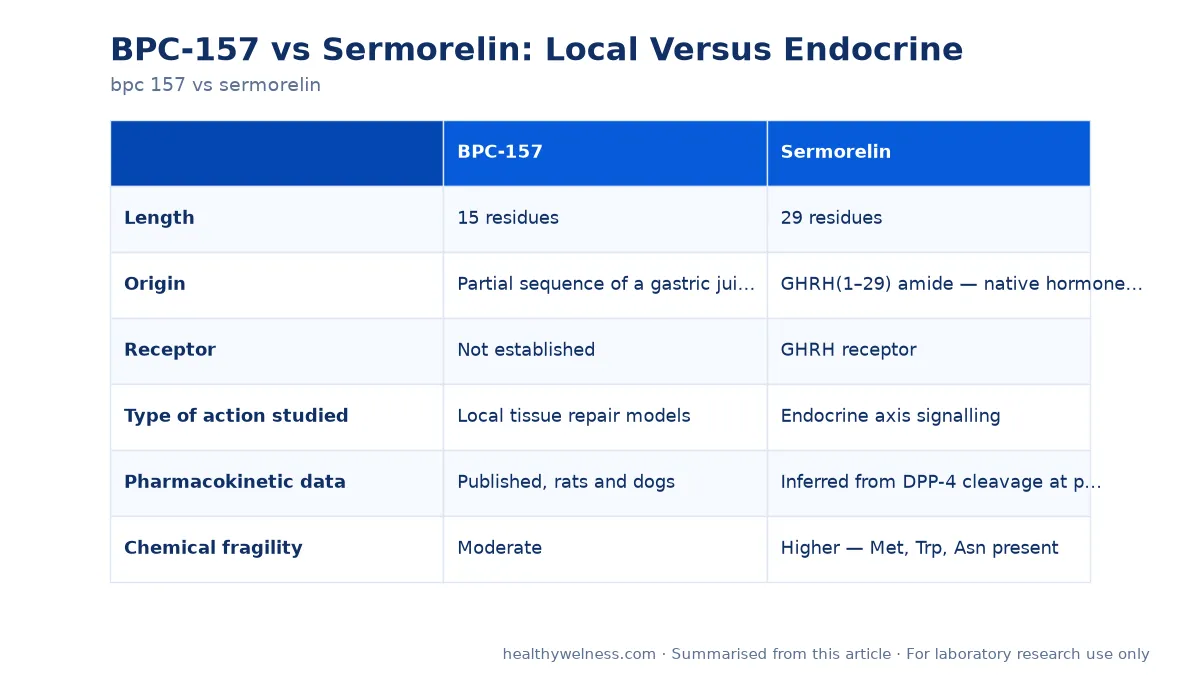
Side by side
| BPC-157 | Sermorelin | |
|---|---|---|
| Length | 15 residues | 29 residues |
| Origin | Partial sequence of a gastric juice protein | GHRH(1–29) amide — native hormone fragment |
| Receptor | Not established | GHRH receptor |
| Type of action studied | Local tissue repair models | Endocrine axis signalling |
| Pharmacokinetic data | Published, rats and dogs | Inferred from DPP-4 cleavage at position 2 |
| Chemical fragility | Moderate | Higher — Met, Trp, Asn present |
| Human literature | Systematic reviews, developing | Older clinical studies of GHRH fragments |
What sermorelin’s mechanism gives you
Sermorelin is the first twenty-nine residues of growth hormone releasing hormone, amidated at the C-terminus. There is nothing inferential about where it acts: the GHRH receptor is characterised, the axis downstream of it is mapped, and the peptide is identical in sequence to the native ligand’s active region.
The 1985 study by Barron and colleagues in Peptides compared GHRH(1–29)-NH2 with a D-Ala2 analogue in normal men, and the 1997 study by Khorram and colleagues used a norleucine-substituted version. Both are informative in an indirect way as well as a direct one: the substitutions tell you where the native peptide is weak, since each modification exists to block a degradation route. Position 2 is the dipeptidyl peptidase-4 site, and sermorelin carries the native, unprotected residue there.
The practical benefit of a mapped mechanism is that controls exist. Receptor antagonists, axis measurements and known downstream markers are all available, so an observed effect can be attributed or excluded.
What BPC-157’s literature gives you instead
BPC-157 has no established receptor. Its mechanism is reconstructed from downstream signalling: the 2017 study by Hsieh and colleagues in the Journal of Molecular Medicine associated its pro-angiogenic activity with VEGFR2 activation and upregulation, which is an association with a pathway rather than an identification of a binding site.
What it does have, unusually, is pharmacokinetics. The 2022 study by He and colleagues in Frontiers in Pharmacology characterised distribution, metabolism and excretion in rats and dogs. Published disposition data of that quality is rare in this product category, and it is what allows exposure in an animal model to be planned from measurement rather than from assumption.
The 2025 narrative review by McGuire and colleagues, titled “Regeneration or Risk?”, is worth reading for its framing as much as its content — a review that poses the question that way is not treating the evidence as settled, and neither should a reader.
The asymmetry, stated plainly
| Knowledge type | BPC-157 | Sermorelin |
|---|---|---|
| Receptor identity | Unknown | Known |
| Mechanistic controls available | Limited | Yes |
| Disposition measured | Yes | Inferred |
| Native to the organism | Fragment of a native protein | Native sequence |
| Number of models studied | Many | Fewer, axis-focused |
Each has what the other lacks. This is why neither can be used to reason about the other: a conclusion about sermorelin rests on receptor pharmacology that BPC-157 does not have, and a conclusion about BPC-157’s exposure rests on measurements that have not been made for sermorelin.
Designing an experiment with both
If a comparison is wanted, a few points are not negotiable:
- Molar equivalence, not mass equivalence. A 15-mer and a 29-mer differ substantially in molecular weight.
- A readout that both could plausibly affect. Without a shared target, only a functional endpoint makes the comparison interpretable at all.
- Separate stability assumptions. Sermorelin is the more fragile peptide and degrades faster in protease-containing media; a difference in effect may be a difference in survival.
- No combination inference. There is no published co-administration work, so any such arm is exploratory and should be described that way.
Handling
Both are stored sealed, dry and dark at −20 °C, warmed before opening, and aliquoted on first reconstitution. The difference is in how much that discipline matters.
Sermorelin contains methionine, tryptophan and asparagine — oxidation at the first two, deamidation at the third — across 29 residues. BPC-157 is shorter with fewer vulnerable positions. In a side-by-side experiment, the sermorelin arm is the one more likely to be compromised by handling, and that asymmetry should be considered before a pharmacological explanation is adopted for a difference in result. The detail is in sermorelin reconstitution and storage.
Concentration maths for both runs from net peptide content rather than vial weight; our reconstitution calculator takes those figures. Our BPC-157 research material is supplied for laboratory research use. Certificates are available for listed products — contact us for the latest report.
Open questions
- Does BPC-157 have a primary receptor, or is its activity receptor-independent?
- Has sermorelin’s clearance been measured as directly as BPC-157’s has?
- Is there any mechanistic rationale for studying the two together?
Related research
Frequently asked questions
What is the core difference between these two peptides?
The kind of system each acts on. Sermorelin is a native hormone fragment acting at a defined receptor on a known endocrine axis. BPC-157 is studied largely as a locally acting peptide in tissue repair models, with its mechanism inferred from downstream signalling rather than from an identified receptor.
Does either have an identified receptor?
Sermorelin does: it is GHRH(1-29) amide and acts at the GHRH receptor. BPC-157 does not have an established receptor, and published work implicates angiogenic and growth factor receptor signalling without identifying a primary binding site.
Which has better pharmacokinetic data?
BPC-157, which is unusual for a research peptide. A 2022 study characterised its pharmacokinetics, distribution, metabolism and excretion in rats and dogs. For sermorelin, the relevant knowledge is structural: it is cleaved rapidly at position 2 by dipeptidyl peptidase-4.
Can they be compared in one experiment?
Only on a shared functional readout, and the result would say little about relative potency because the targets are different. There is no mechanistic basis for expecting them to interact, and no published co-administration work to anchor such a design.
Do they need different handling?
Somewhat. Both are conventional peptides stored dry, dark and frozen. Sermorelin is the more fragile of the two, being 29 residues with methionine, tryptophan and asparagine present, whereas BPC-157 is 15 residues and more forgiving.
References
- He L, et al. Pharmacokinetics, distribution, metabolism, and excretion of body-protective compound 157, a potential drug for treating various wounds, in rats and dogs. Front Pharmacol. 2022. PMID: 36588717 https://pubmed.ncbi.nlm.nih.gov/36588717/
- Barron JL, et al. Growth hormone responses to growth hormone-releasing hormone (1-29)-NH2 and a D-Ala2 analog in normal men. Peptides. 1985. PMID: 2866496 https://pubmed.ncbi.nlm.nih.gov/2866496/
- Hsieh MJ, et al. Therapeutic potential of pro-angiogenic BPC157 is associated with VEGFR2 activation and up-regulation. J Mol Med (Berl). 2017. PMID: 27847966 https://pubmed.ncbi.nlm.nih.gov/27847966/
- Khorram O, et al. Effects of [norleucine27]growth hormone-releasing hormone (GHRH) (1-29)-NH2 administration on the immune system of aging men and women. J Clin Endocrinol Metab. 1997. PMID: 9360512 https://pubmed.ncbi.nlm.nih.gov/9360512/
- McGuire FP, et al. Regeneration or Risk? A Narrative Review of BPC-157 for Musculoskeletal Healing. Curr Rev Musculoskelet Med. 2025. PMID: 40789979 https://pubmed.ncbi.nlm.nih.gov/40789979/
For laboratory research use only. The research materials supplied by HealthyWelness are not approved medicines, foods or cosmetics and are not for human or veterinary use. This article summarises published research and is not medical advice.
Sources
- He L, et al. Pharmacokinetics, distribution, metabolism, and excretion of body-protective compound 157, a potential drug for treating various wounds, in rats and dogs. Front Pharmacol. 2022. PMID: 36588717
- Barron JL, et al. Growth hormone responses to growth hormone-releasing hormone (1-29)-NH2 and a D-Ala2 analog in normal men. Peptides. 1985. PMID: 2866496
- Hsieh MJ, et al. Therapeutic potential of pro-angiogenic BPC157 is associated with VEGFR2 activation and up-regulation. J Mol Med (Berl). 2017. PMID: 27847966
- Khorram O, et al. Effects of [norleucine27]growth hormone-releasing hormone (GHRH) (1-29)-NH2 administration on the immune system of aging men and women. J Clin Endocrinol Metab. 1997. PMID: 9360512
- McGuire FP, et al. Regeneration or Risk? A Narrative Review of BPC-157 for Musculoskeletal Healing. Curr Rev Musculoskelet Med. 2025. PMID: 40789979