IGF-1 DES vs LR3: Two Ways to Evade Binding Proteins
IGF-1 DES and LR3 both alter the N-terminus to reduce binding protein capture, but by opposite means: one removes residues, one adds them.

Cover illustration: AI-generated editorial artwork. Conceptual only; not an exact molecular structure, actual laboratory result or evidence of clinical effects.
These two IGF-1 variants are solutions to the same problem arrived at from opposite directions. The problem is that IGF binding proteins capture IGF-1 and limit how much is free to engage its receptor. DES solves it by removing residues from the N-terminus; LR3 solves it by adding them. That symmetry makes the pair unusually instructive.
For laboratory research use only. The research materials supplied by HealthyWelness are not approved medicines, foods or cosmetics and are not for human or veterinary use. This article summarises published research and is not medical advice.
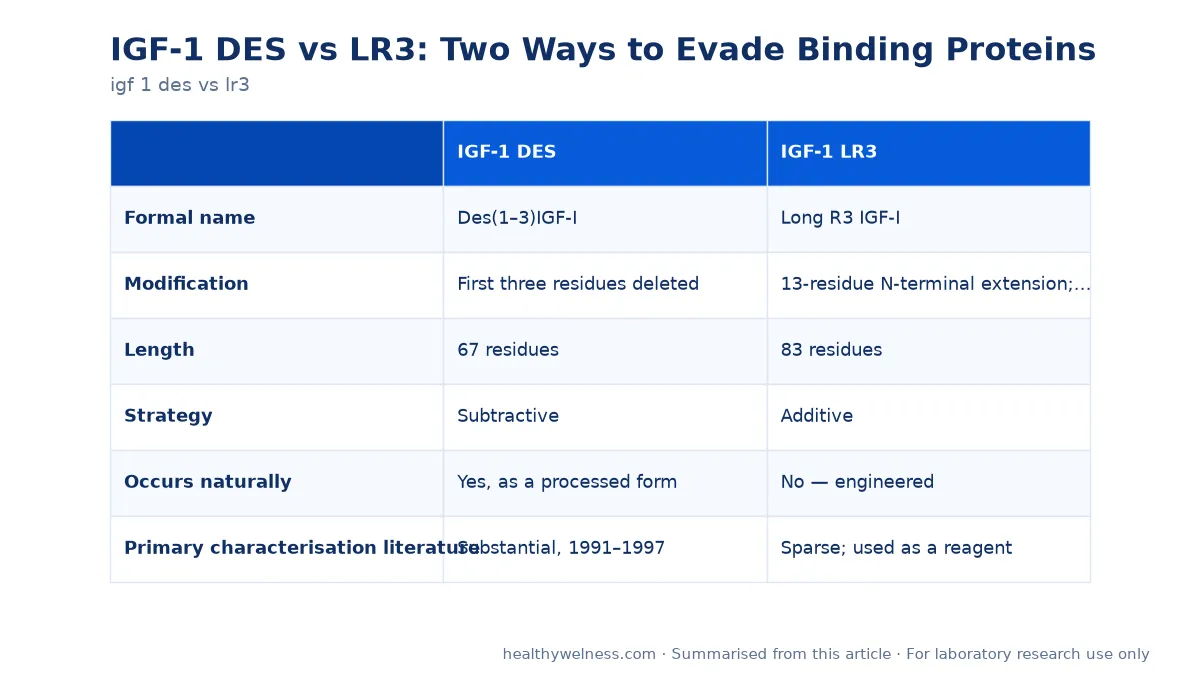
Side by side
| IGF-1 DES | IGF-1 LR3 | |
|---|---|---|
| Formal name | Des(1–3)IGF-I | Long R3 IGF-I |
| Modification | First three residues deleted | 13-residue N-terminal extension; Arg at position 3 |
| Length | 67 residues | 83 residues |
| Strategy | Subtractive | Additive |
| Occurs naturally | Yes, as a processed form | No — engineered |
| Primary characterisation literature | Substantial, 1991–1997 | Sparse; used as a reagent |
| Disulfide bridges | Three | Three |
Both retain the three disulfide bridges and the folded core of IGF-1. Neither is a peptide in the handling sense — both are folded proteins, and both lose activity silently if denatured.
DES: the better-characterised of the two
Des(1–3)IGF-I has a genuinely strong primary literature from the early 1990s, and it is worth knowing that this variant is not purely synthetic: it occurs as a naturally processed form of IGF-1.
Three papers carry most of the weight:
- Simes 1991, in the Journal of Endocrinology, compared IGF-I, IGF-II and des(1–3)IGF-I on growth hormone and binding protein secretion from cultured rat anterior pituitary cells, describing des(1–3)IGF-I as a potent analogue.
- Ballard 1991, in the same journal, measured plasma clearance and tissue distribution of labelled IGF-I, IGF-II and des(1–3)IGF-I in rats — a pharmacokinetic study rather than an activity one, and therefore the paper that explains why the potency differs.
- Ballard 1996, a dedicated review in the International Journal of Biochemistry and Cell Biology, consolidates the picture.
The 1991 clearance paper is the one most worth reading carefully, because it separates two things that are easily conflated. A variant can appear more potent because it engages the receptor better, or because less of it is sequestered and cleared. Measuring distribution and clearance is how that distinction gets made, and it is the kind of study that is almost entirely absent from the modern research-peptide literature.
The unifying evidence
The 1997 study by Tomas and colleagues is the paper that ties the class together, and its title states the thesis directly: IGF-I variants that bind poorly to IGF binding proteins show more potent and prolonged action than native IGF-I, demonstrated in pigs and marmoset monkeys.
That is a statement about a mechanism shared by the whole variant class, tested in two species. It applies to DES and to LR3 alike, and it is the single best citation for the design principle behind both. It also contains an implicit warning: the effect depends on binding proteins being present. In a serum-free system with no binding proteins, the advantage of either variant over native IGF-1 largely disappears, and the comparison measures something else entirely.
LR3’s literature is different in kind
LR3 appears in the literature predominantly as a tool rather than as a subject. The 2008 study by Hadsell and colleagues used long-R3-IGF-I in a mouse model and examined mammary signalling and gene expression — the variant is an input to that experiment, not the thing being characterised.
This asymmetry has a practical consequence. For DES, there are published clearance and distribution measurements to anchor expectations against. For LR3, there are fewer, so more has to be inferred from the shared mechanism rather than read from direct measurement. That is not a reason to avoid LR3, but it is a reason to be more cautious about quantitative expectations.
Choosing between them
| If the experiment | Consider | Reason |
|---|---|---|
| Needs to match published pharmacokinetics | DES | Clearance and distribution data exist |
| Runs in serum-free medium | Native IGF-1 may suffice | No binding proteins for a variant to evade |
| Tests the binding protein mechanism itself | Both, plus native | The three-way contrast is the readout |
| Follows an established applied protocol | Whichever that protocol used | Substitution changes the system |
| Requires precise molar concentration | Either, with the correct molecular weight | 67 and 83 residues are very different masses |
That last row is a routine source of error. The two proteins differ by sixteen residues, so a molecular weight carried over from one to the other introduces a large systematic offset. Our reconstitution calculator takes molecular weight as an explicit input for exactly this reason.
Our IGF-1 LR3 research material is supplied for laboratory research use. Certificates are available for listed products — contact us for the latest report. See reconstituting IGF-1 LR3.
Open questions
- How do DES and LR3 compare directly on binding protein affinity in one assay?
- Has LR3’s clearance been measured as carefully as DES’s was in 1991?
- Does either variant differ from native IGF-1 at the receptor, as distinct from in availability?
Related research
Frequently asked questions
What is IGF-1 DES?
Des(1-3)IGF-I: native IGF-1 with the first three residues removed, giving a 67-residue protein. It occurs naturally as a processed form and was characterised in the 1990s as a more potent IGF analogue in several systems.
What is the difference between DES and LR3?
Direction. DES removes the first three residues; LR3 adds a 13-residue extension and substitutes arginine at position 3. Both alter the same region, and both reduce capture by IGF binding proteins, but by opposite structural strategies.
Why does the N-terminal region matter?
Because it contributes to the interaction with IGF binding proteins, which sequester IGF-1 and limit its availability. Published work on des(1-3)IGF-I reported both reduced binding protein inhibition and altered clearance, which together account for the apparent potency difference.
Which has stronger published evidence?
DES has the older and more detailed primary literature, including clearance and tissue distribution work in rats from 1991 and a dedicated 1996 review. LR3 appears more often as a reagent in applied studies than as the subject of characterisation papers.
Are they interchangeable in an experiment?
No. They differ in length, mass and binding protein interaction, so molar concentration calculations differ and behaviour in a serum-containing medium differs. Substituting one for the other changes the experiment.
References
- Ballard FJ, et al. Des(1-3)IGF-I: a truncated form of insulin-like growth factor-I. Int J Biochem Cell Biol. 1996. PMID: 8930132 https://pubmed.ncbi.nlm.nih.gov/8930132/
- Simes JM, et al. The effects of insulin-like growth factor-I (IGF-I), IGF-II and des(1-3)IGF-I, a potent IGF analogue, on growth hormone and IGF-binding protein secretion from cultured rat anterior pituitary cells. J Endocrinol. 1991. PMID: 1715381 https://pubmed.ncbi.nlm.nih.gov/1715381/
- Ballard FJ, et al. Plasma clearance and tissue distribution of labelled insulin-like growth factor-I (IGF-I), IGF-II and des(1-3)IGF-I in rats. J Endocrinol. 1991. PMID: 2005410 https://pubmed.ncbi.nlm.nih.gov/2005410/
- Tomas FM, et al. IGF-I variants which bind poorly to IGF-binding proteins show more potent and prolonged hypoglycaemic action than native IGF-I in pigs and marmoset monkeys. J Endocrinol. 1997. PMID: 9415072 https://pubmed.ncbi.nlm.nih.gov/9415072/
- Hadsell DL, et al. Enhancement of maternal lactation performance during prolonged lactation in the mouse by mouse GH and long-R3-IGF-I is linked to changes in mammary signaling and gene expression. J Endocrinol. 2008. PMID: 18577570 https://pubmed.ncbi.nlm.nih.gov/18577570/
For laboratory research use only. The research materials supplied by HealthyWelness are not approved medicines, foods or cosmetics and are not for human or veterinary use. This article summarises published research and is not medical advice.
Sources
- Ballard FJ, et al. Des(1-3)IGF-I: a truncated form of insulin-like growth factor-I. Int J Biochem Cell Biol. 1996. PMID: 8930132
- Simes JM, et al. The effects of insulin-like growth factor-I (IGF-I), IGF-II and des(1-3)IGF-I, a potent IGF analogue, on growth hormone and IGF-binding protein secretion from cultured rat anterior pituitary cells. J Endocrinol. 1991. PMID: 1715381
- Ballard FJ, et al. Plasma clearance and tissue distribution of labelled insulin-like growth factor-I (IGF-I), IGF-II and des(1-3)IGF-I in rats. J Endocrinol. 1991. PMID: 2005410
- Tomas FM, et al. IGF-I variants which bind poorly to IGF-binding proteins show more potent and prolonged hypoglycaemic action than native IGF-I in pigs and marmoset monkeys. J Endocrinol. 1997. PMID: 9415072
- Hadsell DL, et al. Enhancement of maternal lactation performance during prolonged lactation in the mouse by mouse GH and long-R3-IGF-I is linked to changes in mammary signaling and gene expression. J Endocrinol. 2008. PMID: 18577570