Kisspeptin-10 vs Kisspeptin-54: Same Ending, Different Peptide
Both forms share the C-terminal region the receptor reads, so why is the longer one more potent in vivo? Duration, not receptor affinity.


Cover illustration: AI-generated editorial artwork. Conceptual only; not an exact molecular structure, actual laboratory result or evidence of clinical effects.
Both forms end in the same ten residues, and those ten residues are the part the receptor reads. That makes the obvious prediction — that they should behave identically — and the obvious prediction is wrong. Kisspeptin-54 is reported as more potent in vivo, and the explanation is not receptor affinity but how long each peptide survives.
For laboratory research use only. The research materials supplied by HealthyWelness are not approved medicines, foods or cosmetics and are not for human or veterinary use. This article summarises published research and is not medical advice.
- Kisspeptin-10 is the C-terminal decapeptide of the longer kisspeptin forms and retains the receptor-engaging region.
- Kisspeptin-54 carries 44 additional residues upstream of that same C-terminal region.
- A 2017 PLoS One study examined why kisspeptin-54 is more potent than kisspeptin-10 in vivo (d’Anglemont de Tassigny et al., PMID 28464043).
- Kisspeptin-10’s pharmacokinetics in rats were reported alongside a characterised decomposition product (Liu et al., 2013, PMID 23524040).
- Both signal through the KISS1 receptor on gonadotropin-releasing hormone neurons.
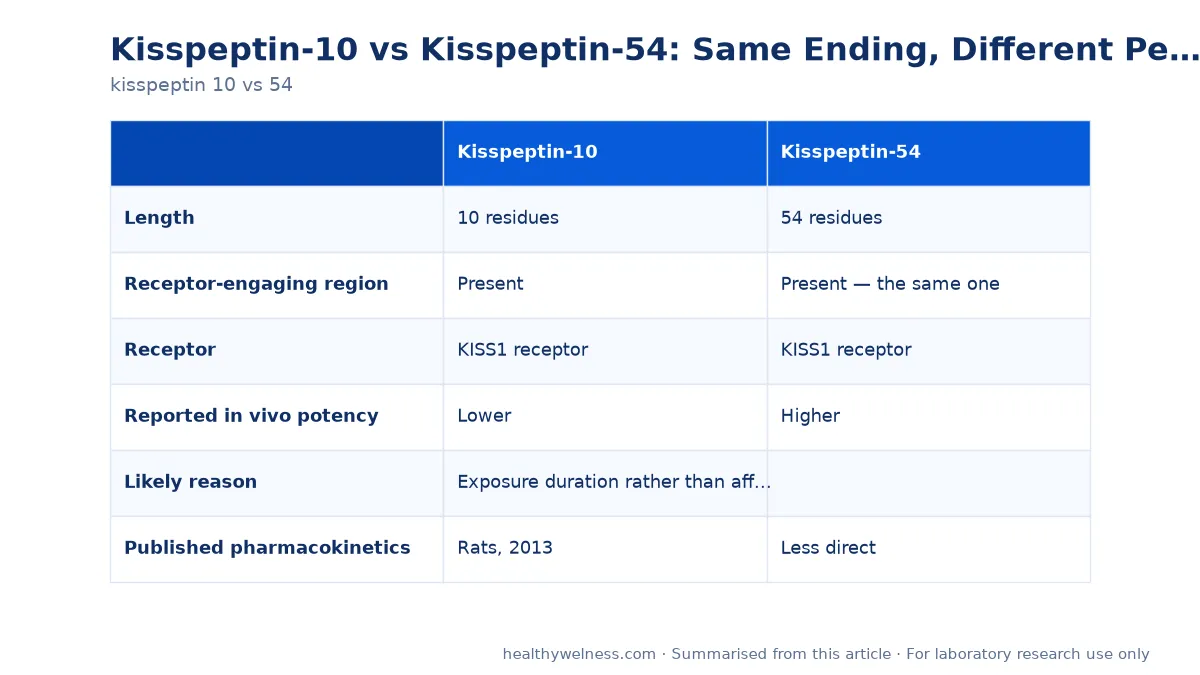
Side by side
| Kisspeptin-10 | Kisspeptin-54 | |
|---|---|---|
| Length | 10 residues | 54 residues |
| Receptor-engaging region | Present | Present — the same one |
| Receptor | KISS1 receptor | KISS1 receptor |
| Reported in vivo potency | Lower | Higher |
| Likely reason | Exposure duration rather than affinity | |
| Published pharmacokinetics | Rats, 2013 | Less direct |
| Synthesis difficulty | Low | Substantially higher |
| Verification by mass | Close to definitive | Needs the chromatogram |
Why does a shared binding region not produce shared behaviour?
Because what reaches the receptor is not the same as what was added.
A peptide in a biological system is simultaneously being cleaved, bound, distributed and cleared. The receptor sees whatever survives that process. Two peptides with identical receptor-engaging regions can therefore produce very different results if one survives longer.
The 2017 study by d’Anglemont de Tassigny and colleagues addressed this directly, and its framing is the useful part: the question it set out to answer was why the longer form is more potent in vivo, not whether it is. The answer involves more than affinity, with duration of exposure contributing — a longer peptide presents a different substrate to the peptidases that clear it.
The general principle is worth carrying beyond this pair: in vivo potency is a composite of receptor activity and survival, and a comparison that does not separate them is measuring both at once.
What does that mean for choosing between them?
It converts the choice from a question about molecules into a question about experimental design.
- Choosing a form is choosing an exposure profile. The shorter peptide delivers a briefer stimulus; the longer one a more sustained stimulus. Neither is more correct.
- A result with one form does not transfer to the other. Even though both engage the same receptor, a conclusion drawn from one is a conclusion about that exposure profile.
- Comparing them is legitimate and informative, provided molar equivalence is used and any difference is attributed to duration rather than to receptor pharmacology by default.
- In vitro the gap narrows. In a buffer without peptidases, the main driver of the in vivo difference is largely absent, so the two forms behave more alike than the animal literature suggests.
That last point is the one most often missed when a protocol moves from an animal model into a dish. The system that produced the potency difference is not present.
Why does the pattern of stimulation matter here?
Because the axis these peptides feed into reads timing, not only amount.
Kisspeptin acts within the KNDy neuron network, which the 2021 review by Uenoyama and colleagues describes as the GnRH pulse generator: neurokinin B initiates activity, dynorphin A terminates it, and kisspeptin carries the resulting signal to GnRH neurons. Downstream, the GnRH receptor responds in opposite directions to intermittent and continuous engagement — intermittent sustains signalling, continuous desensitises it, as set out in the 2016 review by Herbison.
So exposure duration is not merely a potency modifier in this system. A briefer stimulus and a sustained one can push the axis in different directions, which makes the choice between kisspeptin forms more consequential here than a duration difference would be elsewhere. The mechanism is covered in how kisspeptin works.
Does length change what has to be verified?
Yes, and in a way that favours the shorter peptide.
| Check | Kisspeptin-10 | Kisspeptin-54 |
|---|---|---|
| Observed mass | Close to definitive | Necessary but not sufficient |
| Deletion impurities | Few possible | A real synthesis outcome |
| Chromatogram needed | Useful | Essential |
| Net content correction | Proportionally large | Smaller share of mass |
At ten residues the number of same-mass alternatives is small, so computing the expected mass and comparing it against the reported value rules out most wrong sequences — though a match is consistent with the stated sequence rather than proof of it, because same-composition alternatives share a mass. At 54 residues it is not: stepwise synthesis yield is multiplicative, so chains missing a single residue accumulate, and those are precisely the impurities most likely to co-elute with the target and be counted as it.
The counterion correction runs the other way. For a decapeptide, counterion and residual water are a proportionally larger share of the vial weight, so the net content correction matters more — the arithmetic is in peptide counterions: TFA versus acetate.
What else does the 2013 bioanalytical work give you?
A characterised decomposition product, which is unusual and practically useful.
The study by Liu and colleagues developed an LC-MS/MS method for kisspeptin-10, identified its decomposition product, and reported rat pharmacokinetics. The identification matters because a degradation product that is itself detectable can be counted as parent peptide by a less selective assay, which is how an apparently clean measurement overstates the concentration of the intended species.
For anyone comparing the two forms, that is a reason to prefer a method validated to distinguish them, and a reason to prepare dilute solutions close to use. The handling practice is in reconstituting kisspeptin-10 and the measured behaviour in kisspeptin-10 half-life.
Our kisspeptin-10 research material is supplied for laboratory research use. Certificates are available for listed products — contact us for the latest report. Concentration maths runs from net peptide content, which our reconstitution calculator applies.
What to record when reporting which form was used
Because the two forms differ in exposure rather than in receptor engagement, a methods section that names only the peptide leaves out the variable that drives the difference. Three items make a kisspeptin experiment reproducible by someone else.
- Which form, by residue count, not only by name. Numbering conventions vary between papers.
- The timing of the readout relative to administration, since a brief stimulus and a sustained one are distinguishable only in time.
- Whether the medium contained peptidases, because that determines whether the exposure difference between the forms exists in the system at all.
None of these is onerous, and together they turn a result that reads as being about kisspeptin into one that is about a defined stimulus.
Scope note
This material is supplied for laboratory research use only. It is not a medicine, not a supplement, and not for human or veterinary use. The 2011 review by Hameed and colleagues is cited as background on what this axis controls.
Open questions
- How much of the in vivo potency difference remains in a peptidase-free system?
- Does the decomposition product of either form retain receptor activity?
- Can exposure be matched between the two closely enough to isolate receptor-level differences?
Related research
Frequently asked questions
What is the difference between kisspeptin-10 and kisspeptin-54?
Length, and what length does to exposure. Both are products of the same KISS1 gene and share the C-terminal region that engages the KISS1 receptor. Kisspeptin-10 is the final ten residues; kisspeptin-54 carries 44 further residues upstream of them.
If they share the receptor-binding region, why do they differ?
Because receptor engagement is not the only variable. A 2017 PLoS One study examined why kisspeptin-54 has a more potent effect in vivo, and duration of exposure contributes: a longer peptide presents a different substrate to the peptidases that clear it.
Which one should an experiment use?
Whichever matches the exposure profile the design needs. Choosing between them is choosing a duration, not simply a molecule, and a result obtained with one does not transfer to the other without justification.
Is kisspeptin-10 a fragment of kisspeptin-54?
In sequence terms it corresponds to the C-terminal decapeptide of the longer forms. Both are naturally occurring products of processing from the same precursor, so calling one a fragment of the other understates that both are real species.
Does the shorter form have published pharmacokinetics?
Yes, in rats. A 2013 study in the Journal of Chromatography B reported kisspeptin-10 pharmacokinetics alongside a characterised decomposition product, which is more direct measurement than most research peptides have.
For laboratory research use only. The research materials supplied by HealthyWelness are not approved medicines, foods or cosmetics and are not for human or veterinary use. This article summarises published research and is not medical advice.
Sources
- d'Anglemont de Tassigny X, et al. Mechanistic insights into the more potent effect of KP-54 compared to KP-10 in vivo. PLoS One. 2017. PMID: 28464043
- Liu Z, et al. LC-MS/MS quantification of a neuropeptide fragment kisspeptin-10 (NSC 741805) and characterization of its decomposition product and pharmacokinetics in rats. J Chromatogr B Analyt Technol Biomed Life Sci. 2013. PMID: 23524040
- Hameed S, et al. Kisspeptin and fertility. J Endocrinol. 2011. PMID: 21084385
- Uenoyama Y, et al. Role of KNDy Neurons Expressing Kisspeptin, Neurokinin B, and Dynorphin A as a GnRH Pulse Generator Controlling Mammalian Reproduction. Front Endocrinol (Lausanne). 2021. PMID: 34566891
- Herbison AE. Control of puberty onset and fertility by gonadotropin-releasing hormone neurons. Nat Rev Endocrinol. 2016. PMID: 27199290