Mazdutide vs Survodutide vs Tirzepatide Compared
Two of these three engage the glucagon receptor and one engages GIP instead. The receptor split, the trial records and what it means in the lab.


Cover illustration: AI-generated editorial artwork. Conceptual only; not an exact molecular structure, actual laboratory result or evidence of clinical effects.
These three are usually listed as three alternatives. The receptor pharmacology groups them as two plus one: mazdutide and survodutide both engage the glucagon receptor alongside GLP-1, while tirzepatide engages GIP instead and leaves glucagon alone. Everything else follows from that split.
For laboratory research use only. The research materials supplied by HealthyWelness are not approved medicines, foods or cosmetics and are not for human or veterinary use. This article summarises published research and is not medical advice.
- Mazdutide and survodutide are both dual agonists at the GLP-1 receptor and the glucagon receptor.
- Tirzepatide is a dual agonist at the GLP-1 receptor and the GIP receptor, and does not engage the glucagon receptor.
- Tirzepatide’s half-life was reported as approximately 5 days in a 2024 population pharmacokinetic analysis (Schneck et al., PMID 38356317).
- Survodutide has a published phase 2 trial in MASH and fibrosis (Sanyal et al., N Engl J Med 2024, PMID 38847460).
- Mazdutide received its first regulatory approval in 2025 (Shirley, Drugs, PMID 41028652).
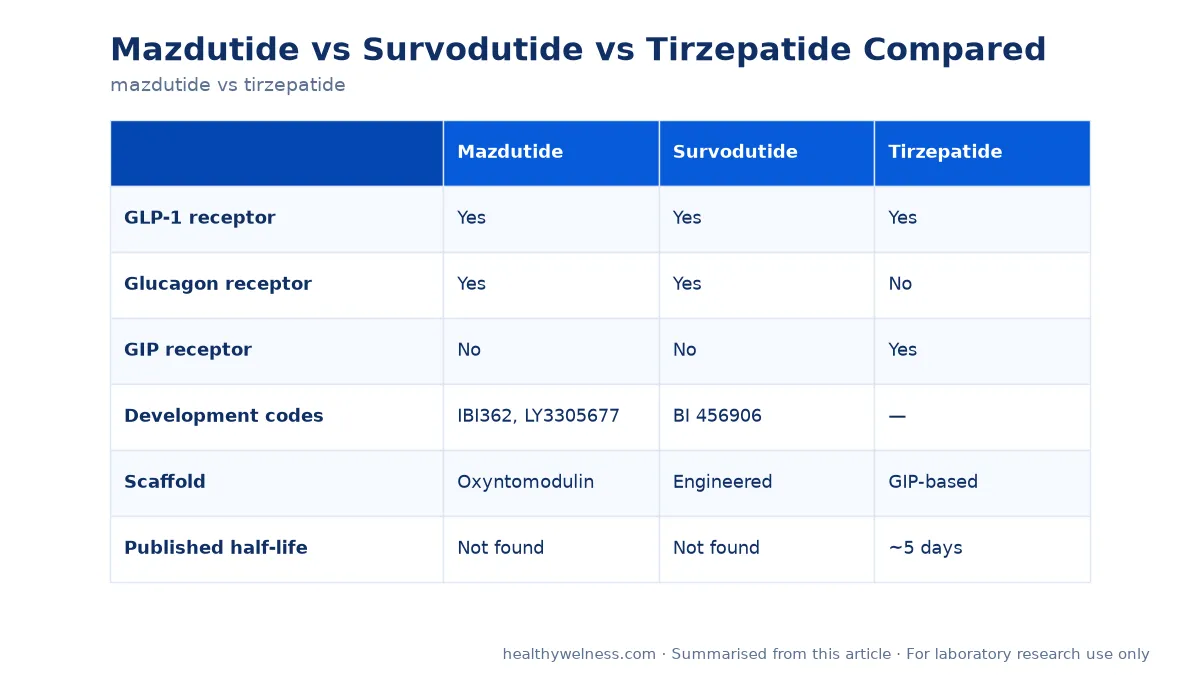
Which receptors does each compound engage?
| Mazdutide | Survodutide | Tirzepatide | |
|---|---|---|---|
| GLP-1 receptor | Yes | Yes | Yes |
| Glucagon receptor | Yes | Yes | No |
| GIP receptor | No | No | Yes |
| Development codes | IBI362, LY3305677 | BI 456906 | — |
| Scaffold | Oxyntomodulin | Engineered | GIP-based |
| Published half-life | Not found | Not found | ~5 days |
| Dosing in trials | Once weekly | Once weekly | Once weekly |
The glucagon row is the one that does the work. A compound that engages the glucagon receptor reaches hepatocytes directly, because that is where glucagon receptors are concentrated — which is why survodutide has a published liver trial and tirzepatide’s literature does not take that shape.
Why is tirzepatide the odd one out?
Because GIP and glucagon are different hormones acting on different tissues, even though both pair with GLP-1 in these designs.
The clearest evidence of the divergence is the trial programmes rather than any argument from first principles. Survodutide was tested in metabolic dysfunction-associated steatohepatitis and fibrosis, published by Sanyal and colleagues in the New England Journal of Medicine in 2024. A liver trial is a reasonable thing to run for a glucagon receptor agonist and a less obvious one for a GIP-based agent.
So the three compounds are not three points on one scale. They are two different pairings, one of which has been tested in an organ the other has not.
What does each one’s evidence base look like?
| Compound | Strongest published evidence | Notable gap |
|---|---|---|
| Tirzepatide | Population pharmacokinetics with a measured half-life | No glucagon receptor coverage to compare |
| Survodutide | Phase 2 in obesity and in MASH; phase 3 under way | No published half-life figure found |
| Mazdutide | Phase 1b and once-weekly trials; first approval in 2025 | No published half-life figure found; trials in one population |
The half-life row is worth dwelling on, because it is the question most often asked and most often answered badly. Only tirzepatide has a published number. The 2024 analysis by Schneck and colleagues reported approximately 5 days and noted that this supports sustained exposure with once-weekly dosing.
For the other two, once-weekly dosing is a fact about the trial design, not a measurement of the molecule. A dosing interval is chosen from pharmacokinetics plus a target exposure range; it is frequently shorter than the half-life so that concentrations accumulate. Reading a half-life off a dosing schedule gets the direction right and the number wrong.
What can a three-way comparison establish?
Less than it appears, and being clear about that is the point of running one properly.
- It can show whether the three differ on a chosen functional endpoint. That is a legitimate and useful question.
- It cannot attribute a difference to one receptor. Each compound differs from the others in receptor coverage, scaffold and exposure simultaneously, so no single variable is isolated.
- Isolating a receptor requires selective comparators — a GLP-1-only agonist as a floor, and ideally a glucagon-only and a GIP-only agent. A non-peptide GLP-1 agonist is now available for that role, which has the additional advantage of being chemically unrelated to all three.
- Molar equivalence is required, not mass equivalence. The three differ in molecular weight and in salt form.
- Exposure should be matched or modelled. Only one of the three has a published half-life to match against, which is itself a limit on how well this can be done.
How are all three handled in the laboratory?
Identically, because the chemistry is the same kind in each case: long engineered peptides carrying hydrophobic modifications intended to bind albumin and extend circulation.
- Sealed, dry, dark, −20 °C; warm the vial to room temperature before opening.
- Diluent down the wall, then swirl. No vortexing — hydrophobic modifications make these peptides surface-active, and foaming drives aggregation at the air–liquid interface.
- Inspect for haze after reconstitution and after dilution. Aggregated material is not at the nominal concentration.
- Aliquot on first reconstitution, date every tube, and do not refreeze one tube repeatedly. See storing reconstituted peptides.
- Net peptide content, not vial weight, for every concentration calculation. Our reconstitution calculator takes the net figure and the molecular weight for each compound separately.
One point applies specifically to a side-by-side experiment: the albumin-binding modification only does anything where albumin is present. In serum-free medium that defining property is absent from all three at once, which makes the comparison measure something different from what the trials measured.
Our mazdutide research material is supplied for laboratory research use. Certificates are available for listed products — contact us for the latest report.
Three claims this comparison does not support
Comparisons in this class are quoted more often than they are read, so it is worth stating what the material above does not establish.
- That one compound is stronger than another. Potency is defined against a receptor. These three do not share a full receptor set, so a difference on any endpoint is a difference between pharmacologies, not a ranking.
- That the glucagon-containing pair are interchangeable. Mazdutide and survodutide share a receptor pair, which is not the same as sharing a receptor balance. Whether the ratio of GLP-1 to glucagon activity differs between them is an open question, and it would matter.
- That trial results predict in vitro behaviour. The clinical literature was generated in whole organisms with albumin, peptidases and renal clearance. In a dish those are absent or different, and the property that gives these peptides their weekly interval has nothing to bind to in serum-free medium.
A note on development codes
The codes are more reliable identifiers than the names. BI 456906 is survodutide, IBI362 and LY3305677 are both mazdutide, and LY3437943 is retatrutide. Codes appear throughout the primary literature, they do not change when a compound is renamed or licensed, and a certificate of analysis quoting one is stronger evidence of identity than a trade name alone.
Scope note
This material is supplied for laboratory research use only. It is not a medicine, not a supplement, and not for human or veterinary use. The clinical trials cited are referenced as published literature about these molecules.
Open questions
- Do mazdutide and survodutide differ in the balance between GLP-1 and glucagon receptor activity?
- Will published pharmacokinetic analyses give half-life figures for the two glucagon-containing agents?
- How much of the difference between the glucagon and GIP pairings is tissue distribution rather than signalling?
Related research
Frequently asked questions
What is the main difference between these three compounds?
Which second receptor each one adds to GLP-1. Mazdutide and survodutide both add the glucagon receptor. Tirzepatide adds the GIP receptor instead and does not engage glucagon at all. That single difference separates the three into two groups, not three.
Which two are most similar?
Mazdutide and survodutide. Both are peptides acting at the GLP-1 and glucagon receptors, both are given once weekly in their published trials, and both have phase 2 or later evidence. Their clearest differences are development origin and the populations studied.
Does tirzepatide have a published half-life?
Yes. A 2024 population pharmacokinetic analysis in CPT: Pharmacometrics & Systems Pharmacology reported a half-life of approximately 5 days, which supports once-weekly dosing. Mazdutide and survodutide do not have an equivalent published figure that we can find.
Can the three be compared in one experiment?
On a shared functional readout, yes. What such a comparison cannot do is attribute a difference to one receptor, because each compound differs from the others in more than one way at once.
Do they need different laboratory handling?
No. All three are long engineered peptides carrying modifications that extend circulation, so they share the same practice: gentle reconstitution, no vortexing, aliquoting on first use, and concentration computed from net peptide content.
References
- Ji L, et al. Once-Weekly Mazdutide in Chinese Adults with Obesity or Overweight. N Engl J Med. 2025. PMID: 40421736 https://pubmed.ncbi.nlm.nih.gov/40421736/
- le Roux CW, et al. Glucagon and GLP-1 receptor dual agonist survodutide for obesity: a randomised, double-blind, placebo-controlled, dose-finding phase 2 trial. Lancet Diabetes Endocrinol. 2024. PMID: 38330987 https://pubmed.ncbi.nlm.nih.gov/38330987/
- Schneck K, et al. Population pharmacokinetics of the GIP/GLP receptor agonist tirzepatide. CPT Pharmacometrics Syst Pharmacol. 2024. PMID: 38356317 https://pubmed.ncbi.nlm.nih.gov/38356317/
- Sanyal AJ, et al. A Phase 2 Randomized Trial of Survodutide in MASH and Fibrosis. N Engl J Med. 2024. PMID: 38847460 https://pubmed.ncbi.nlm.nih.gov/38847460/
- Shirley M. Mazdutide: First Approval. Drugs. 2025. PMID: 41028652 https://pubmed.ncbi.nlm.nih.gov/41028652/
For laboratory research use only. The research materials supplied by HealthyWelness are not approved medicines, foods or cosmetics and are not for human or veterinary use. This article summarises published research and is not medical advice.
Sources
- Ji L, et al. Once-Weekly Mazdutide in Chinese Adults with Obesity or Overweight. N Engl J Med. 2025. PMID: 40421736
- le Roux CW, et al. Glucagon and GLP-1 receptor dual agonist survodutide for obesity: a randomised, double-blind, placebo-controlled, dose-finding phase 2 trial. Lancet Diabetes Endocrinol. 2024. PMID: 38330987
- Schneck K, et al. Population pharmacokinetics of the GIP/GLP receptor agonist tirzepatide. CPT Pharmacometrics Syst Pharmacol. 2024. PMID: 38356317
- Sanyal AJ, et al. A Phase 2 Randomized Trial of Survodutide in MASH and Fibrosis. N Engl J Med. 2024. PMID: 38847460
- Shirley M. Mazdutide: First Approval. Drugs. 2025. PMID: 41028652