What Is Survodutide? Dual GLP-1 and Glucagon Agonist
Survodutide (BI 456906) is a dual glucagon and GLP-1 receptor agonist peptide. Its receptor design, trial literature and laboratory handling.


Cover illustration: AI-generated editorial artwork. Conceptual only; not an exact molecular structure, actual laboratory result or evidence of clinical effects.
Survodutide, development code BI 456906, is an engineered peptide that activates both the glucagon receptor and the GLP-1 receptor. It is the glucagon-containing member of the dual-agonist group, which is what separates it from tirzepatide, and it has a larger published trial literature than most compounds in a research catalogue.
For laboratory research use only. The research materials supplied by HealthyWelness are not approved medicines, foods or cosmetics and are not for human or veterinary use. This article summarises published research and is not medical advice.
- Survodutide (BI 456906) is a dual agonist at the glucagon receptor and the GLP-1 receptor, not at the GIP receptor.
- A dose-finding phase 2 trial in obesity was published in Lancet Diabetes & Endocrinology in 2024 (le Roux et al., PMID 38330987).
- A separate phase 2 trial in MASH and fibrosis appeared in the New England Journal of Medicine in 2024 (Sanyal et al., PMID 38847460).
- Survodutide was given once weekly by subcutaneous route in its published phase 2 obesity trial, which ran 46 weeks.
- Retatrutide differs by adding the GIP receptor, making it a triple agonist rather than a dual one.
Which receptors does survodutide engage?
Two: the glucagon receptor (GCGR) and the GLP-1 receptor (GLP-1R). Both belong to the class B family of G protein-coupled receptors, which normally bind long peptide ligands in two parts — the receptor’s extracellular domain grips the ligand’s C-terminal region while the N-terminal region reaches into the receptor core.
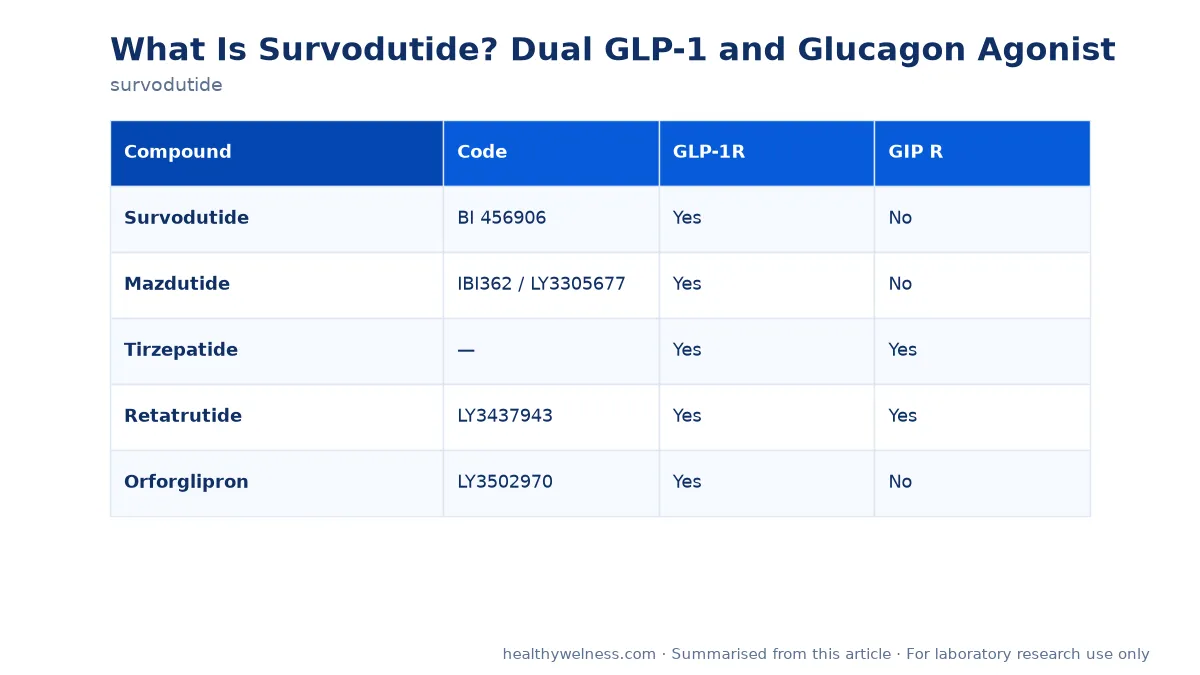
The choice of those two receptors rather than any other pair is the design decision that defines the compound. The table below places it against the other multi-receptor agonists now in the literature.
| Compound | Code | GLP-1R | GIP R | Glucagon R | Class |
|---|---|---|---|---|---|
| Survodutide | BI 456906 | Yes | No | Yes | Peptide |
| Mazdutide | IBI362 / LY3305677 | Yes | No | Yes | Peptide |
| Tirzepatide | — | Yes | Yes | No | Peptide |
| Retatrutide | LY3437943 | Yes | Yes | Yes | Peptide |
| Orforglipron | LY3502970 | Yes | No | No | Non-peptide |
Reading down the glucagon column groups the field in the way that matters for an experiment: survodutide and mazdutide share a receptor pair, tirzepatide does not include glucagon at all, and retatrutide covers all three.
What does the published literature actually cover?
Survodutide has an unusually complete trial record for a compound sold as research material, and the studies address two different conditions rather than one.
| Study | Year | Journal | Design |
|---|---|---|---|
| le Roux et al. | 2024 | Lancet Diabetes Endocrinol | Randomised, double-blind, placebo-controlled dose-finding phase 2, 46 weeks |
| Sanyal et al. | 2024 | N Engl J Med | Phase 2 randomised trial in MASH and fibrosis |
| le Roux et al. | 2026 | N Engl J Med | Once-weekly treatment in adults with obesity |
| SYNCHRONIZE-2 | 2026 | Diabetes Obes Metab | Phase 3 baseline characteristics |
The MASH trial is the one worth singling out. Metabolic dysfunction-associated steatohepatitis is a liver condition, and a glucagon receptor agonist has a mechanistic reason to be studied there that a GLP-1-only agent does not: the glucagon receptor is expressed on hepatocytes and glucagon signalling acts directly on liver metabolism.
In other words, the second receptor is not a bolt-on for extra potency; it opens a different tissue. That is the most useful single idea for understanding why dual agonists exist.
Why adding glucagon changes the interpretation
For anyone designing an experiment, a dual agonist carries a specific constraint that a single-receptor agonist does not.
- An observed effect cannot be assigned to one receptor. It is an effect of dual agonism unless selective comparators are included.
- The two receptors are expressed differently by tissue. A preparation rich in one and poor in the other will respond as though the compound were a single-receptor agonist.
- Selective comparators now exist. A GLP-1-only agonist is available as a contrast, including the non-peptide orforglipron described by Sloop and colleagues in 2024 — a useful control precisely because it engages one receptor and is chemically unrelated.
The same logic, applied to three receptors instead of two, is set out in the 2025 systematic review of retatrutide by Abdrabou Abouelmagd and colleagues and in orforglipron compared with retatrutide.
What does once-weekly dosing imply about the molecule?
The published phase 2 obesity trial administered survodutide subcutaneously once weekly across 46 weeks, with a 20-week escalation period followed by 26 weeks of maintenance. The 2026 New England Journal of Medicine report is likewise a once-weekly design, and the SYNCHRONIZE-2 phase 3 trial described by Wharton and colleagues continues it.
A weekly interval is not an administrative convenience; it is evidence about the molecule. A native incretin peptide survives minutes in circulation, because dipeptidyl peptidase-4 cleaves it and the kidney clears what remains. Getting from minutes to a week requires engineering on two fronts at once: blocking the enzymatic cleavage site, and raising the effective size of the molecule so it is not filtered. The usual solution to the second problem is a lipid chain that binds albumin, parking the peptide on a long-lived carrier protein.
Three consequences follow for laboratory work, and they are easy to get wrong:
- The albumin interaction only exists where albumin does. In serum-free medium there is nothing for the lipid modification to bind, so the property that defines the compound in vivo is absent from the assay.
- Free and bound fractions are not the same thing. In serum-containing medium the nominal concentration and the concentration available to the receptor diverge, and the gap depends on albumin concentration.
- The lipid chain changes physical behaviour. A hydrophobic modification makes the peptide more surface-active, which is why gentle reconstitution matters more here than for a plain peptide.
The 2025 review by Arun and colleagues in Cardiology in Review places the compound in its therapeutic class, which is useful background, but the handling consequences above come from the chemistry rather than from the clinical framing.
How is survodutide handled in the laboratory?
As a peptide, and specifically as a long engineered peptide carrying modifications intended to extend circulation. Those modifications raise hydrophobic character, which changes how the material behaves on reconstitution.
- Store the sealed lyophilized powder at −20 °C, dry and dark. Let the vial reach room temperature before opening so atmospheric moisture does not condense into a hygroscopic powder.
- Add diluent down the inside wall and swirl. Do not vortex: shear and foaming at the air–liquid interface promote aggregation, which is the characteristic failure mode for peptides of this length.
- Inspect the solution. Haze or particulates mean aggregation has begun and the concentration is no longer what the label says.
- Aliquot on first reconstitution and date each tube, so no tube is warmed and refrozen more than once. See storing reconstituted peptides.
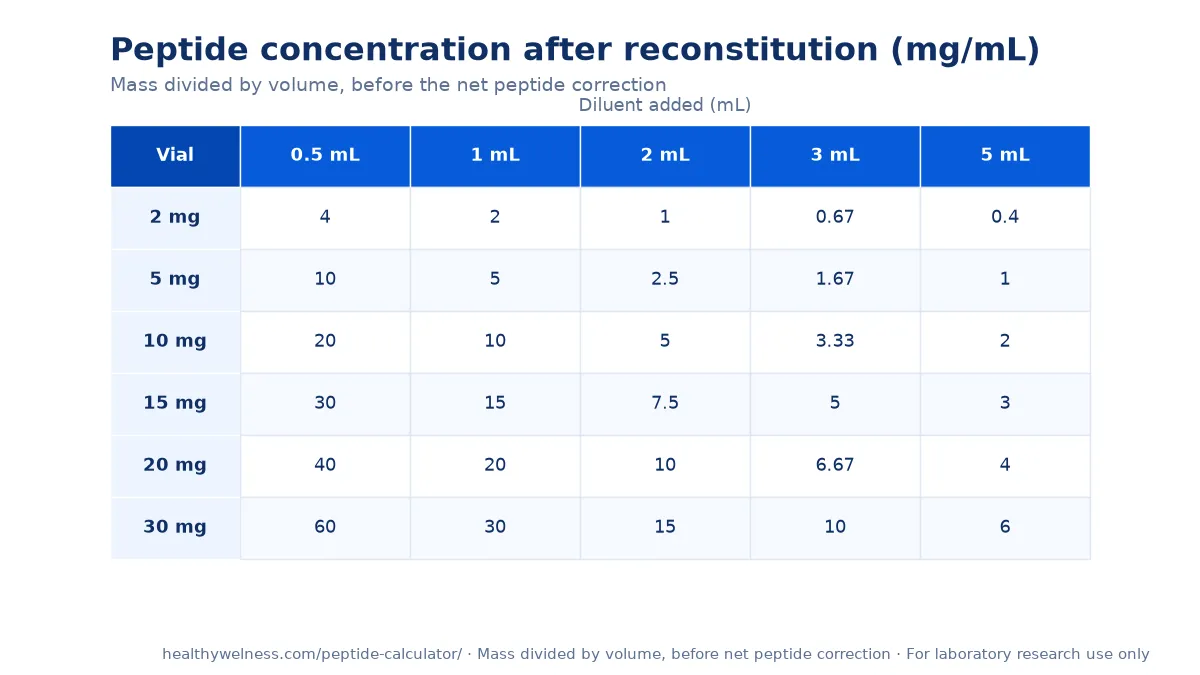
- Compute molarity from net peptide content, not from the nominal vial weight: counterion and residual water are real mass. The chart above gives the gross arithmetic, and our reconstitution calculator applies the net correction.
What should be checked on the analytical report?
For a long engineered peptide the most informative item is the chromatogram, not the purity percentage. Deletion impurities — chains missing one residue — are a real outcome of synthesising a molecule this long, and they are the impurities most likely to co-elute with the target and be counted as target peptide.
| Check | Why it matters here |
|---|---|
| Stated sequence and modifications | A name alone does not identify an engineered peptide |
| Observed mass as a number | Compute the expected value and compare it yourself |
| Chromatogram, not just a percentage | Deletion impurities co-elute and inflate the purity figure |
| Counterion named | Needed for the molecular weight and relevant in cell work |
| Net peptide content | Without it, weight-based concentrations are systematically high |
The general framework is in how to read a certificate of analysis, and the counterion arithmetic in peptide counterions: TFA versus acetate.
Our survodutide research material is supplied for laboratory research use. Certificates are available for listed products — contact us for the latest report.
Scope note
This material is supplied for laboratory research use only. It is not a medicine, not a supplement, and not for human or veterinary use. The clinical trials cited above are referenced as published literature about a molecule; nothing here describes or recommends administration of research material to any organism.
Open questions
- How much of survodutide’s profile is attributable to glucagon receptor engagement rather than GLP-1 receptor engagement?
- Is there a published pharmacokinetic study giving a half-life figure for survodutide?
- Do the two dual agonists in this class, survodutide and mazdutide, differ at the receptor or only in exposure?
Related research
Frequently asked questions
What is survodutide?
Survodutide, development code BI 456906, is an engineered peptide that activates two receptors: the glucagon receptor and the GLP-1 receptor. It is described in the literature as a dual agonist, and it is given once weekly in the published trials.
Which receptors does survodutide act on?
The glucagon receptor (GCGR) and the GLP-1 receptor (GLP-1R). That pairing is what distinguishes it from tirzepatide, which acts at GLP-1 and GIP receptors, and from single-receptor GLP-1 agonists.
What published trials exist for survodutide?
A dose-finding phase 2 trial in obesity published in Lancet Diabetes & Endocrinology in 2024, a phase 2 trial in MASH and fibrosis in the New England Journal of Medicine in 2024, a 2026 NEJM report of once-weekly treatment in adults with obesity, and baseline data from the SYNCHRONIZE-2 phase 3 trial.
How does survodutide differ from retatrutide?
By the number of receptors. Survodutide is a dual agonist at the glucagon and GLP-1 receptors. Retatrutide is a triple agonist that adds the GIP receptor. Adding a receptor widens the pharmacology and makes attribution of any single effect harder.
Is survodutide a peptide or a small molecule?
A peptide. It is an engineered peptide carrying modifications intended to extend circulation, which is why it is handled with peptide practice: aqueous reconstitution, gentle mixing, aliquoting, and concentration calculated from net peptide content.
References
- le Roux CW, et al. Glucagon and GLP-1 receptor dual agonist survodutide for obesity: a randomised, double-blind, placebo-controlled, dose-finding phase 2 trial. Lancet Diabetes Endocrinol. 2024. PMID: 38330987 https://pubmed.ncbi.nlm.nih.gov/38330987/
- Sanyal AJ, et al. A Phase 2 Randomized Trial of Survodutide in MASH and Fibrosis. N Engl J Med. 2024. PMID: 38847460 https://pubmed.ncbi.nlm.nih.gov/38847460/
- le Roux CW, et al. Survodutide Once Weekly for the Treatment of Adults with Obesity. N Engl J Med. 2026. PMID: 42253238 https://pubmed.ncbi.nlm.nih.gov/42253238/
- Abdrabou Abouelmagd A, et al. Efficacy and safety of retatrutide, a novel GLP-1, GIP, and glucagon receptor agonist for obesity treatment: a systematic review and meta-analysis of randomized controlled trials. Proc (Bayl Univ Med Cent). 2025. PMID: 40291085 https://pubmed.ncbi.nlm.nih.gov/40291085/
- Sloop KW, et al. The pharmacological basis for nonpeptide agonism of the GLP-1 receptor by orforglipron. Sci Transl Med. 2024. PMID: 39693407 https://pubmed.ncbi.nlm.nih.gov/39693407/
- Arun AJ, et al. Survodutide: A Dual GLP-1/Glucagon Agonist Reshaping Cardiometabolic Care. Cardiol Rev. 2025. PMID: 40963161 https://pubmed.ncbi.nlm.nih.gov/40963161/
- Wharton S, et al. Baseline characteristics in the SYNCHRONIZE-2 randomized phase 3 trial of survodutide, a glucagon receptor/GLP-1 receptor dual agonist, for obesity in people with type 2 diabetes. Diabetes Obes Metab. 2026. PMID: 41216778 https://pubmed.ncbi.nlm.nih.gov/41216778/
For laboratory research use only. The research materials supplied by HealthyWelness are not approved medicines, foods or cosmetics and are not for human or veterinary use. This article summarises published research and is not medical advice.
Sources
- le Roux CW, et al. Glucagon and GLP-1 receptor dual agonist survodutide for obesity: a randomised, double-blind, placebo-controlled, dose-finding phase 2 trial. Lancet Diabetes Endocrinol. 2024. PMID: 38330987
- Sanyal AJ, et al. A Phase 2 Randomized Trial of Survodutide in MASH and Fibrosis. N Engl J Med. 2024. PMID: 38847460
- le Roux CW, et al. Survodutide Once Weekly for the Treatment of Adults with Obesity. N Engl J Med. 2026. PMID: 42253238
- Abdrabou Abouelmagd A, et al. Efficacy and safety of retatrutide, a novel GLP-1, GIP, and glucagon receptor agonist for obesity treatment: a systematic review and meta-analysis of randomized controlled trials. Proc (Bayl Univ Med Cent). 2025. PMID: 40291085
- Sloop KW, et al. The pharmacological basis for nonpeptide agonism of the GLP-1 receptor by orforglipron. Sci Transl Med. 2024. PMID: 39693407
- Arun AJ, et al. Survodutide: A Dual GLP-1/Glucagon Agonist Reshaping Cardiometabolic Care. Cardiol Rev. 2025. PMID: 40963161
- Wharton S, et al. Baseline characteristics in the SYNCHRONIZE-2 randomized phase 3 trial of survodutide, a glucagon receptor/GLP-1 receptor dual agonist, for obesity in people with type 2 diabetes. Diabetes Obes Metab. 2026. PMID: 41216778