Mod GRF 1-29 vs CJC-1295: What the Names Mean
Mod GRF 1-29 and CJC-1295 without DAC usually name the same molecule. The DAC version is a different compound. How to tell from the report.

Cover illustration: AI-generated editorial artwork. Conceptual only; not an exact molecular structure, actual laboratory result or evidence of clinical effects.
This is a naming question with a real compound difference hidden inside it. Mod GRF 1-29 and CJC-1295 without DAC are generally used for the same molecule. CJC-1295 with DAC is a different compound. So the useful comparison is not between the two names but between the versions with and without the linker, and the only reliable way to tell them apart is the observed mass.
For laboratory research use only. The research materials supplied by HealthyWelness are not approved medicines, foods or cosmetics and are not for human or veterinary use. This article summarises published research and is not medical advice.
- Both compounds are built on GHRH(1-29), the first twenty-nine residues of growth hormone releasing hormone.
- Mod GRF 1-29 and CJC-1295 without DAC generally refer to the same modified GHRH(1-29) analogue.
- DAC stands for Drug Affinity Complex and means a maleimide-containing linker intended to bind a free thiol on albumin.
- The DAC linker adds substantial mass, so the two versions are distinguishable by a reported observed mass.
- Native GHRH is cleaved at position 2 by dipeptidyl peptidase-4, which is the liability these analogues are designed around.
What is the 1-29 fragment?
The first twenty-nine residues of growth hormone releasing hormone, which is the region that retains activity at the GHRH receptor. Everything in this family is built on it.
Sermorelin is that fragment unmodified — the native sequence, amidated at the C-terminus. The analogues add substitutions to it, and reading which substitutions were made tells you where the native peptide is weak.
The 1985 study by Barron and colleagues compared GHRH(1–29)-NH2 against a D-Ala2 analogue, and the 1997 study by Khorram and colleagues used a norleucine-substituted version. Position 2 is the dipeptidyl peptidase-4 cleavage site, which is why so many analogues carry a substitution there, and position 27 carries a methionine in the native sequence, which is oxidation-prone. Each modification marks a liability someone decided was worth engineering around. The unmodified parent is covered in what sermorelin is.
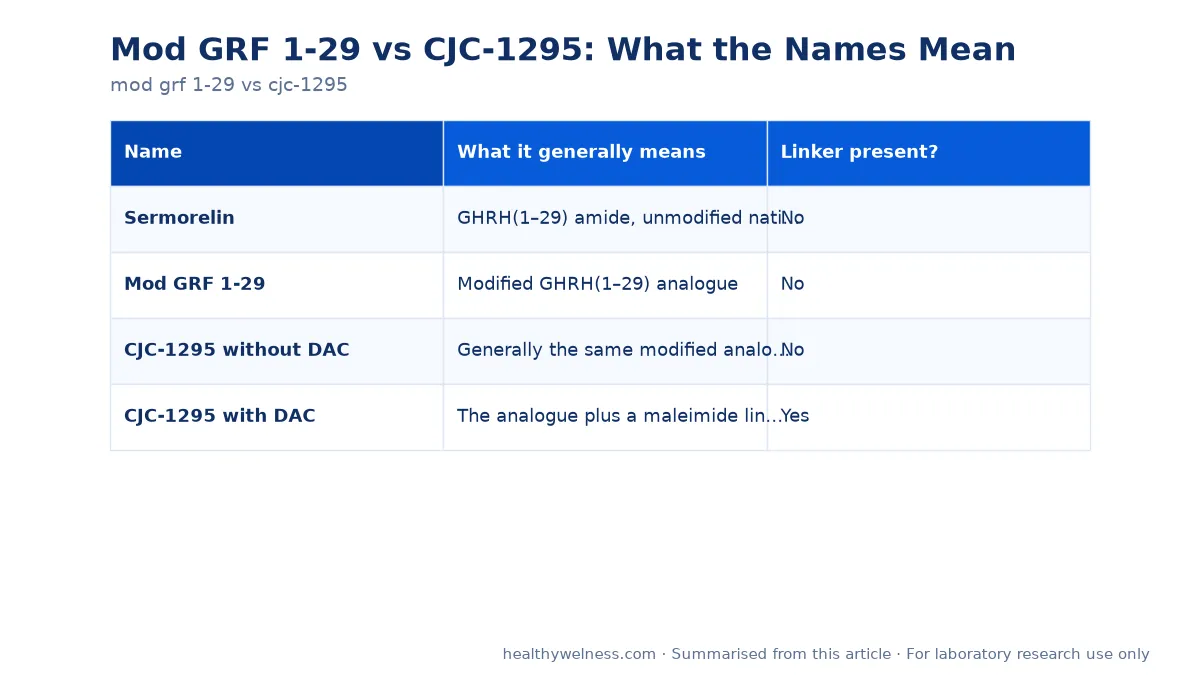
Which names refer to which molecule?
| Name | What it generally means | Linker present? |
|---|---|---|
| Sermorelin | GHRH(1–29) amide, unmodified native sequence | No |
| Mod GRF 1-29 | Modified GHRH(1–29) analogue | No |
| CJC-1295 without DAC | Generally the same modified analogue | No |
| CJC-1295 with DAC | The analogue plus a maleimide linker | Yes |
The word “generally” is doing deliberate work in the middle two rows. These are informal product names rather than regulated identifiers, and a name alone does not establish what is in a vial. The stated sequence and the observed mass do.
What does the DAC linker change?
It changes the compound, the pharmacology and the storage requirements, in that order of obviousness.
Maleimide chemistry is one of the most widely used bioconjugation reactions: a maleimide reacts rapidly and selectively with a free thiol to form a stable covalent bond. The intended target is the free cysteine thiol on serum albumin, and attaching the peptide to albumin gives it albumin’s long circulating lifetime. That is the entire design rationale.
The 2006 studies by Teichman and by Ionescu, both in the Journal of Clinical Endocrinology and Metabolism, characterise the resulting prolonged activity. The Ionescu paper contains the more interesting observation: pulsatile secretion persisted despite continuous stimulation, so the pulse generator kept running rather than being flattened by a sustained input.
Three consequences follow for the laboratory:
- A reactive group is a storage liability. A maleimide will react with any thiol it meets, and it hydrolyses in aqueous solution over time into a form that no longer conjugates.
- Thiol-free diluent is mandatory for the DAC version. Reducing agents and sulfhydryl-containing buffer components consume the linker.
- The failure is silent. A preparation whose maleimide has hydrolysed still contains an intact peptide of nearly the right mass, and will behave like the version without DAC.
The storage detail is in CJC-1295 storage and the design background in CJC-1295 with DAC.
How do you tell which version you have?
By computing the expected mass for each and comparing against the reported value. This is the one check that settles the question, and it takes a few minutes.
- Read the stated sequence and modifications from the report. If neither is stated, the document has not identified the compound and no further check is possible.
- Note whether a linker is described. DAC, maleimide or a conjugation moiety all indicate the version with the linker.
- Compute the expected mass for the stated structure, including the linker if present.
- Compare against the observed mass as a number. A pass statement saying “mass conforms” is not this check: conforms to what?
- Look at the chromatogram. At 29 residues, deletion impurities are a real synthesis outcome and are the ones most likely to co-elute with the target and inflate a purity figure.
The general framework is in how to read a certificate of analysis.
Does the counterion matter here?
As mass, yes. A 29-residue peptide with basic residues is isolated as a salt, and reverse-phase purification leaves trifluoroacetate behind unless an exchange step is added. The 2008 evaluation by Roux and colleagues found that exchange approaches differ in completeness, so “acetate salt” tells you an exchange was performed rather than that no trifluoroacetate remains.
For concentration work the rule is the same as everywhere: use the net peptide content and the molecular weight of the exact form supplied. The non-peptide share — counterion plus residual water — is real mass that a balance reads, so calculating from the nominal vial weight gives a solution more dilute than intended, always in the same direction. The arithmetic is in peptide counterions: TFA versus acetate, and our reconstitution calculator applies the correction.
Which version should an experiment use?
| If the design needs | Use | Why |
|---|---|---|
| A brief, defined stimulus | Without DAC | No albumin attachment to prolong exposure |
| Sustained exposure in a whole organism | With DAC | That is what the linker is for |
| Work in serum-free medium | Without DAC | No albumin for the linker to bind |
| Comparison with the 2006 clinical literature | With DAC | Those studies used the long-acting form |
| Minimal handling risk | Without DAC | No reactive group to lose |
The serum-free row is the one most often overlooked. The DAC version’s defining property depends on albumin being present; in a medium without it, the linker has nothing to attach to and the compound behaves much like the version without DAC — while still carrying the storage liability.
Our CJC-1295 no DAC research material is supplied for laboratory research use. Certificates are available for listed products — contact us for the latest report.
A practical note on ordering
Because the informal names are not regulated identifiers, the surest way to specify which compound is wanted is to describe it rather than name it: the GHRH(1-29) analogue with the stated substitutions, with or without the conjugation linker. A supplier who can confirm that description and supply a matching observed mass has answered the question; one who confirms only the product name has not.
Scope note
This material is supplied for laboratory research use only. It is not a medicine, not a supplement, and not for human or veterinary use.
Open questions
- How quickly does the maleimide hydrolyse in common aqueous diluents at refrigerator temperature?
- Can linker integrity be confirmed by a routine analytical method?
- How consistently do suppliers distinguish Mod GRF 1-29 from the version with DAC on their reports?
Related research
Frequently asked questions
Is Mod GRF 1-29 the same as CJC-1295?
It depends which CJC-1295 is meant. Mod GRF 1-29 and CJC-1295 without DAC are generally used for the same modified GHRH(1-29) analogue. CJC-1295 with DAC is a different molecule, carrying an added linker that the other does not have.
What does DAC stand for?
Drug Affinity Complex. In practice it means a maleimide-containing linker attached to the peptide, intended to react with a free thiol on serum albumin and attach the peptide to a long-lived carrier protein.
What does the 1-29 refer to?
The first twenty-nine residues of growth hormone releasing hormone, which is the region that retains activity at the GHRH receptor. Both compounds are built on that fragment.
Why do the modifications exist at all?
To resist degradation. Native GHRH is cleaved rapidly at position 2 by dipeptidyl peptidase-4, and the substitutions in these analogues exist to block that cleavage and extend the molecule’s useful life.
How can the two be told apart from a report?
By mass. The DAC linker adds substantial mass, so the observed mass for the DAC version differs clearly from the version without it. A report stating only a name has not identified which compound is in the vial.
References
- Teichman SL, et al. Prolonged stimulation of growth hormone (GH) and insulin-like growth factor I secretion by CJC-1295, a long-acting analog of GH-releasing hormone, in healthy adults. J Clin Endocrinol Metab. 2006. PMID: 16352683 https://pubmed.ncbi.nlm.nih.gov/16352683/
- Ionescu M, et al. Pulsatile secretion of growth hormone (GH) persists during continuous stimulation by CJC-1295, a long-acting GH-releasing hormone analog. J Clin Endocrinol Metab. 2006. PMID: 17018654 https://pubmed.ncbi.nlm.nih.gov/17018654/
- Barron JL, et al. Growth hormone responses to growth hormone-releasing hormone (1-29)-NH2 and a D-Ala2 analog in normal men. Peptides. 1985. PMID: 2866496 https://pubmed.ncbi.nlm.nih.gov/2866496/
- Khorram O, et al. Effects of [norleucine27]growth hormone-releasing hormone (GHRH) (1-29)-NH2 administration on the immune system of aging men and women. J Clin Endocrinol Metab. 1997. PMID: 9360512 https://pubmed.ncbi.nlm.nih.gov/9360512/
- Roux S, et al. Elimination and exchange of trifluoroacetate counter-ion from cationic peptides: a critical evaluation of different approaches. J Pept Sci. 2008. PMID: 18035848 https://pubmed.ncbi.nlm.nih.gov/18035848/
For laboratory research use only. The research materials supplied by HealthyWelness are not approved medicines, foods or cosmetics and are not for human or veterinary use. This article summarises published research and is not medical advice.
Sources
- Teichman SL, et al. Prolonged stimulation of growth hormone (GH) and insulin-like growth factor I secretion by CJC-1295, a long-acting analog of GH-releasing hormone, in healthy adults. J Clin Endocrinol Metab. 2006. PMID: 16352683
- Ionescu M, et al. Pulsatile secretion of growth hormone (GH) persists during continuous stimulation by CJC-1295, a long-acting GH-releasing hormone analog. J Clin Endocrinol Metab. 2006. PMID: 17018654
- Barron JL, et al. Growth hormone responses to growth hormone-releasing hormone (1-29)-NH2 and a D-Ala2 analog in normal men. Peptides. 1985. PMID: 2866496
- Khorram O, et al. Effects of [norleucine27]growth hormone-releasing hormone (GHRH) (1-29)-NH2 administration on the immune system of aging men and women. J Clin Endocrinol Metab. 1997. PMID: 9360512
- Roux S, et al. Elimination and exchange of trifluoroacetate counter-ion from cationic peptides: a critical evaluation of different approaches. J Pept Sci. 2008. PMID: 18035848