CJC-1295 Storage: Why the DAC Version Differs
CJC-1295 with DAC carries a reactive maleimide group; the no-DAC version does not. That difference changes how each should be stored and handled.

Cover illustration: AI-generated editorial artwork. Conceptual only; not an exact molecular structure, actual laboratory result or evidence of clinical effects.
Storage guidance for CJC-1295 is usually given as a single answer, which is a mistake, because the two versions of the compound are chemically different in a way that matters for storage. The DAC version carries a deliberately reactive group. The no-DAC version does not. A reactive group is useful in an experiment and a liability in a freezer.
For laboratory research use only. The research materials supplied by HealthyWelness are not approved medicines, foods or cosmetics and are not for human or veterinary use. This article summarises published research and is not medical advice.
What DAC is, chemically
DAC stands for Drug Affinity Complex, and in practice it means a maleimide-containing linker attached to the peptide. Maleimide chemistry is one of the most widely used bioconjugation reactions: a maleimide reacts rapidly and selectively with a free thiol to form a stable covalent bond.
The intended target is the free cysteine thiol on serum albumin. Attaching the peptide to albumin gives it albumin’s long circulating lifetime, which is the entire design rationale. The 2006 studies by Teichman and by Ionescu, both in the Journal of Clinical Endocrinology and Metabolism, characterise the resulting prolonged activity — and the Ionescu paper makes the more interesting observation that pulsatile secretion persisted despite continuous stimulation.
The storage consequence follows directly. A group that reacts rapidly with thiols will react with any thiol it encounters, not only the intended one. It also undergoes hydrolysis in aqueous solution over time, converting to a form that no longer conjugates.
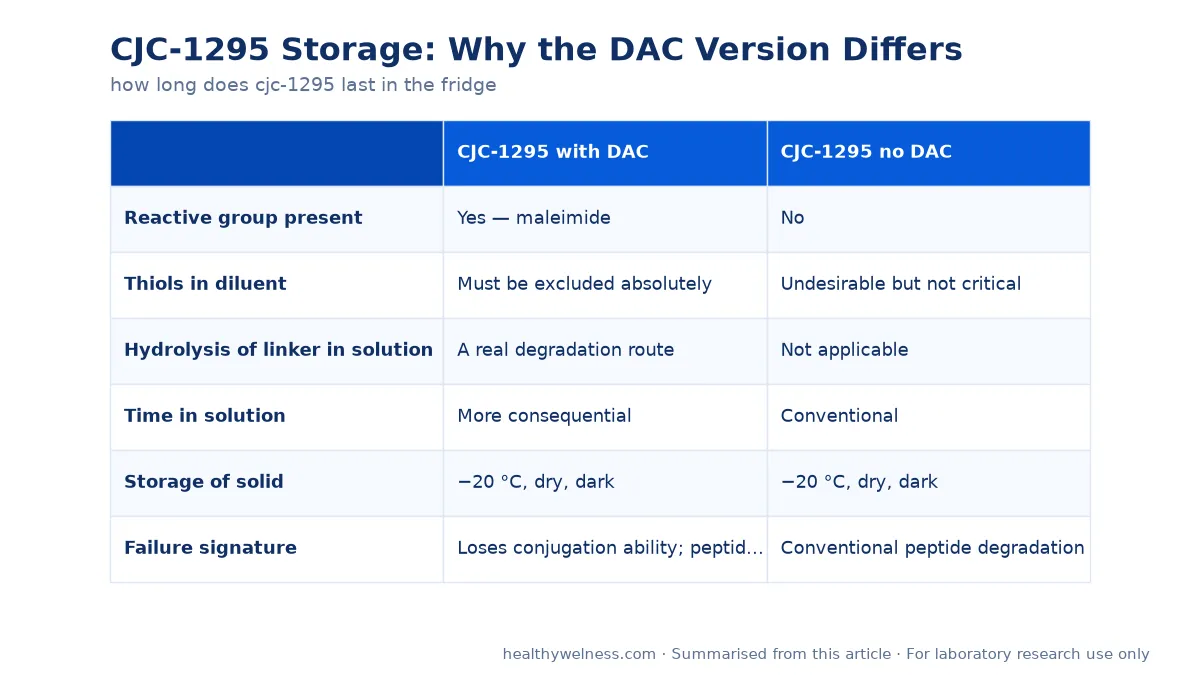
The two versions compared for storage purposes
| CJC-1295 with DAC | CJC-1295 no DAC | |
|---|---|---|
| Reactive group present | Yes — maleimide | No |
| Thiols in diluent | Must be excluded absolutely | Undesirable but not critical |
| Hydrolysis of linker in solution | A real degradation route | Not applicable |
| Time in solution | More consequential | Conventional |
| Storage of solid | −20 °C, dry, dark | −20 °C, dry, dark |
| Failure signature | Loses conjugation ability; peptide intact | Conventional peptide degradation |
The failure signature row is the one that catches people. A DAC preparation whose maleimide has hydrolysed still contains an intact peptide of nearly the right mass. It will look acceptable on a routine analysis and will behave, in an experiment, like the no-DAC version — which is to say, it will appear to lose its defining property for no visible reason.
Practical storage of the solid
For both versions the same principles apply, and they are the ordinary ones for a 29-residue peptide analogue:
- Sealed, dry, dark, at −20 °C or below. Desiccant in the storage container.
- Warm the sealed vial to room temperature before opening, so atmospheric moisture does not condense into a hygroscopic powder.
- Reseal properly after use; a lyophilized peptide is not inert, and water uptake accelerates chemical degradation in the solid state.
The 1999 study by Lai and colleagues on peptide deamidation in a polymer matrix makes the underlying point well: water acts both as a solvent for the reaction and as a plasticiser that gives molecules the mobility to react. Keeping a solid dry is therefore not merely about avoiding dissolution.
Practical storage of solutions
- Use a thiol-free diluent. For the DAC version this is not a preference. Any reducing agent or sulfhydryl-containing additive consumes the maleimide.
- Keep trace metals out. Metal-catalysed oxidation is a general peptide degradation route, documented for histidine in model peptides by Khossravi and colleagues, and CJC-1295 contains oxidation-prone residues.
- Aliquot on first reconstitution. One warming and cooling round per aliquot, rather than many for one tube, is the whole point.
- Refrigerate what is in active use; freeze the rest. Refrigeration is for days of working use, not for storage over months.
- Date every tube and record the diluent. When a result is anomalous, this is the first record to consult.
- For the DAC version, minimise time in solution before use. Linker hydrolysis proceeds whether or not the experiment has started.
Volume arithmetic from net peptide mass is handled by our reconstitution calculator; note that the DAC and no-DAC versions have different molecular weights, so the figure cannot be carried from one to the other.
What the published work implies about handling
The two 2006 papers establish that the DAC design achieves prolonged activity. Read as handling guidance, they say something more specific: the prolonged activity depends on the conjugation happening. The peptide alone does not persist; the peptide attached to albumin does. A preparation that has lost its ability to conjugate has lost the property those papers describe, while remaining a peptide of approximately the right mass.
For anyone comparing the two versions experimentally, this means a confirmation step is worth building in. If the DAC arm behaves like the no-DAC arm, linker integrity is the first hypothesis to test, ahead of any biological explanation. See CJC-1295 with DAC for the design detail and reading a certificate of analysis for what the analytical data can and cannot confirm.
Our CJC-1295 no DAC research material is supplied for laboratory research use. Certificates are available for listed products — contact us for the latest report.
Open questions
- How quickly does the maleimide hydrolyse in common aqueous diluents at refrigerator temperature?
- Can linker integrity be confirmed by a routine analytical method?
- What fraction of DAC material in circulation has intact conjugation capability?
Related research
Frequently asked questions
Do the DAC and no-DAC versions store differently?
Yes, and the reason is chemical. The DAC version carries a maleimide group designed to react with a thiol. A reactive group is a liability in storage as well as an asset in use, because it can react with anything thiol-containing it meets, including another molecule of itself.
What is DAC?
Drug Affinity Complex: a maleimide-containing linker attached to the peptide, intended to form a covalent bond with a free thiol on serum albumin. The point is to extend circulation by attaching the peptide to a long-lived carrier.
Can reconstituted CJC-1295 be kept in a refrigerator?
Refrigeration is appropriate for material in active use over a short period. For longer storage, aliquoting and freezing is standard practice. The relevant question is not a single number of days but how many warming and cooling rounds the solution undergoes.
What must be avoided in the diluent for the DAC version?
Thiol-containing components, including reducing agents and any buffer additive with a free sulfhydryl group. These will consume the maleimide, leaving a peptide that no longer behaves as the DAC version is intended to.
Is the no-DAC version simply less stable?
Not in storage. Without the maleimide it is a conventional 29-residue peptide analogue with conventional storage requirements. The shorter persistence of the no-DAC version is a biological property, not a storage one, and the two should not be confused.
References
- Teichman SL, et al. Prolonged stimulation of growth hormone (GH) and insulin-like growth factor I secretion by CJC-1295, a long-acting analog of GH-releasing hormone, in healthy adults. J Clin Endocrinol Metab. 2006. PMID: 16352683 https://pubmed.ncbi.nlm.nih.gov/16352683/
- Ionescu M, et al. Pulsatile secretion of growth hormone (GH) persists during continuous stimulation by CJC-1295, a long-acting GH-releasing hormone analog. J Clin Endocrinol Metab. 2006. PMID: 17018654 https://pubmed.ncbi.nlm.nih.gov/17018654/
- Khossravi M, et al. Chemical pathways of peptide degradation: IX. Metal-catalyzed oxidation of histidine in model peptides. Pharm Res. 1998. PMID: 9688066 https://pubmed.ncbi.nlm.nih.gov/9688066/
- Lai MC, et al. Chemical stability of peptides in polymers. 2. Discriminating between solvent and plasticizing effects of water on peptide deamidation in poly(vinylpyrrolidone). J Pharm Sci. 1999. PMID: 10514359 https://pubmed.ncbi.nlm.nih.gov/10514359/
For laboratory research use only. The research materials supplied by HealthyWelness are not approved medicines, foods or cosmetics and are not for human or veterinary use. This article summarises published research and is not medical advice.
Sources
- Teichman SL, et al. Prolonged stimulation of growth hormone (GH) and insulin-like growth factor I secretion by CJC-1295, a long-acting analog of GH-releasing hormone, in healthy adults. J Clin Endocrinol Metab. 2006. PMID: 16352683
- Ionescu M, et al. Pulsatile secretion of growth hormone (GH) persists during continuous stimulation by CJC-1295, a long-acting GH-releasing hormone analog. J Clin Endocrinol Metab. 2006. PMID: 17018654
- Khossravi M, et al. Chemical pathways of peptide degradation: IX. Metal-catalyzed oxidation of histidine in model peptides. Pharm Res. 1998. PMID: 9688066
- Lai MC, et al. Chemical stability of peptides in polymers. 2. Discriminating between solvent and plasticizing effects of water on peptide deamidation in poly(vinylpyrrolidone). J Pharm Sci. 1999. PMID: 10514359