NAD vs NR: Precursor Chemistry and the Evidence
Nicotinamide riboside is a precursor; NAD+ is the cofactor itself. What the comparison literature reports, and where the evidence is thin.

Cover illustration: AI-generated editorial artwork. Conceptual only; not an exact molecular structure, actual laboratory result or evidence of clinical effects.
NAD+ and nicotinamide riboside are not alternatives to one another in the way the comparison implies. One is a cofactor; the other is a building block the cell uses to make it. The interesting question is not which is better but why anyone would supply a precursor instead of the thing itself — and the answer is chemistry.
For laboratory research use only. The research materials supplied by HealthyWelness are not approved medicines, foods or cosmetics and are not for human or veterinary use. This article summarises published research and is not medical advice.
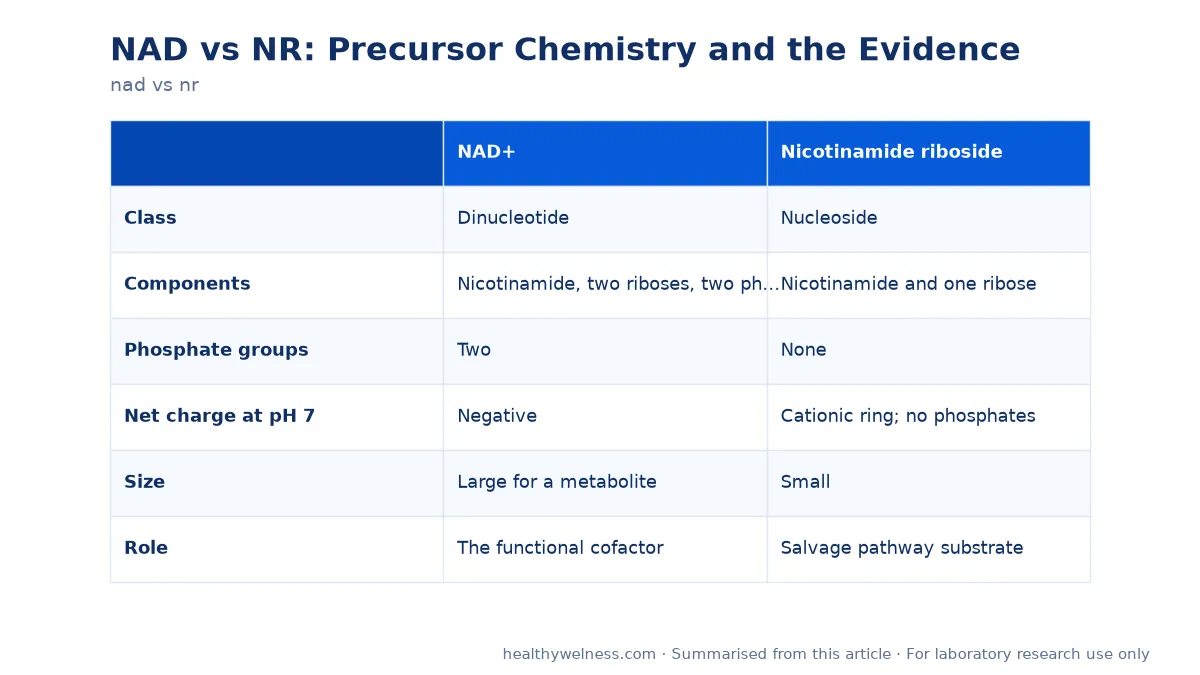
Structural comparison
| NAD+ | Nicotinamide riboside | |
|---|---|---|
| Class | Dinucleotide | Nucleoside |
| Components | Nicotinamide, two riboses, two phosphates, adenine | Nicotinamide and one ribose |
| Phosphate groups | Two | None |
| Net charge at pH 7 | Negative | Cationic ring; no phosphates |
| Size | Large for a metabolite | Small |
| Role | The functional cofactor | Salvage pathway substrate |
| Membrane permeability | Poor | Transport routes available |
The phosphate rows explain the whole comparison. Two negatively charged phosphate groups make NAD+ a poor candidate for crossing a membrane unassisted. Nicotinamide riboside has none, is smaller, and resembles the nucleosides that cells already have transporters for. The precursor approach is a way around a transport problem, not a claim of superior activity.
The bioavailability finding
The 2016 paper by Trammell and colleagues in Nature Communications is the foundational reference, and its title states the claim: nicotinamide riboside is uniquely and orally bioavailable in mice and humans. Work of this kind — measuring what appears in the NAD+ metabolome after administering a precursor — is the evidence base for the entire precursor approach.
It is worth being precise about what such a finding establishes. It establishes that the precursor is absorbed and enters the relevant metabolic pool. It does not, by itself, establish that any particular functional consequence follows. Those are separate claims requiring separate evidence, and the literature does not always keep them apart.
The negative result worth reading
The 2021 study by Stocks and colleagues in the Journal of Physiology reported that nicotinamide riboside supplementation did not alter whole-body or skeletal muscle metabolic responses to a single bout of endurance exercise.
This paper deserves attention precisely because it is a null result, and null results in this field are underrepresented relative to how informative they are. Read alongside the 2016 bioavailability work, the pair illustrates the gap described above: a precursor can demonstrably enter the metabolome and still not change a specific measured outcome. Both findings can be correct, and a reader who has seen only one has an incomplete picture.
Comparing precursors against each other
The 2021 review by Palmer and colleagues in Aging Medicine surveys the available precursors for raising NAD+, which is the natural next question once more than one exists. The honest summary of that comparative literature is that the differences reported between precursors are modest and the head-to-head evidence is thinner than the volume of discussion suggests. Nicotinamide riboside and nicotinamide mononucleotide enter the salvage pathway at adjacent points, and distinguishing them experimentally requires measurements most studies do not make. The related comparison is covered in NMN compared with NAD.
The oxidation state nobody controls for
The most interesting recent finding in this area concerns a variable that is usually ignored. The 2026 study by Vinten and colleagues in the FASEB Journal reported that reduced and oxidised NAD+ precursors drove distinct transcriptomic, proteomic and metabolic profiles in hepatocytes.
If that holds up, it has a direct methodological implication: the oxidation state of the precursor supplied is an experimental variable in its own right, not an incidental property of the material. Two preparations of nominally the same precursor differing in oxidation state would not be interchangeable. For anyone running this kind of experiment, it is a reason to record and ideally verify the form supplied rather than assuming it.
It also connects to a basic point about the cofactor itself: the oxidised and reduced forms of NAD are chemically and functionally distinct, as set out in NAD+ to NADH: reduction or oxidation.
Practical notes for the laboratory
| Consideration | NAD+ | Nicotinamide riboside |
|---|---|---|
| Solubility | Water-soluble | Water-soluble |
| Solution stability | Limited; pH-dependent | Limited; the salt form matters |
| Cell-permeable | Poorly | Yes, via transport |
| Spectrophotometric handle | Reduced form absorbs at 340 nm | No equivalent simple readout |
| Molecular weight for calculations | Of the exact salt supplied | Of the exact salt supplied |
Both are supplied as salts, and in both cases the molecular weight used in concentration calculations has to be that of the form in the vial. Our reconstitution calculator takes molecular weight explicitly rather than assuming a default.
Store the solid dry, dark and frozen; prepare solutions close to use rather than keeping them. Our NAD+ research material is supplied for laboratory research use. Certificates are available for listed products — contact us for the latest report.
Open questions
- Do different precursors produce measurably different compartmental distributions of NAD+?
- How often does entry into the metabolome translate into a functional change?
- Can the oxidation state of a supplied precursor be verified routinely?
Related research
Frequently asked questions
What is the difference between NAD+ and NR?
NAD+ is the cofactor itself, a dinucleotide. Nicotinamide riboside is a much smaller precursor: a nicotinamide joined to a ribose, with no phosphates and no adenosine. Cells convert NR to NAD+ through a salvage pathway; NAD+ is the end point.
Why use a precursor rather than the cofactor?
Because the cofactor is large, charged and poorly membrane-permeable. A smaller precursor has transport routes available to it. The 2016 Nature Communications study by Trammell and colleagues reported NR to be orally bioavailable in mice and humans, which is the central practical finding on this point.
Does NR raise NAD+ levels?
Measurement work indicates NR enters the NAD+ metabolome. Whether that translates into a given functional change is a separate question, and the 2021 study in the Journal of Physiology reporting no alteration to skeletal muscle metabolic responses in one exercise protocol illustrates that the two questions have different answers.
How does NR compare with NMN?
Both are precursors entering the salvage pathway at slightly different points. A 2021 comparison review in Aging Medicine surveys the precursors against each other; the differences reported are modest and the comparative evidence is thinner than the volume of discussion suggests.
Do the oxidised and reduced precursor forms behave the same way?
Not according to recent work. A 2026 FASEB Journal study reported that reduced and oxidised NAD+ precursors drove distinct transcriptomic, proteomic and metabolic profiles in hepatocytes, which means the oxidation state of a precursor is itself an experimental variable.
References
- Trammell SA, et al. Nicotinamide riboside is uniquely and orally bioavailable in mice and humans. Nat Commun. 2016. PMID: 27721479 https://pubmed.ncbi.nlm.nih.gov/27721479/
- Stocks B, et al. Nicotinamide riboside supplementation does not alter whole-body or skeletal muscle metabolic responses to a single bout of endurance exercise. J Physiol. 2021. PMID: 33492681 https://pubmed.ncbi.nlm.nih.gov/33492681/
- Palmer RD, et al. Precursor comparisons for the upregulation of nicotinamide adenine dinucleotide. Novel approaches for better aging. Aging Med (Milton). 2021. PMID: 34553119 https://pubmed.ncbi.nlm.nih.gov/34553119/
- Vinten KT, et al. Reduced Versus Oxidized NAD(+) Precursors Drive Distinct Transcriptomic, Proteomic, and Metabolic Profiles in Hepatocytes. FASEB J. 2026. PMID: 41701114 https://pubmed.ncbi.nlm.nih.gov/41701114/
For laboratory research use only. The research materials supplied by HealthyWelness are not approved medicines, foods or cosmetics and are not for human or veterinary use. This article summarises published research and is not medical advice.
Sources
- Trammell SA, et al. Nicotinamide riboside is uniquely and orally bioavailable in mice and humans. Nat Commun. 2016. PMID: 27721479
- Stocks B, et al. Nicotinamide riboside supplementation does not alter whole-body or skeletal muscle metabolic responses to a single bout of endurance exercise. J Physiol. 2021. PMID: 33492681
- Palmer RD, et al. Precursor comparisons for the upregulation of nicotinamide adenine dinucleotide. Novel approaches for better aging. Aging Med (Milton). 2021. PMID: 34553119
- Vinten KT, et al. Reduced Versus Oxidized NAD(+) Precursors Drive Distinct Transcriptomic, Proteomic, and Metabolic Profiles in Hepatocytes. FASEB J. 2026. PMID: 41701114