Semax Compared: Adamax, Cerebrolysin and NAD+
Semax is a defined heptapeptide; Cerebrolysin is a mixture, NAD+ a coenzyme, Adamax a marketed variant. Why these are not like-for-like comparisons.

Cover illustration: AI-generated editorial artwork. Conceptual only; not an exact molecular structure, actual laboratory result or evidence of clinical effects.
Semax gets compared with three very different things: Adamax, a marketed variant; Cerebrolysin, a brain-derived peptide mixture; and NAD+, a coenzyme. None of these is a like-for-like comparison. Working out what kind of substance each one is explains more than any attempt to rank them.
For laboratory research use only. The research materials supplied by HealthyWelness are not approved medicines, foods or cosmetics and are not for human or veterinary use. This article summarises published research and is not medical advice.
Key points
- Semax: one defined heptapeptide, MEHFPGP, 813.9 g/mol.
- Adamax: a product name; no peer-reviewed literature found under it.
- Cerebrolysin: a porcine brain-derived peptide preparation, i.e. a mixture.
- NAD+: a nucleotide coenzyme, not a peptide at all.
- Comparing a pure compound with a mixture or a coenzyme requires stating what is being compared.
Four different kinds of substance
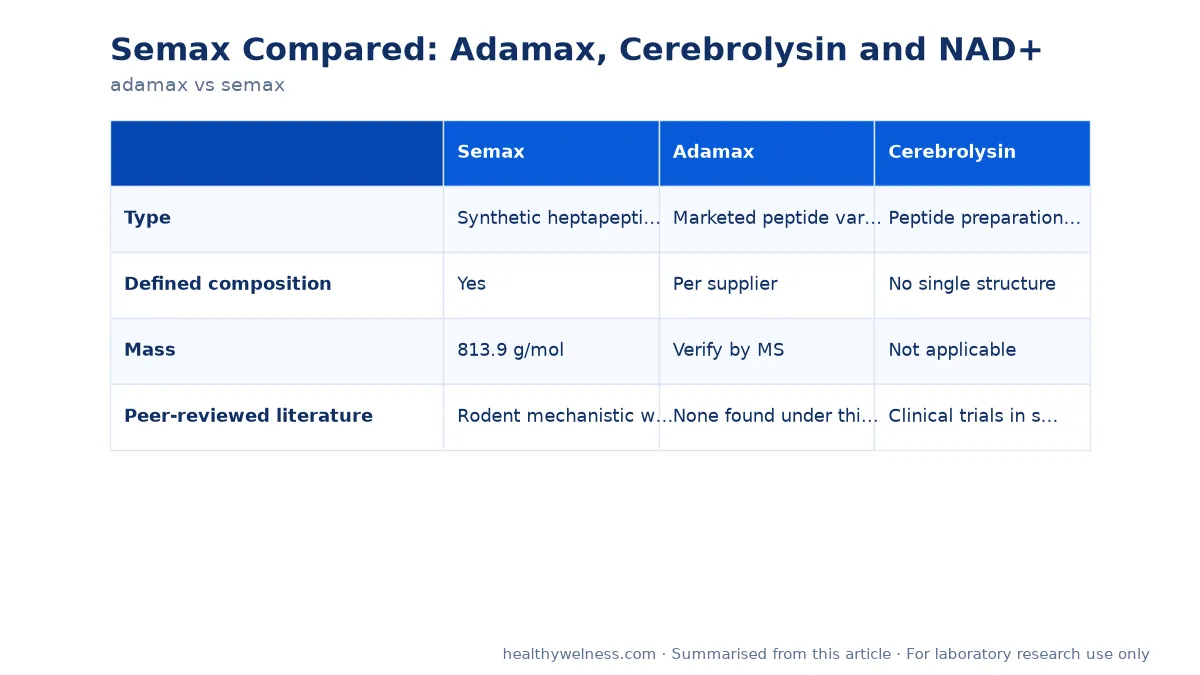
| Semax | Adamax | Cerebrolysin | NAD+ | |
|---|---|---|---|---|
| Type | Synthetic heptapeptide | Marketed peptide variant | Peptide preparation (mixture) | Nucleotide coenzyme |
| Defined composition | Yes | Per supplier | No single structure | Yes |
| Mass | 813.9 g/mol | Verify by MS | Not applicable | 663.4 g/mol |
| Peer-reviewed literature | Rodent mechanistic work | None found under this name | Clinical trials in stroke | Extensive biochemistry |
Products: Semax, Adamax and NAD+.
Semax: the reference point
Semax combines the ACTH(4-7) fragment with a C-terminal Pro-Gly-Pro. Its best-documented mechanistic work concerns neurotrophins: in rats with permanent middle cerebral artery occlusion, Semax increased cortical transcription of Bdnf, TrkC and TrkA at 3 hours and Nt-3 and Ngf at 24 hours, with PGP alone showing a partly overlapping profile (Dmitrieva et al., 2010). Its histidine also lets it bind copper and zinc, and N-terminal acetylation changes which complexes form (Magrì et al., 2016). Full profile: what is Semax?
Adamax: what can and cannot be said
Adamax is sold as a Semax-related peptide. Searching the peer-reviewed literature under that name returns nothing, which means any structural or potency claim comes from the supplier rather than from published work. That is not an accusation, simply a description of the evidence available. Two practical implications:
- Verify the structure. Mass spectrometry tells you what is in the vial regardless of the name on it. Semax is 813.9 g/mol; acetylation adds about 42 Da and amidation subtracts about 1 Da.
- Do not assume Semax data apply. If the molecule differs, the published Semax results describe a different compound. The same reasoning applies to acetylated variants; see N-acetyl Semax amidate.
Analytical identification of research peptides in this family is routine: a Belgian control laboratory developed an LC-MS/MS method after finding Semax and Selank in seized preparations (Vanhee et al., 2020).
Cerebrolysin: a mixture, not a molecule
Cerebrolysin is described in the literature as a neuropeptide preparation with neurotrophic effects, derived from brain tissue. A 2018 review covers its use in cerebral ischemia and neurodegeneration and discusses the clinical trial picture, noting that earlier stroke trials enrolled mostly mildly affected populations where ceiling effects may have obscured differences, while subgroup analyses of more severely affected patients showed larger effects, with effect size increasing with stroke severity (Brainin, 2018).
For a laboratory comparison, the key point is that Cerebrolysin has no molecular weight, no sequence and no certificate of analysis in the sense a synthetic peptide does. Batch-to-batch composition is a variable in a way it is not for Semax. Any experiment comparing them is comparing a defined compound with a preparation.
NAD+: a different molecular class entirely
NAD+ is a dinucleotide coenzyme built from nicotinamide, adenine, two riboses and two phosphates. It serves as an electron carrier in redox reactions and as a cosubstrate for sirtuins, CD38 and PARPs, linking it to DNA repair, chromatin remodelling and cellular senescence (Covarrubias et al., 2021; Verdin, 2015). It contains no amino acids and no peptide bonds. The comparison with Semax exists only because both appear in catalogues under headings like “cognitive” or “longevity”. See what is NAD+?
How to frame a valid comparison
| Question | Valid comparison |
|---|---|
| Does acetylation change Semax’s properties? | Semax vs N-acetyl Semax, same assay |
| Which peptide affects neurotrophin transcription more? | Semax vs Selank vs PGP, same model |
| Does a defined peptide match a mixture’s effect? | Semax vs Cerebrolysin, stated as compound vs preparation |
| Do peptide and coenzyme approaches converge? | Only with a shared, explicitly stated endpoint |
Handling
Semax and its variants: powder at −20 °C, solutions at 2–8 °C, protected from light because of the methionine. NAD+ is a nucleotide and is governed by buffer and pH rather than by oxidation of residues; see reconstituting NAD+. Concentrations for all: peptide reconstitution calculator.
Open questions
- What is Adamax’s actual structure, and is any of it published?
- Would a defined peptide reproduce any part of Cerebrolysin’s reported effects?
- Is there a mechanistic link between neurotrophin signalling and NAD+ availability worth testing directly?
Related research
Frequently asked questions
What is Adamax compared with Semax?
Adamax is sold as a modified Semax-type peptide. We found no peer-reviewed literature under that name, so any comparison with Semax rests on supplier descriptions rather than published studies. Verify what is in a vial by mass spectrometry before assuming a structure.
How does Cerebrolysin differ from Semax?
Cerebrolysin is a neuropeptide preparation derived from porcine brain, a mixture rather than a single compound. Semax is one defined heptapeptide. A mixture and a pure peptide cannot be compared on equal terms.
Is NAD+ comparable to Semax?
No. NAD+ is a nucleotide coenzyme with no amino acids, central to redox metabolism. Semax is a peptide studied for neurotrophin expression. They share only the loose category of ‘things studied in brain research’.
Which of these has the most evidence?
Cerebrolysin has the largest clinical trial literature, including stroke trials. Semax has rodent mechanistic work and Russian clinical use. NAD+ has extensive biochemistry. Adamax has, as far as we found, none under that name.
Can these be used as alternatives to each other?
They are not alternatives. Different molecular classes, different mechanisms and different evidence bases mean each answers a different research question.
For laboratory research use only. The research materials supplied by HealthyWelness are not approved medicines, foods or cosmetics and are not for human or veterinary use. This article summarises published research and is not medical advice.
Sources
- Dmitrieva VG, et al. Semax and Pro-Gly-Pro activate the transcription of neurotrophins and their receptor genes after cerebral ischemia. Cell Mol Neurobiol. 2010. PMID: 19633950
- Brainin M. Cerebrolysin: a multi-target drug for recovery after stroke. Expert Rev Neurother. 2018. PMID: 30004268
- Covarrubias AJ, et al. NAD(+) metabolism and its roles in cellular processes during ageing. Nat Rev Mol Cell Biol. 2021. PMID: 33353981
- Verdin E. NAD+ in aging, metabolism, and neurodegeneration. Science. 2015. PMID: 26785480
- Vanhee C, et al. The occurrence of putative cognitive enhancing research peptides in seized pharmaceutical preparations: An incentive for controlling agencies to prepare for future encounters of the kind. Drug Test Anal. 2020. PMID: 31667971
- Magrì A, et al. Influence of the N-terminus acetylation of Semax, a synthetic analog of ACTH(4-10), on copper(II) and zinc(II) coordination and biological properties. J Inorg Biochem. 2016. PMID: 27586814